Apple, Nvidia and the chips, three months
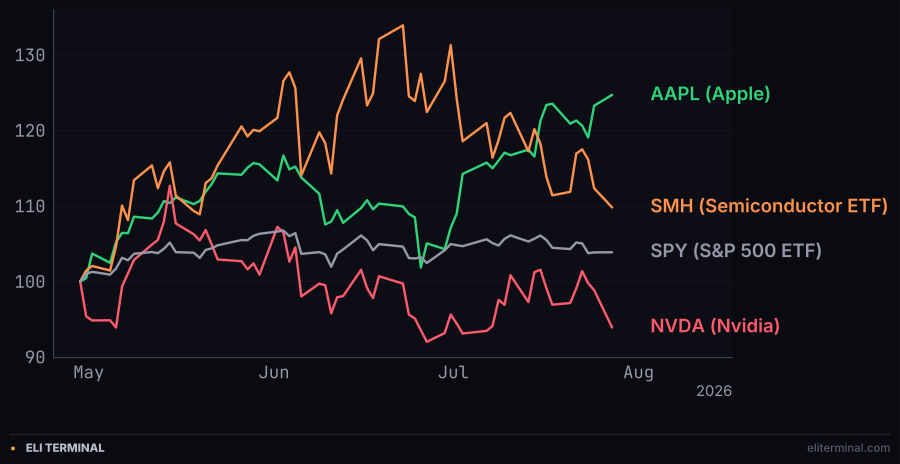
Each indexed to 100 at the April 29 close. The semiconductor ETF led the quarter until June 22 and has given back most of it. Apple ends the stretch on top; Nvidia ends it below where it started.
Five-year protection on Nvidia's debt had its biggest one-day jump on record three minutes before the bell, the stock fell 5.0%, Apple closed as the world's most valuable company, and Brent gave back 8.7%.
Each indexed to 100 at the April 29 close. The semiconductor ETF led the quarter until June 22 and has given back most of it. Apple ends the stretch on top; Nvidia ends it below where it started.
7,464.20 was the S&P 500's opening print, up 0.70% on a weekend pause in the American bombing campaign against Iran, and 7,413.18 was the close, up 1.20 points. Every point of the gap came out in the first hour. The Dow held on to 0.51% and the Russell 2000 to 0.62%; the Nasdaq Composite went from up 1.04% at the open to down 0.18% at the bell.
682.12 is where the Nasdaq-100 ETF closed, its lowest in 25 sessions, on a session the S&P 500 finished green and small caps finished greener. The S&P 500 ETF sits 2.1% under its own 25-session high and 1.4% above the low; the Nasdaq-100 ETF is at the bottom of that range. The VIX touched 19.93 during the selling and closed at 18.67, barely changed. A market that had just been handed an 8.7% drop in Brent and a truce spent the day selling one thing.
82 basis points is where the cost of five-year protection against a Nvidia default reached on Monday, up as much as 14 basis points, the biggest intraday rise since the swaps began actively trading in November. The story crossed the wires at 13:27 UTC. The opening bell was at 13:30 UTC.
208.11 was Nvidia's price in the first minute of trading and 202.28 was its price fifteen minutes later, a 2.8% loss inside one candle. By 14:30 UTC it was at 197.67 and the low for the day, 195.44, was in. The stock closed at 196.51, down 5.0%, roughly 250 billion dollars of market value gone.
250 billion dollars is also the figure reported late Sunday: Nvidia in talks to guarantee that much of OpenAI's leasing of a data-center project in southern Ohio. Stacked on the 500 billion dollar partnership with SK Group announced at 23:53 UTC on Friday, that is more than 750 billion dollars of commitment discussed inside 72 hours. The debt market repriced it before the equity market opened.
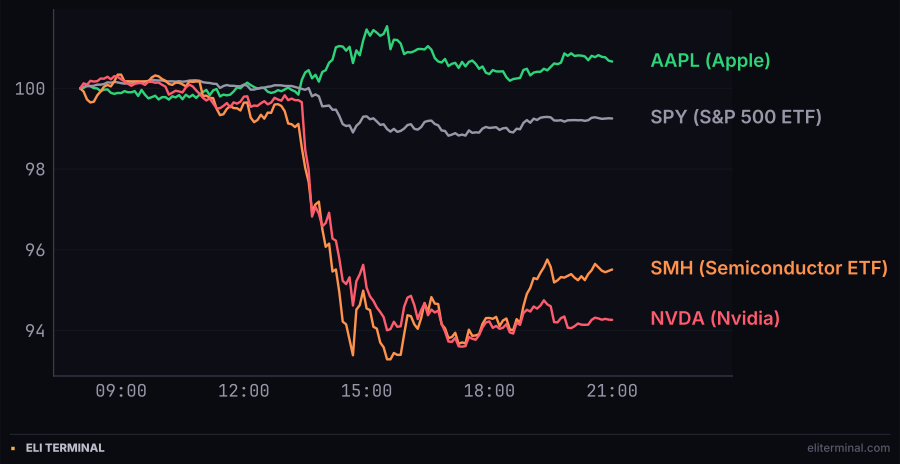
Each indexed to 100 at 08:00 UTC on July 27. Four hours of a flat pre-market, then a vertical move in the first hour of trading. Apple went the other way and stayed there.
336.91 is where Apple closed, up 1.17% and at a record, worth about 4.94 trillion dollars against Nvidia's 4.75 trillion, and for the first time since 2025 it is the most valuable company in the world. Apple is up more than 22% this year. Nvidia closed Monday at 196.51 against 195.74 twenty-one sessions ago, and 5.6% below where it traded a quarter ago.
Flat for a month is the number that matters for a company that has publicly discussed three quarters of a trillion dollars of new commitments in three days. "Once criticized for not spending more on AI, they have been able to avoid some of those capex pitfalls," said Jay Woods, chief market strategist at Freedom Capital Markets, of Apple. The market paid for the company that is not writing the cheques.
3.2% is what SK hynix added in Seoul overnight, with Samsung Electronics up 1.8% and the KOSPI up 0.97%, trading the Nvidia partnership as a supply contract for high-bandwidth memory. Seoul closed at 06:00 UTC. The credit story landed seven and a half hours later.
1,816,000 won is where SK hynix finished, still 37.8% below its June 22 close, so Monday's gain is a small step inside a large drawdown rather than a recovery. The same announcement was read as revenue in one hemisphere and as leverage in the other, and the only thing separating the two readings was the clock.
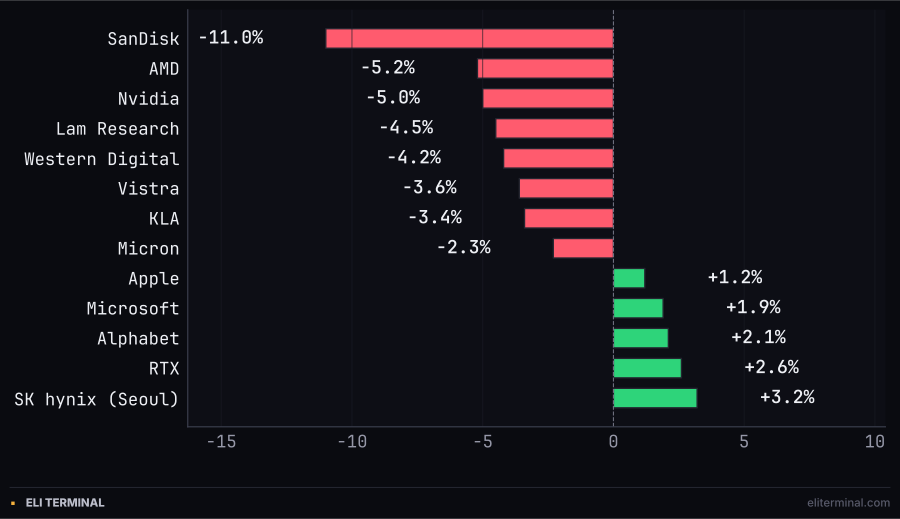
The red names build or power artificial-intelligence capacity. The green names sell software, weapons, or memory into a contract signed by somebody else. SK hynix is its Seoul session, which closed at 06:00 UTC.
466% is what shares of ChangXin Memory gained on their Shanghai debut on Monday, from 8.66 yuan to 49, raising 57.92 billion yuan and taking the company past Industrial and Commercial Bank of China as the country's most valuable listed name. ChangXin is the world's fourth-largest maker of DRAM, at roughly 8% of that market.
1,278.23 is where SanDisk closed, down 11.0%, having opened at 1,462.99 and traded as high as 1,509 before the bell. SanDisk makes NAND, not DRAM. The stock has now lost 20.6% in three sessions and 45.3% in 21, closed at a 25-session low, and fell on Monday because a company in an adjacent business listed in another country.
548.55 is where the semiconductor ETF closed, a 25-session low and 18.0% below its June 22 peak, with Lam Research down 4.5%, Western Digital down 4.2% and KLA down 3.4%. There was no downgrade behind any of it. There was a credit print and a Chinese listing.
8.1 billion dollars is the record backlog Cadence Design Systems reported after Monday's close, on quarterly revenue of 1.584 billion, up 24%, and non-GAAP earnings of 2.11 a share. The company lifted its full-year revenue range to 6.260 to 6.340 billion dollars from 6.125 to 6.225, and its non-GAAP earnings range to 8.05 to 8.15 from 7.85 to 7.95.
19% is the full-year revenue growth Cadence now guides to, written into a filing that also puts its own capital spending at about 240 million dollars for the year. The layer of the artificial-intelligence trade that sells the tools and books the backlog raised its numbers on the same day the layer that buys the equipment closed at a 25-session low. China was 15% of Cadence revenue in the quarter, up from 9% a year ago.
0.3% was the June rise in durable-goods orders released at 12:30 UTC, against a consensus near 1.6% and with May revised down to a 4.0% decline, a clean miss on the headline. Core capital-goods shipments rose 1.9%, the fastest month since December 2021, and orders for computers and electronics rose 3.1% to 31.1 billion dollars.
1.3 was the Dallas Fed's July general activity reading at 14:30 UTC, up from zero, with production at 10.1 and the company outlook up eleven points. Neither number moved the tape. The spending on artificial-intelligence capacity is showing up in the government's own shipment data at the fastest rate in four and a half years, which is precisely the fact that made Monday's credit print legible.
4.315% was the high yield on the 69 billion dollar two-year note at 15:30 UTC, the richest since December 2024, and it stopped through with a bid-to-cover of 2.662, the strongest since January. Ninety minutes later the 70 billion dollar five-year tailed 0.9 basis point at 4.408%, its fourteenth consecutive tail, on a bid-to-cover of 2.28 that was the weakest since September 2022.
4.641% is where the ten-year yield settled anyway, down about four basis points, with the long bond ETF up 0.6%. The Federal Open Market Committee meets Tuesday and Wednesday under Chair Kevin Warsh with a hold at 3.50 to 3.75% carrying roughly two-thirds of the pricing and a 25 basis point hike carrying the rest. Rates took their cue from crude rather than from either auction.
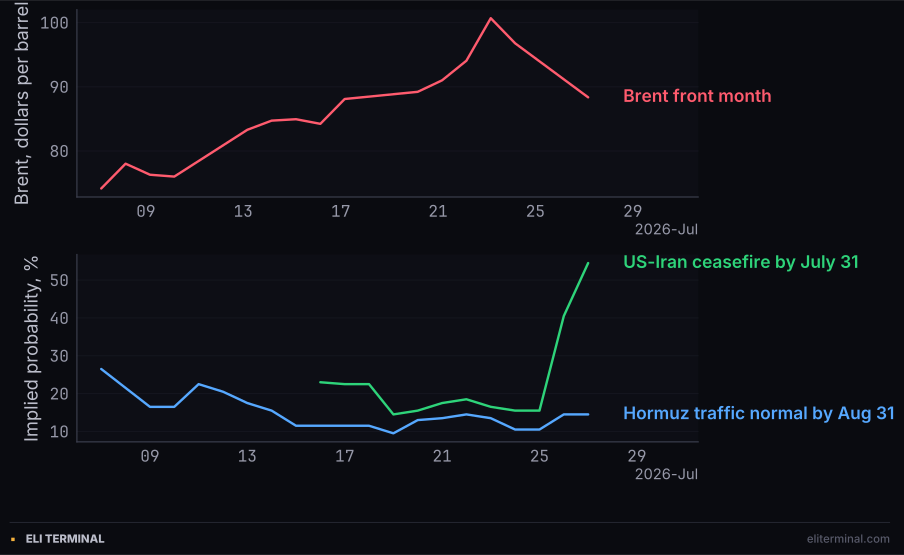
Front-month Brent above, implied probabilities below. The ceasefire line moved 39 points in two days. The line for the strait actually reopening did not move.
84.63 dollars was West Texas crude at the Sunday reopen at 22:00 UTC, against a Friday settle of 89.31, a 5.2% gap before a single Monday headline. The Pentagon had suspended the bombing campaign after thirteen consecutive nights of strikes, and Reuters reported Sunday that Iran would hold its fire as long as the American pause held. Crude ground down through the whole American session and settled at 82.61, down 7.5%, with Brent down 8.7% to 88.36.
54.5% is where the market on a United States and Iran ceasefire by July 31 finished Monday, from 15.5% on Friday. The market on Strait of Hormuz traffic returning to normal by August 31 went from 10.5% to 14.5% and then sat still through Monday. The premium that came out of crude was the premium on shooting, not the premium on shipping, and the second one is what took Brent from 71.57 on July 1 to above 100 on July 23 in the first place.
400,000 barrels a day is the capacity Aramco shut at its Jazan refinery on Monday after Houthi missiles hit the plant on Sunday, and Iran's foreign ministry spokesman Esmail Baghaei said in Tehran that morning that his government is not engaged in any negotiations with the United States. Crude fell through both. Helima Croft of RBC Capital Markets called the oil futures market a "broken barometer" for Middle East risk on CNBC that morning, pointing at Chinese buyers cutting imports by 4 to 5 million barrels a day.
218.42 is where RTX closed, up 2.6% and at its highest in a quarter, after gaining 9.2% over the two prior sessions on a raised full-year outlook and a record 289 billion dollar backlog. The Pentagon on Monday announced seven-year framework agreements with L3Harris and Lockheed Martin to triple Patriot interceptor propulsion output and quadruple THAAD's, and TD Cowen lifted its RTX target to 240 dollars from 225. The peace trade paid out in paper crude and bid the missile makers on the same afternoon.
7.6% is what Strategy gained to close at 98.65, on a day bitcoin fell 2.5% to 63,724.90, and the reason was a morning filing about dollars rather than coins. The company raised its cash reserve by 525 million to 3.75 billion, enough to cover 2.1 years of preferred dividends and interest, and left its holding at 843,775 bitcoin for a fifth straight week without buying or selling any.
49.7% below its quarter high is where that 7.6% leaves Strategy, and Coinbase's 5.8% leaves it 22.7% below its own, so both are bounces inside drawdowns rather than breaks higher. What the filing removed was the specific fear that had cost the stock 8.3% over the two prior sessions: that the dividend would eventually be paid in sold coins.