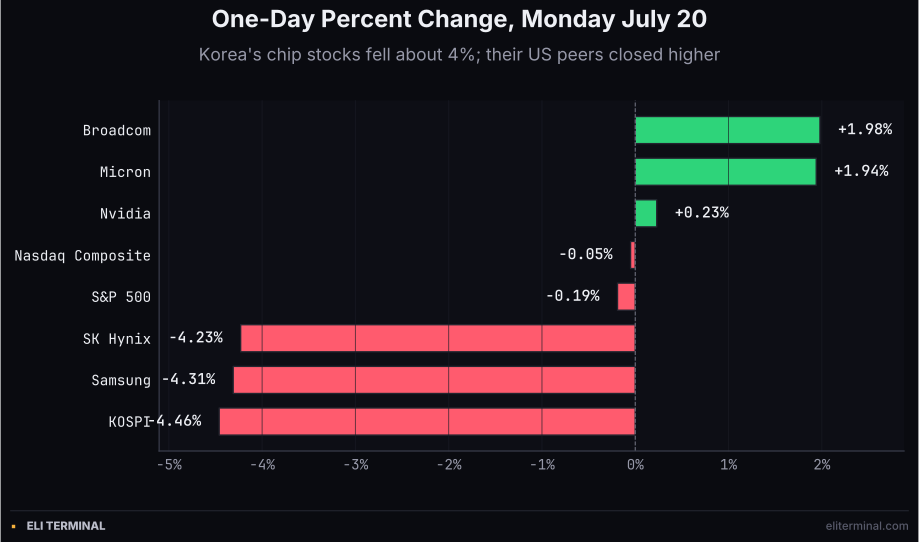
Korea, closed Friday for a holiday, spent Monday catching down to last week's chip selloff. Broadcom, Micron and Nvidia, the US names that led that selloff, closed higher the same day Samsung and SK Hynix fell more than 4%.
Korea's KOSPI fell 4.46% catching down to a chip selloff it sat out on holiday, Brent crude tagged 90 dollars a barrel on a weekend of intensifying US strikes on Iran, and the S&P 500 closed down 0.19% with the only real weakness in small caps and the Dow.
Korea, closed Friday for a holiday, spent Monday catching down to last week's chip selloff. Broadcom, Micron and Nvidia, the US names that led that selloff, closed higher the same day Samsung and SK Hynix fell more than 4%.
0.19% is what the S&P 500 lost on Monday, closing at 7,443.28. Between Friday's close and this one, Korea's main index crashed 4.46%, Brent crude tagged 90 dollars a barrel on a ninth straight night of US strikes on Iran, and Washington signed a 50% tariff on Canadian goods.
The index that is supposed to price all three finished the day almost exactly where it started, and the VIX, at 18.65, never reached 19. Each headline ran on a different clock, and the tape paid only one of them.
4.46% is what the KOSPI fell on Monday, with SK Hynix down 4.23% and Samsung down 4.31%, and none of it was Monday's news. Korea's exchange was closed Friday for Constitution Day, so Seoul spent Monday catching down to a selloff the rest of the world had already taken.
On July 16, Taiwan Semiconductor lifted its 2026 capital-spending guidance to as much as 64 billion dollars, and the fear of what that spending does to margins pushed the Philadelphia semiconductor index into a bear market, down 20% from its June peak, with US chip stocks falling for two straight sessions into Friday's close. Taiwan's market took a 6.5% hit on Friday and Tokyo dropped 4%. Korea, shut for the holiday, took none of it until Monday.
The tell is what the same industry did on the same Monday. While Samsung and SK Hynix fell 4%, their US counterparts closed green: Broadcom up 1.98%, Micron up 1.94%, Nvidia up 0.23%. Seoul was not leading a fresh chip selloff. It was the last market to price an old one, and the US names that started the trouble had already turned back up.
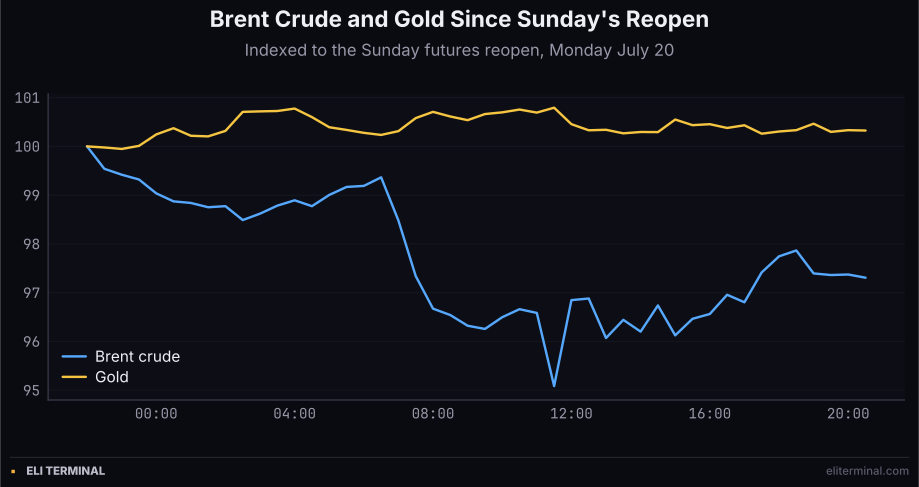
Brent reopened Sunday night near 91 dollars a barrel on the weekend strikes and gave the premium back by Monday's close. Gold, the classic haven, never moved. Indexed to the Sunday futures reopen.
90.67 is where Brent crude reopened Sunday night, up from 88.10 on Friday, after an Iranian missile strike on a Jordanian air base killed US service members and CENTCOM ran a ninth straight night of strikes inside Iran. Brent tagged 91.43 in the first half hour, then spent all of Monday giving the premium back, settling at 89.22. West Texas crude never got near 90, closing at 83.23.
The assets that rally in a real geopolitical scare did not move. Gold closed at 4,010 dollars an ounce, down 0.06% on the day, and the yen weakened rather than caught a bid. A market pricing whether crude hits 90 this month actually cooled over the weekend, and a market on the near-term ceasefire holding firmed toward 90%.
50% is the tariff rate Washington set on a list of Canadian goods on Monday, effective in August, and the S&P still closed down 0.19%. A war premium that faded by midday and a fresh tariff on a G7 neighbor that the tape ignored are the same signal from two directions: the loud headlines were not the ones setting prices.
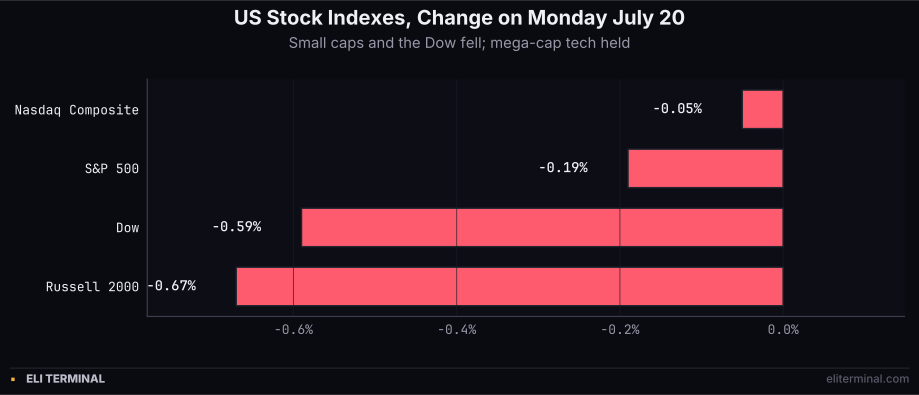
The Russell 2000 and the Dow took the day's damage while mega-cap tech held, the pattern a rise in yields leaves behind, not a war or an overseas crash.
0.67% is what the Russell 2000 lost on Monday, the worst of the major US indexes, with the Dow down 0.59% while the Nasdaq Composite was flat at down 0.05%. The weakness sat where higher rates land, not where a war or a chip crash would.
The 10-year Treasury yield rose almost 6 basis points to 4.598% and held the move into the close, and a market pricing any Federal Reserve rate cut in 2026 slipped over the weekend toward 18%. Small caps carry the most debt and the most rate sensitivity, and on a quiet-macro day with the Fed in its pre-meeting blackout, that is exactly the corner that gives way first.
The Dow's softness was partly one stock: Apple fell 2.14% on profit-taking after Friday's record high, dragging the average more than the tariff or the oil tape did. And the single biggest moves of the day belonged to none of the headlines. A wave of new AI data-center contracts sent a group of former bitcoin miners up 10 to 20%, led by IREN's 19.6%, the kind of idiosyncratic melt-up that owns a day when nothing macro is actually moving.