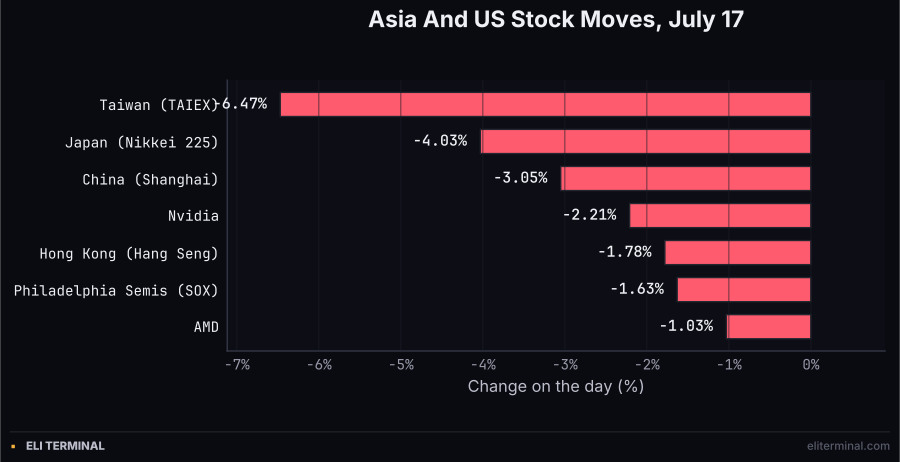
Every market that traded fell, but the shock hit hardest where it was live: Taiwan lost 6.47% and Japan 4.03%, while the US semiconductor index and its largest names lost 1 to 2%. Korea, the most exposed market of all, was closed for a holiday.
Taiwan's market fell 6.47% in its worst point drop on record and Tokyo slid into a correction, yet the US semiconductor index lost just 1.63% after trading back into the green by early afternoon, while Netflix sank 7.26% and Korea's market never opened.
Every market that traded fell, but the shock hit hardest where it was live: Taiwan lost 6.47% and Japan 4.03%, while the US semiconductor index and its largest names lost 1 to 2%. Korea, the most exposed market of all, was closed for a holiday.
6.47% is what Taiwan's TAIEX gave up Friday, the largest single-day point drop in the index's history, with foreign investors selling a record 189 billion New Taiwan dollars of stock into the close. Tokyo's Nikkei 225 fell 4.03% and finished more than 10% below its June high, a correction stamped in one session. Both markets were open while the day's chip news was live, and both took the full hit.
Seoul took none of it, because Seoul was closed. The Korea Exchange was shut for Constitution Day, restored as a public holiday this year after an 18-year absence, which froze Samsung Electronics and SK Hynix, the two companies most exposed to the memory-and-AI trade, at Thursday's marks. A shock that lands on a holiday does not get a vote until the next session.
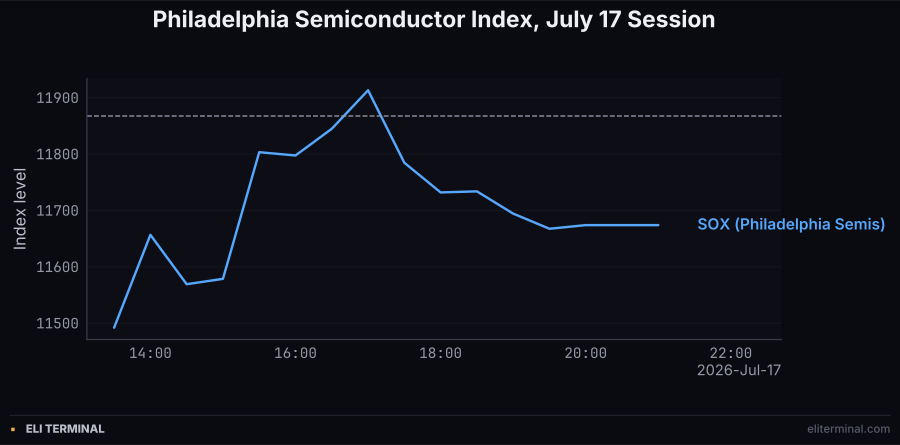
The US semiconductor index opened 3.2% below Thursday's close, its low for the day, then climbed above that close and into the green by shortly after 17:00 UTC before fading to a 1.63% loss into the options expiration.
3.2% below Thursday's close is where the Philadelphia Semiconductor Index opened at 13:30 UTC, and that opening print was the low of the day. Over the next three and a half hours it climbed the entire way back, crossing above Thursday's close and into the green shortly after 17:00 UTC.
1.63% is where that index actually finished, giving back its whole recovery in the last three hours into a monthly options expiration. The S&P 500 fell 0.94% and the Nasdaq 100 1.37%, and all four major indices printed their session low in the opening fifteen minutes, then faded a late-morning bounce into the bell. That is not the shape of a market absorbing a shock in real time. It is a market that absorbed it overnight, bounced, and then sold the expiration.
20.5% is how much the one-week VIX jumped Friday, outrunning the headline VIX's 12.2% gain and closing at a ten-day high the same session stocks touched ten-day lows. Short-dated hedging demand into the expiration, not a proportional selloff in the cash indices, is what that spike describes.
2.8 trillion parameters is the size of Kimi K3, the open-weight model Moonshot AI put live during the Chinese session on July 16, billed as the strongest openly available system at launch. By Friday morning the wires had made it the reason American chips were falling, though the model was reachable only through a paid interface and its weights were not yet released.
5.57% is what Applied Materials lost, the worst of the US names, with the equipment makers Lam Research and KLA close behind, while Nvidia, the stock a cheaper-model story should punish first, fell 2.21% and AMD 1.03%. Equipment led and the GPU maker held, which is a market doubting the durability of capital spending, not one cutting its estimate of GPU demand. TSMC and ASML had each raised guidance earlier in the week and were sold regardless, and on Thursday's call in Taipei TSMC chairman C.C. Wei said only AI-related mature nodes were supply-tight, the read-through that actually took Taiwan down.
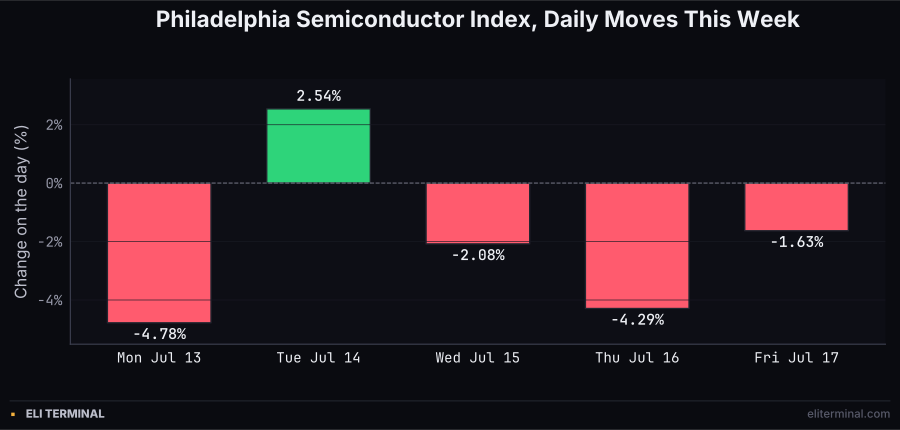
Friday's 1.63% was the smallest of the week's four down days. Monday's 4.78% and Thursday's 4.29%, both before any Chinese-model headline drove the tape, did the real damage.
9.97% is what the semiconductor index lost across the week, and Friday was the smallest slice of it. Monday erased 4.78% and Thursday 4.29%, the two sessions that did the real damage, and the Chinese model had not been released when Monday's selling ran. Monday moved on an Iranian naval escalation in the Strait of Hormuz, not on anything from a lab in Beijing.
1.54% and 4.16% are the S&P 500's and Nasdaq 100's losses for the week, a genuine decline but a shallow one next to the semiconductor index's near-10% drop. The chip trade, not the broad market, carried the week's stress, and it carried most of it before Friday ever opened.
11.7% is the revenue growth Netflix guided for the third quarter, its slowest in three years, and that figure, filed at 20:01 UTC Thursday, is why the stock gapped down 11.9% at Friday's open and closed 7.26% lower. The prior quarter was fine, with revenue of 12.56 billion dollars up 13.4% and earnings a cent ahead. The market sold the deceleration in the guide, not the quarter behind it.
4.5% is what WTI crude gained to close at 82.49 dollars, after Iran struck a Kuwaiti desalination and power plant at 11:18 UTC and a US license permitting Iranian-oil transactions lapsed the same morning. Energy was the only S&P sector to finish green. The 10-year Treasury yield eased 2.8 basis points to 4.541% and gold added 0.68%, a mild safety bid on a day the tape read as risk-off but stopped well short of a rout.