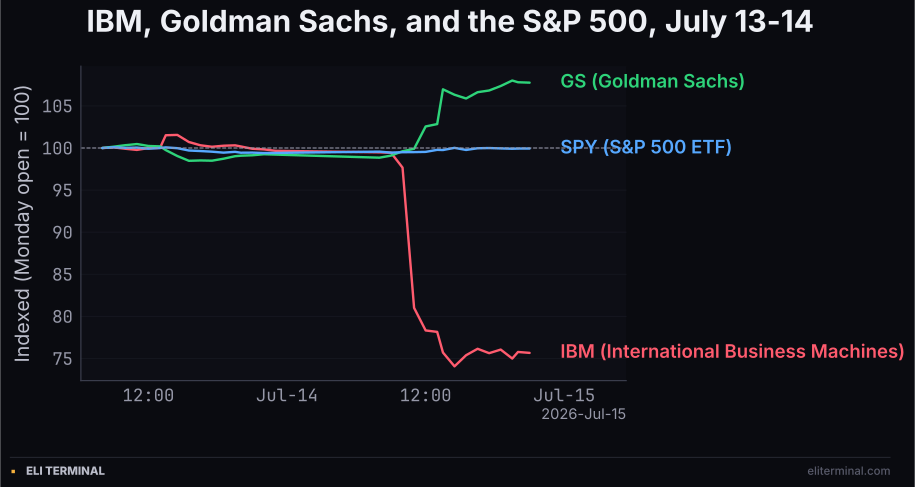
Indexed to Monday's open. IBM fell 25% and Goldman Sachs gained 9% inside the same trading day the S&P 500 ETF never strayed more than 0.5% from where it started.
IBM lost 25% of its value in the worst trading day in its history, Goldman Sachs gained 9% on the same morning four other banks also beat estimates, and a cooler than forecast CPI print briefly cratered the July rate-hike bet, while the S&P 500 closed up 0.37%.
Indexed to Monday's open. IBM fell 25% and Goldman Sachs gained 9% inside the same trading day the S&P 500 ETF never strayed more than 0.5% from where it started.
0.37% is what the S&P 500 gained Tuesday, closing at 7,543.59 after a session high near 7,557. The Dow added 9.63 points to 52,508.27. The Nasdaq Composite did the most work of the three, up 0.88% to 26,107.01.
25% of IBM's value disappeared the same day Goldman Sachs added 9% of its own, and Citigroup and Wells Fargo, the two banks with the widest earnings beats of the morning, closed lower anyway. A bet on whether the Fed holds rates in July moved 25 points in fifteen minutes while the 10-year Treasury yield gave back most of its own reaction within the hour. None of it shows up in a 0.37% index close.
217.08 is where IBM closed Tuesday, down 25.2% from Monday's 290.38 on roughly 64 million shares, something like fifteen times a normal day's volume. It is the steepest one-day decline in the company's history, surpassing the 23.7% drop of October 19, 1987.
17.2 billion dollars is the revenue IBM reported before Tuesday's open in preliminary second-quarter results, against a consensus near 17.9 billion, with operating earnings per share of 2.93 dollars against a 3.02 dollar estimate. Chief executive Arvind Krishna told shareholders the company had faltered: large deals failed to close, and clients shifted late-June spending into supply-constrained servers, storage, and memory.
July 22 is when IBM actually holds its second-quarter call, three weeks after Tuesday's warning stood alone on the tape with no earnings date attached to it. The stock's real-volume low, 213.22, printed in the 14:30 UTC half hour. IBM sits in the Dow, which closed up 9.63 points anyway.
Five of the country's largest banks reported profits before Tuesday's open, and all five beat consensus earnings per share. Goldman Sachs beat by 45%, the widest margin of the group, and its stock rose 9.08%, also the best of the group. JPMorgan beat by 9.8% and rose 2.53%; Bank of America beat by 7.1% and rose 1.83%.
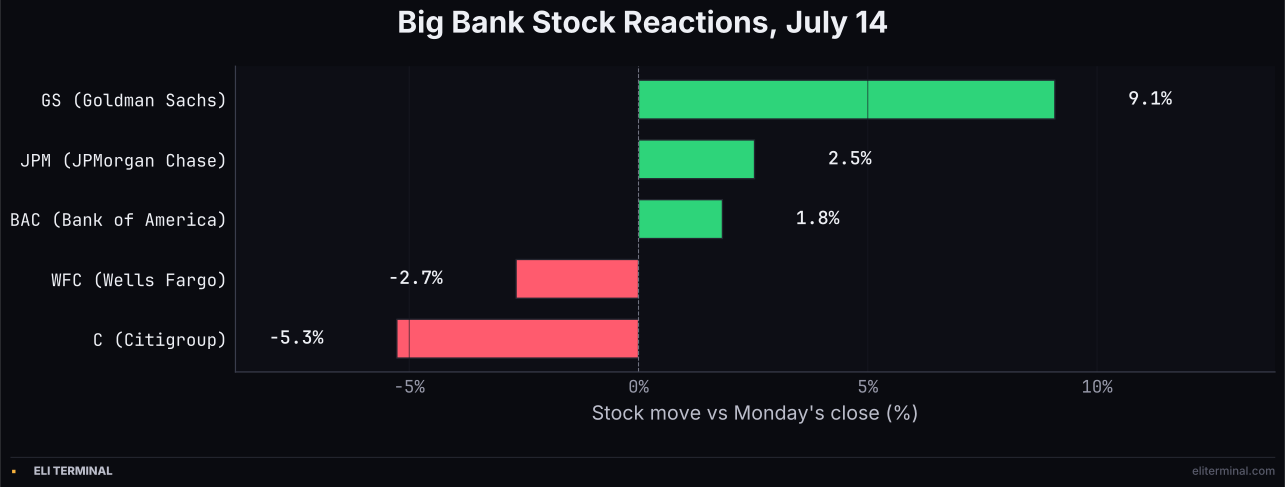
Citigroup and Wells Fargo posted the second and third widest earnings beats of the five banks and were the only two whose stock fell.
15.6% is Wells Fargo's earnings beat, the third widest of the five, and its stock still fell 2.67%. The bank held its full-year net interest income guidance near 50 billion dollars and expense guidance near 55.7 billion, both unchanged from before the quarter, and Raymond James, reiterating its rating on the stock, noted that full-year guidance had been expected to rise and didn't.
15.8% is Citigroup's beat, the second widest, and its stock fell 5.27%, the worst of the five. The bank held its full-year return-on-capital target at 10 to 11% even after the first half ran near 13%, arithmetic that implies the second half needs to slow to high single digits to hit the year's target, and chief executive Jane Fraser told investors the bank would keep spending to pull forward planned investments. The size of the beat, in both cases, told the market less than the guidance attached to it.
0.4% is how much headline CPI fell in June, reported at 12:30 UTC Tuesday against a forecast decline of 0.2%. Core CPI was flat against a forecast gain of 0.2%, with core year-over-year at 2.6% against 2.9% expected. It was a broadly cooler report than the Street had priced on every measure the Bureau of Labor Statistics tracks.
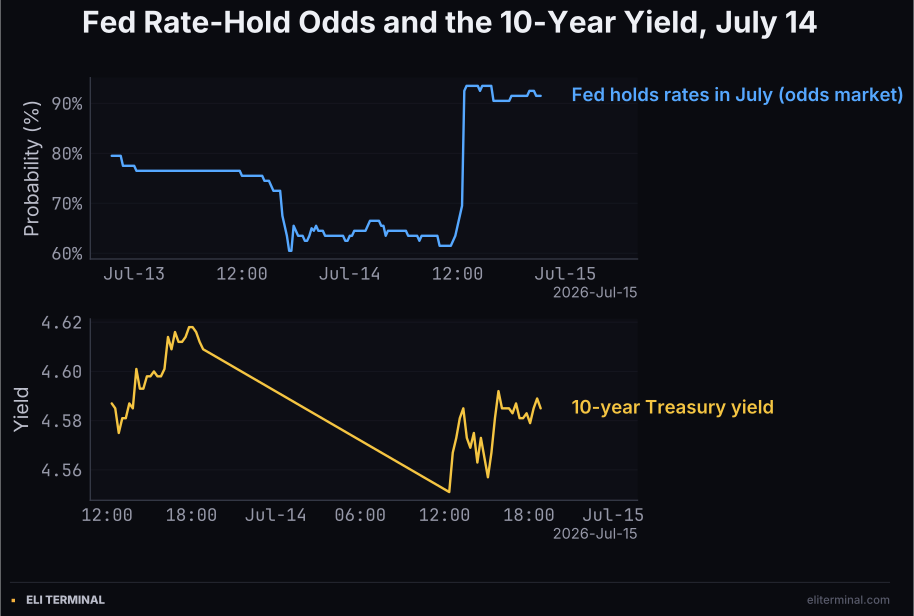
A market pricing the Fed to hold in July jumped from 69.5% to 92.5% between the 12:30 and 12:45 UTC candles and never gave it back. The 10-year yield fell to 4.525% in the same window, then recovered most of the move.
Within fifteen minutes, a market pricing whether the Fed holds rates at its July meeting jumped from 69.5% to 92.5%, a move confirmed independently across two separate prediction-market venues. It held there for the rest of the day. A companion bet on a July hike fell from the mid-30s to single digits and stayed there too.
4.525% is the low the 10-year Treasury yield touched in that same window, down almost 9 basis points, before it gave back roughly two-thirds of the move to close at 4.585%, just 2.4 basis points under Monday. The 30-year did almost a full round trip. Gold spiked toward 4,112 dollars an ounce, matching Friday's close, before fading back to around 4,058 by the end of the day.
14:00 UTC is when Fed Chair Kevin Warsh testified to the House Financial Services Committee and declined to treat the cool print as a green light: "I am not going to show up here and say, mission accomplished. I would say there's plenty of work to do." Yields moved again after his remarks, a second reaction inside the same trading day. The rate-hold bet itself never budged, holding near 92% through and after his testimony.
27% is roughly how much SK Hynix's US shares gained Tuesday, from Monday's close near 152.50 to a close near 193.93, after Barclays initiated the stock at Overweight and new leveraged single-stock funds began trading on the name the same day. Micron rose 4.88% and SanDisk 5.06%.
3.34% is how much Samsung Electronics gained in the Seoul session that closed before 07:00 UTC, hours ahead of the CPI print, with the Korea-listed SK Hynix shares up 3.69% in the same session. The memory complex had its own violent round trip Tuesday, and it ran on a different clock than the CPI-and-earnings morning that dominated the rest of the tape.