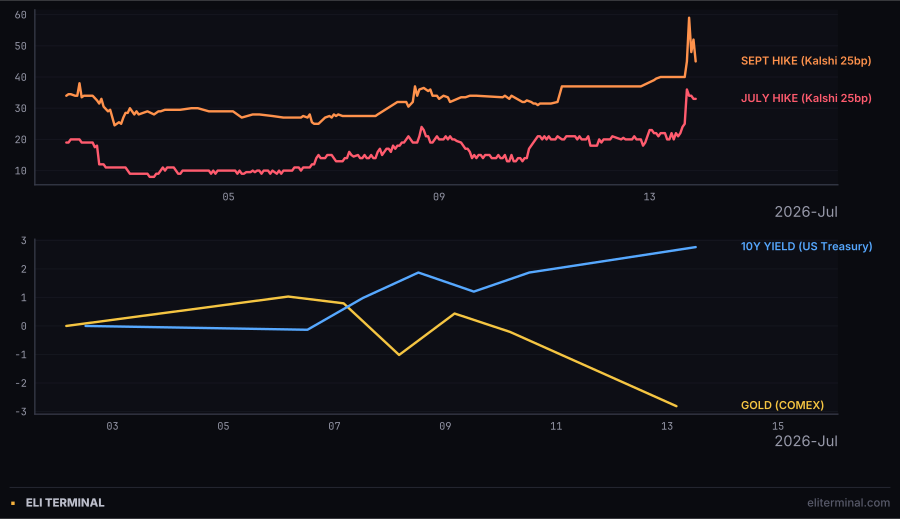
The July and September hike contracts broke higher in the hour after Waller's remarks while gold and the 10-year yield moved the opposite way from what a war headline would predict.
SK Hynix's ADR closed Monday barely above its own 149 offer price, days after debuting 13% over it, the same day a Fed rate-hike bet jumped 12 points, most of it inside a single hour.
The July and September hike contracts broke higher in the hour after Waller's remarks while gold and the 10-year yield moved the opposite way from what a war headline would predict.
Twelve points is how far the Kalshi contract on a 25 basis point July hike moved Monday, from 21% to 33%. Eleven of those points printed inside a single hour, 17:00 to 18:00 UTC, thirty minutes after Fed Governor Christopher Waller told the New York Association for Business Economics that the FOMC would "need to consider tightening monetary policy in the near term" if this week's inflation data ran hot.
A Polymarket contract on no change in July rates fell from 72.5% at 16:00 UTC to 63.5% by 17:00 UTC, the same hour. The Kalshi September-hike contract, already at 40% Monday morning, spiked toward 59% by 18:00 UTC before settling near 45%. Waller named tariffs and Mideast-driven energy costs among the forces that pushed core PCE from 3.0% in December to 3.4% in May.
Zero is how many scheduled US data releases landed Monday; June's CPI prints Tuesday, not Monday. Fed Vice Chair Michelle Bowman also spoke Monday, from a Bank Policy Institute conference in London, but her remarks covered Basel III capital rules and cross-border supervision, not rates. No other scheduled catalyst sits inside the 17:00 UTC hour.
77.66 is where WTI crude settled Monday, up 8.5%, after Iranian forces struck a container ship near the Strait of Hormuz over the weekend and Tehran declared the Strait closed "until further notice." Crude accelerated twice: from about 73.7 to 74.5 near 14:00 UTC, then from 75.11 to an intraday high of 78.45 between 16:45 and 18:15 UTC, a 4.4% move in ninety minutes.
Both a reinstated naval blockade, which Trump announced Monday with a stated 20% reimbursement rate on secured cargo, and a fresh wave of US strikes on Iranian coastal and port targets sat inside that second window. Neither can be cleanly separated from the other by timestamp alone; both were live when crude made its larger move, and either is a plausible source of the energy-cost pressure Waller cited an hour earlier.
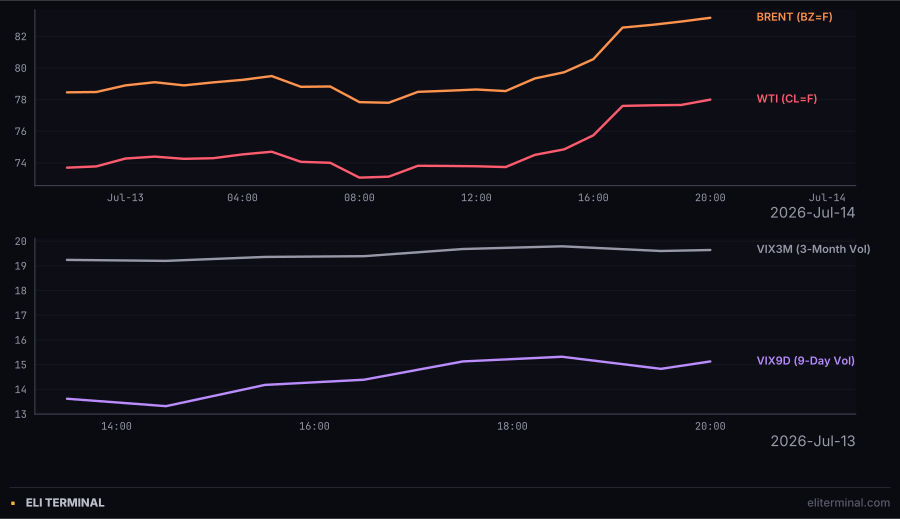
Crude's larger acceleration and the front-dated volatility spike both ran through the mid-afternoon UTC hours, the same window as the blockade announcement and fresh strikes on Iranian coastal targets.
2.6% is how much gold fell Monday, to 3,997, the same day missiles and drones hit five Gulf states and Jordan. The 10-year yield rose to 4.61%, extending Friday's climb, and the 30-year edged to 5.10%, a fresh multi-week high.
35% is how far nine-day implied volatility jumped, from 11.2 to just above 15, while three-month implied volatility rose only 5%, near 19.6. That gap prices an acute shock, not a new regime. High-yield credit fell 0.2% and investment-grade credit fell 0.5%, barely moving against a front-dated vol spike three times that size.
12% versus 10% is where a recession-in-2026 contract sat after and before Monday, essentially unchanged. The stress stayed inside the rate and volatility complex; the market that prices a broader downturn never confirmed it.
162.28 was SK Hynix's US-listed high Monday, a rally from an opening print of 152.62 that was already 9% below Friday's 168.01 debut close. The gap reflected a session already finished in Seoul: the Kospi fell 8.95% and tripped a circuit breaker, Samsung fell 10.7%, and SK Hynix's own Seoul-listed shares fell 15.37%, a record one-day decline, all in the hours before the New York open.
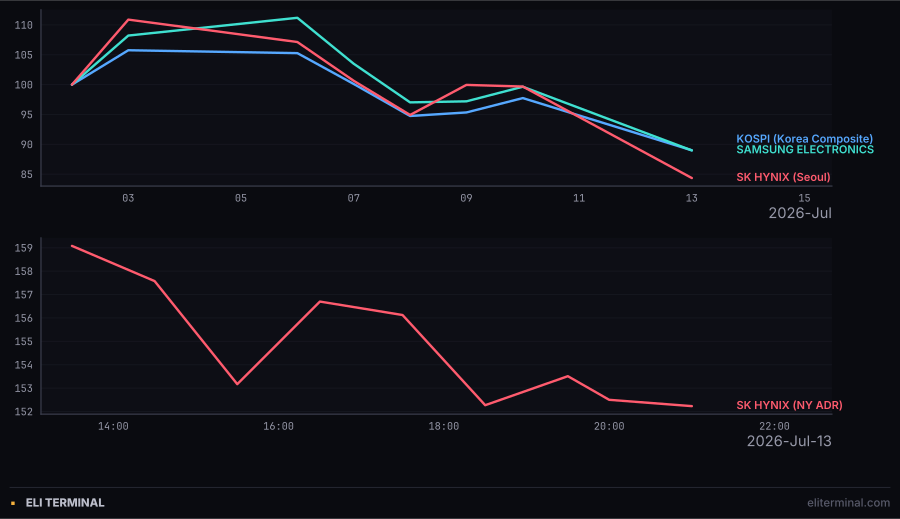
Seoul's circuit-breaker session preceded and gapped down SK Hynix's US shares; the intraday round trip to 162.28 and back to 151.30 was over before the Fed-driven afternoon began.
151.30 was the session low, printed inside the hour that began at 15:30 UTC. By 16:30 UTC, half an hour before Waller's remarks were even released, the shares had already recovered to 156.70. The round trip ran its course before the Fed-driven repricing began at 17:00 UTC: the two moves shared a session, not a cause.
152.35 is where the shares closed, just 2% above their own 149 offer price, versus 13% above it Friday. SanDisk, unwinding the same memory-sector repricing, fell 12.6% after crashing 5% in the first fifteen minutes of trading; Micron fell 4.3%, Nvidia 3.5%, Broadcom 4.0%, and Advanced Micro Devices 4.2%. Oracle, a notch above junk since Friday's downgrade, fell 6.5% to a fresh 52-week low, pressured further by Apple's trade-secret suit against OpenAI, which accounts for roughly half of Oracle's disclosed contract backlog.
12:30 UTC Tuesday brings June CPI, hours before JPMorgan, Goldman Sachs, Bank of America, Wells Fargo, and Citigroup open bank earnings season. A 33% hike bet and a 30-year above 5% meet an inflation print the same morning Waller's own framing gets tested against data instead of a speech.