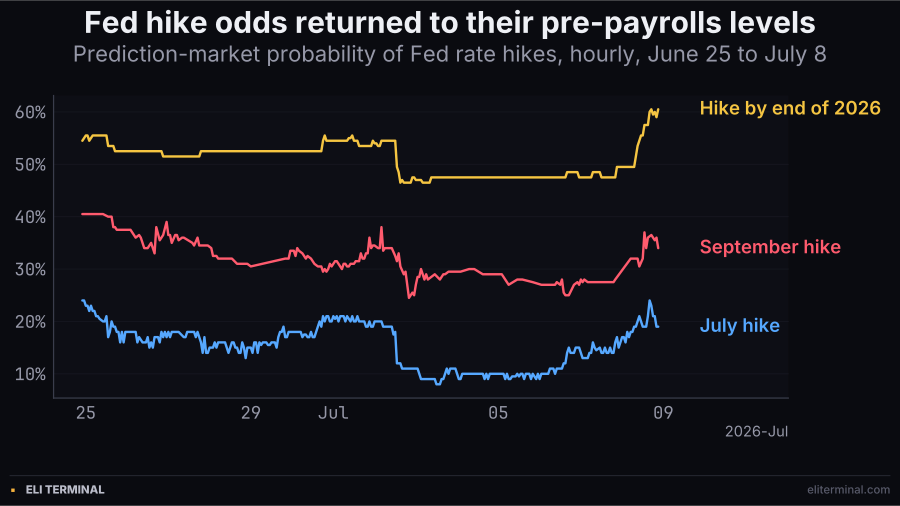
The September contract ended Wednesday at 34%, the level it held before the July 2 payrolls report cut it to 25%; the bet on any 2026 hike closed at 60.5%, above its pre-payrolls 54%.
The strikes resumed and crude rose 3.2%, but the money moved in the Fed path: the September hike bet closed at 34%, its level before the jobs miss, and the Dow gave back 577 points while the chip names rallied.
The September contract ended Wednesday at 34%, the level it held before the July 2 payrolls report cut it to 25%; the bet on any 2026 hike closed at 60.5%, above its pre-payrolls 54%.
Through 08:00 UTC Wednesday, West Texas crude sat at 72.03, flat overnight, even after Bahrain's air-raid sirens had sounded a third time by 06:30 UTC. The overnight exchange, roughly 80 Iranian targets struck by American aircraft and an IRGC barrage answered by fifteen interceptions over Kuwait, had moved Seoul and Tokyo, not the futures in front of New York.
Crude jumped from 72.03 to 74.02 in the quarter hour after 08:15 UTC, on roughly ten times the overnight volume, as Trump arrived at the NATO leaders' meeting in Ankara and told reporters the ceasefire was over: "I think it's over. They're scum." The volatility index ran from 16.41 to a session high of 18.91 by 09:15 UTC.
Gold futures fell from 4,129 to 4,100 in the same quarter hour. The words repriced what the missiles had not, and the first asset marked down was the war hedge.
The September hike bet closed at 34%, up 6 points on the day and exactly the level it held before the July 2 payrolls report cut it to 25%. The July bet ended at 19% against 20% before that report, and the bet that the Fed hikes at all in 2026 finished at 60.5%, above the 54% it carried into the payrolls morning.
Six sessions ago a 57,000 payrolls print priced the tightening cycle nearly out; one dead ceasefire has priced it back. The 2026 recession market moved 1.5 points to 10.5%, so the oil shock is trading as inflation, not as a growth event.
The 10-year yield rose 4 basis points to 4.57%, 9 above its July 2 close, and a 10-year auction at 17:00 UTC still drew a 2.59 bid-to-cover at a 4.58% high yield. The bond market absorbed the supply and the war in the same afternoon.
At 18:00 UTC the June minutes landed with nine of nineteen officials projecting at least one more 2026 hike and Chair Warsh withholding his own projection, the first chair to do so since 2012. The S&P, the 10-year and the volatility index all chopped sideways through the release; by mid-afternoon the Fed's text was already in the price, written there by the morning's oil.
Gold settled at 4,086.60, down 0.5% on a day the United States and Iran traded fire, and 1.3% below where it ended July 2, before the first tanker was hit. Crude carries a 9.3% premium over its July 2 close; the metal carries none.
The dollar index slipped 0.1%, high-yield credit eased 0.1%, AAA CLO paper closed unchanged, and Bitcoin fell 2.5% to 62,132. The nine-day volatility index finished at 14.4, two and a half points below the 30-day index, a curve that never priced a lasting event.
The escalation odds themselves did clear: the market on Iran closing its airspace by July 15 jumped from 9% to 22% on the day, and a market on an American blockade of Iran by July 31 held near 23%, while the deepest Iran market of all, on who leads the country at year-end, sat at 0.2%. Traders paid up for disruption, priced out nothing at the top, and sold the hedge.
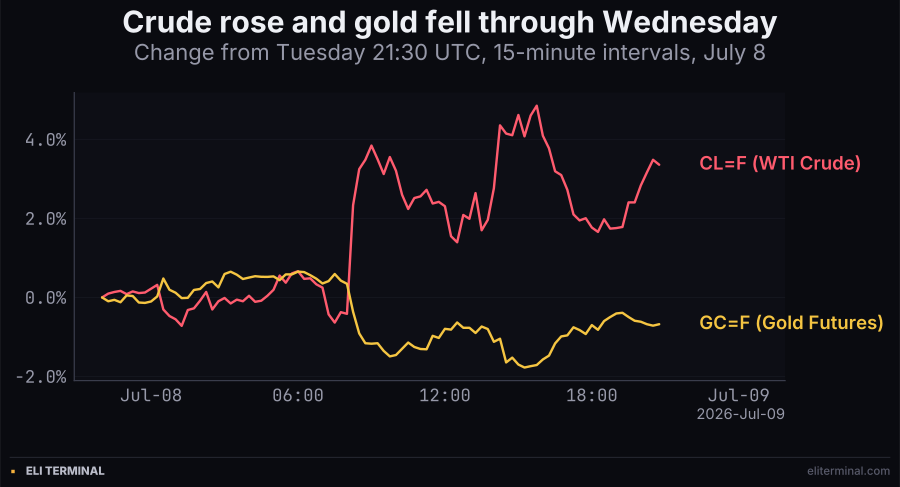
Both futures were flat through 08:00 UTC; in the quarter hour of Trump's remarks in Ankara crude jumped and gold broke down, and the gap never closed.
The Dow lost 576.76 points, 1.09%, to 52,348.39, 707 below Monday's record close, and its low, down 846 points, printed at 15:30 UTC in the same fifteen-minute bar as gold's session low and the volatility peak, a three-asset turn with no headline in the window. From there the average recovered about 270 points into the bell.
The sell list was July 2's buy list: health care down 1.3%, utilities 0.8%, financials 1.9%, regional banks 2.3%, the rate-relief trade unwinding with the rate relief itself.
The buy list was July 2's sell list: Nvidia up 3.67% to 204.15, Broadcom up 4.82% on a 30 billion dollar Apple chip order announced before the open, Taiwan Semi up 0.97%, the technology sector up 1.2%, and the Nasdaq 100 proxy green by 0.27%. Micron and SanDisk, payrolls day's hardest-hit chip names, led it.
Meta fell 2.03% to a fresh session low printed at 19:15 UTC and Tesla lost 2.26%; the bid was silicon, not software.
The S&P closed at 7,482.71, within half a point of its 7,483.24 close on July 2. Four sessions held a payrolls shock, a record, a memory crash and a resumed war, and the index netted them to 0.53 points; everything underneath changed hands.
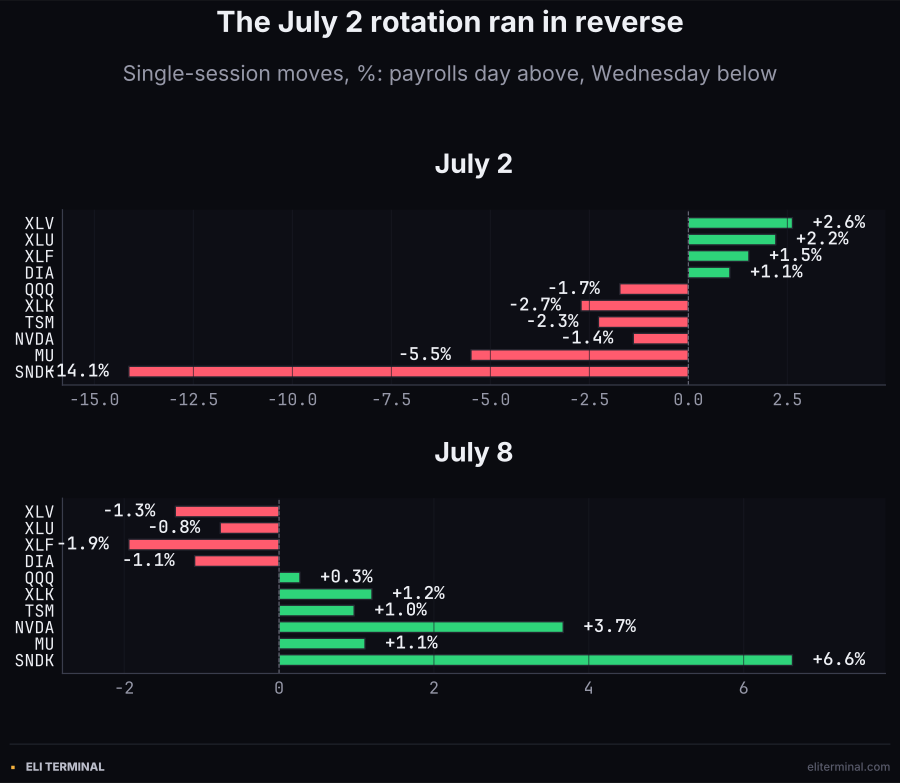
Payrolls day bought rate-sensitive value and sold chips; Wednesday sold the value basket and bought the chips back. Same names, opposite tape.
Samsung fell 6.25% in Seoul on Wednesday with a record quarter on the tape: preliminary guidance issued Tuesday morning showed roughly 89 trillion won of operating profit, nineteen times a year earlier, against a revenue figure that missed. SK Hynix lost 5.68% and the Kospi 5.35%, Seoul pricing the overnight barrage on top of a day-old capacity scare hours before New York opened.
SanDisk, down 7.1% Tuesday, opened New York at 1,591, its low of the session, and closed at 1,727.17, up 6.63%, within 0.5% of its high. Micron, down 4.6% Tuesday, traded 959 in the first half hour against a 902.40 open and held 949.37, up 1.11%, after Citi raised its DRAM price forecasts through 2026 and set a 1,400 target.
The same memory complex closed down more than 5% in Asia and green in New York inside one day. Seoul sold the capacity Samsung is adding; New York bought the prices that capacity has not yet touched.
At 13:06 UTC Trump had said the United States would "probably hit them hard again tonight"; at 20:15 UTC, fifteen minutes after the close, Central Command announced a second round of strikes against roughly 90 targets. Crude's last print of the evening was 74.76.
The July 29 FOMC decision has now been repriced twice in six sessions, from opposite directions. The next payrolls report is a month away; between here and the meeting, the hike path trades on oil, not on labor.