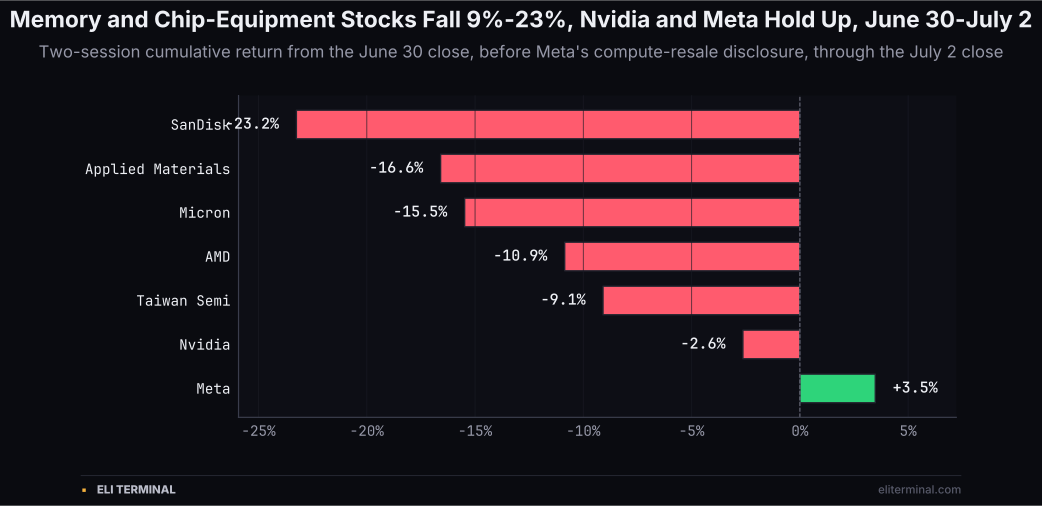
Every bar spans the same two sessions. Nvidia and Meta are the only names still standing.
SanDisk fell 23% and Micron 15% over two sessions while Nvidia held near flat, Tesla dropped 7.49% on a delivery beat it had already front-run, and gold and silver kept climbing through the holiday weekend.
Every bar spans the same two sessions. Nvidia and Meta are the only names still standing.
57,000 is how many jobs June payrolls added, less than half the roughly 115,000 economists expected. The unemployment rate fell to 4.2% only because labor-force participation dropped to 61.5%, the lowest since March 2021.
19% is roughly where the bet on a July Federal Reserve rate hike sat just before the 12:30 UTC release on July 2; it fell to 12% within the hour and to 9% by the close, and it has not moved since. The odds the Fed simply holds in July, near 90% into the weekend, are firmer than at any point in the prior three weeks.
52,900.07 is where the Dow closed, a record, up 595 points or 1.14%, while the S&P finished flat at 7,483.24 and the Nasdaq fell 0.8%. Apple rose 4.84% to 308.63 and health care and utilities both gained more than 2%, the same rate relief that sold the semiconductor and AI-leader complex.
23.25% is how much SanDisk fell across June 30 and July 2, the two sessions bracketing Meta's July 1 disclosure that it plans to resell excess AI compute capacity rather than only consume it. Applied Materials fell 16.59% and Micron 15.48% over the same window, while Nvidia, the name that actually generates cash rather than spends it, fell just 2.63%.
8.83% is how much Meta jumped on July 1 when the compute-resale plan broke, before giving back more than half of it, down 4.90% on July 2 as the broader rate-relief rotation sold anything priced on AI-capex momentum. Net across the two sessions Meta still finished up 3.48%, the only large name in the group to hold a gain.
46.7 million dollars is the net value Micron insiders have sold in the past 90 days, across 48 transactions and zero purchases. Chief executive Sanjay Mehrotra sold shares on June 30 near 1,170.60, about 20% above where the stock closed two sessions later.
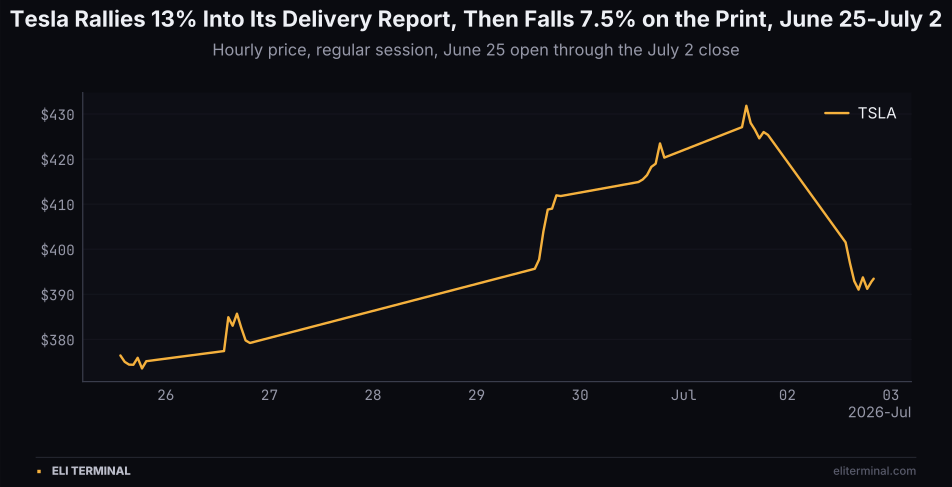
The stock gave back nearly half its run into the report inside the first hour after deliveries were released.
393.45 is where Tesla closed on July 2, down 7.49% on its worst day in eleven months, even though second-quarter deliveries of 480,126 vehicles beat the roughly 406,000 Wall Street expected, a beat of about 18%. Tesla had already rallied 13% in the four sessions before the report, front-running the beat, and gave back nearly half that run in the first hour of trading once deliveries were out.
415 to 430 is the range of price targets Morgan Stanley, Truist and William Blair carried into the report and kept afterward, every one of them above where the stock actually closed. A crowded long position getting the number it wanted and selling it anyway is a positioning problem, not a fundamentals problem.
July 3 is when Tesla began fully unsupervised robotaxi rides in Miami, its first market outside Texas and California, no safety monitor in the car, camera-only self-driving navigating flooded streets through a rainy holiday weekend. Early reports call the rollout flawless, but three days of untested, unsupervised operation in a brand-new city is exactly the kind of open position a single bad clip can reprice fast.
84.75 billion dollars is what Alphabet raised in equity this June, including a 10 billion dollar private placement to Berkshire Hathaway, on top of roughly 85 billion in debt raised over the trailing year for its AI buildout. SpaceX raised a further 85.7 billion in its June 12 initial public offering, the largest in US history, pricing the company near a 2.3 trillion dollar valuation.
June 26 is when OpenAI shipped GPT-5.6 in limited release, and June 27 is when Anthropic's Mythos 5 model opened to more than 100 institutions after months restricted to a government-approved consortium. Both frontier releases landed before Thursday's session even opened, so the newest jump in raw model capability was already known information by the time the market repriced memory and compute stocks; Thursday traded on capital and demand questions, not on model news.
Roughly 800 billion dollars is how much Nvidia's own market capitalization has swung since May, from a peak near 5.5 trillion to about 4.7 trillion now, nearly five times the size of Alphabet's and SpaceX's raises combined, without anything comparable happening on Nvidia's own balance sheet. 50.3 billion dollars was Nvidia's operating cash flow last quarter against 1.76 billion in capital spending, and it paid out 19.3 billion in buybacks with an 80 billion dollar authorization still open, a figure close to the size of Alphabet's entire equity raise.
400 billion dollars was SpaceX's valuation a year before it listed; it priced at 2.3 trillion in June. That escalation is what let its founders raise progressively bigger rounds at better terms each time, which is why the distinction between valuation and capital-in cannot be read as one-directional: a rising share price is exactly what enables the next capital raise, not just a side effect of the last one.
23% and 15%: that is what SanDisk and Micron gave up in two sessions once Meta supplied one piece of real information about actual demand, even as Nvidia, sitting one layer above the debt now funding the buildout, fell just 2.63%. That is the more dangerous version of this story, a feedback loop unwinding hard for a few hours, not the safer one where valuation and consequence never touch.
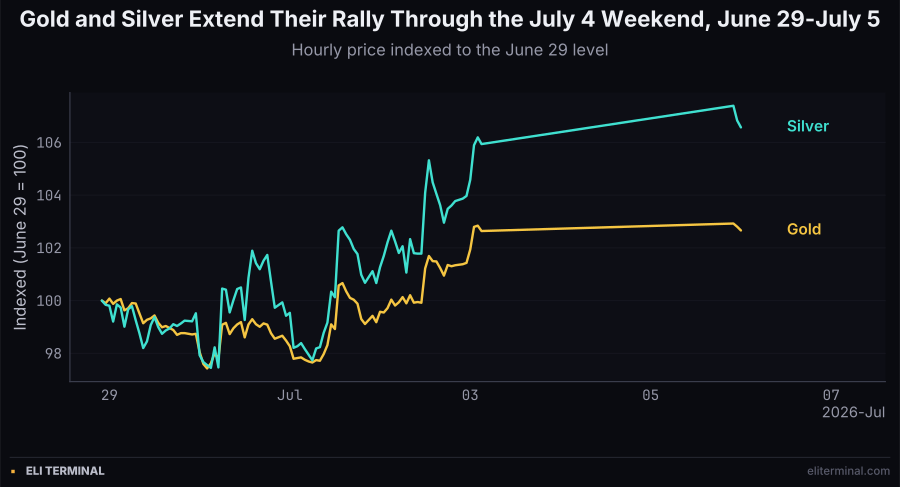
Both lines kept climbing after Thursday's close, through a weekend when the dollar and oil sat still.
1.18% is how much gold has added since Thursday's close, and silver has added 2.34%, both continuing higher through a weekend when the dollar and oil barely moved. Bitcoin is up 3.55% and Ethereum 5.36% over the same stretch, four assets entirely outside the AI-equity complex all bid at once, which reads less like a rate call and more like capital quietly stepping around the exact question raised above.
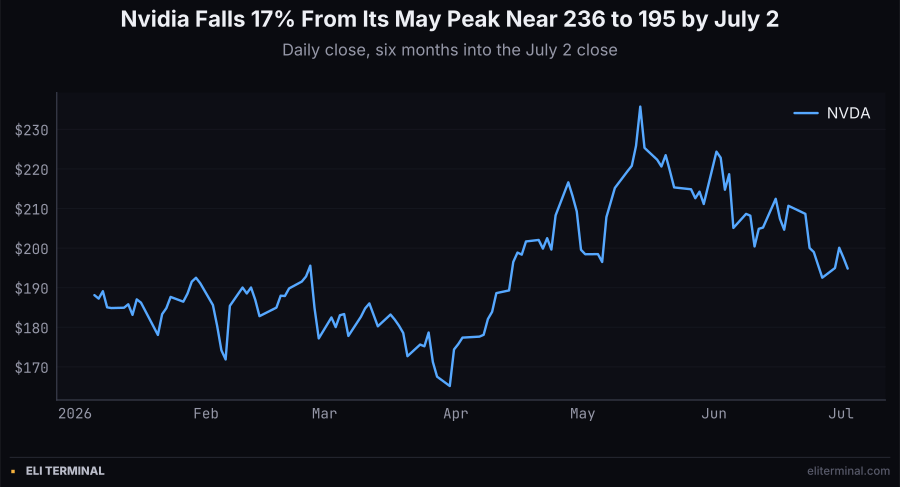
Nvidia's own two-day move through July 2 was a decline of just 2.63%, far calmer than the swing in its market value since May.
82.5% is where the market pricing Nvidia as the world's largest company by market value settled into Sunday night, down from 89.5% before Thursday's session and as low as 69.5% intraday during the payrolls hour itself. A bet on corporate rank does not usually move twenty points in an afternoon over a jobs report; that it did says the AI-leader hierarchy is more contested right now than the calm 2.63% two-day move in Nvidia's own stock would suggest.
Two dates matter more than Monday: July 8, when the FOMC's June meeting minutes land under new chair Kevin Warsh, and July 14, when June's CPI arrives. Monday itself carries no scheduled macro data.
132.7% is where implied volatility sits in SanDisk options, against 101.8% in Micron, 47.1% in Tesla, 45.0% in Meta, 40.9% in Nvidia and 28.8% in Apple, an order that lines up almost exactly with which stocks took the worst of the two sessions through July 2. Index futures were modestly firmer Sunday night heading into the reopen.
15 cents a share is Micron's ex-dividend payment Monday, a mechanical event, not a catalyst. Beyond that the week is genuinely thin, which means Thursday's unresolved positioning, not new information, is what Monday actually trades on.
If I had to point a single-day option at Monday, it would be a put on Tesla. The stock already proved on July 2 that a genuine beat could not hold a crowded long against its own front-running, it carries 47.1% implied volatility into a weekend where its camera-only robotaxi has three untested, unsupervised days of rainy-city driving behind it, and the thin weekend betting on Tesla for Monday is still leaning up near 64%, the exact kind of crowded hope trade Thursday already punished once. I expect Tesla closes below 380 on Monday, July 6, another 3% to 4% down on top of Thursday's 7.49%, before a single bad headline is even required.