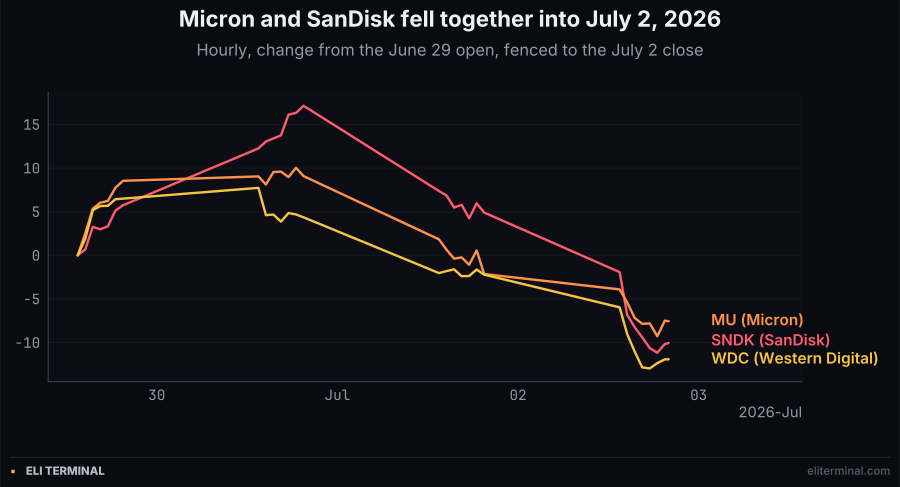
All three memory names fell double digits in the two sessions into July 2, the year's hottest trade breaking as the AI-spending question finally reached it.
June payrolls landed at 57,000, half of forecast, and the Dow rose to a record, but the day's real move was SanDisk down 14.13% as the AI-spending doubt reached the trade that led the year.
All three memory names fell double digits in the two sessions into July 2, the year's hottest trade breaking as the AI-spending question finally reached it.
June payrolls rose 57,000, less than half the roughly 115,000 economists expected, when the Bureau of Labor Statistics released the figure at 12:30 UTC, a Thursday slot because Friday July 3 was the Independence Day holiday.
74,000 jobs disappeared from April and May in downward revisions, and the 4.2% jobless rate slipped a tenth only because participation fell to 61.5%, its lowest since March 2021. A jobless rate that drops because people quit looking is not the strength the headline implies.
The July rate-hike bet fell from 20% to 11% by the close and kept sliding to 9.5% over the weekend, the single biggest repricing on the board. The September hike bet dropped to 27.5%, down 11 points, so the softer read hit the whole path and not one meeting.
9.5% is also where the market puts the odds of a 2026 recession, barely changed on the day, so the weak number read as a reason the Fed stops tightening rather than a reason to fear a downturn. The falling participation rate did that work, letting a soft report land as dovish rather than dangerous.
The Dow closed at 52,900.07, up 595 points or 1.14%, a record, as the rate-sensitive value trade took the full benefit of a softer Fed.
Apple led the average with a 4.84% jump to 308.63, health care rose 2.63% and utilities 2.21%, the two most rate-sensitive defensive sectors. Two thirds of the average's gain came from names with nothing to do with the AI build.
The S&P 500 finished dead flat at 7,483.24 while the Nasdaq Composite fell 0.80% and the Nasdaq 100 dropped 1.73%, the calm headline hiding a violent split. The volatility index eased to 16.2, so the market treated the rotation as orderly rather than as fear.
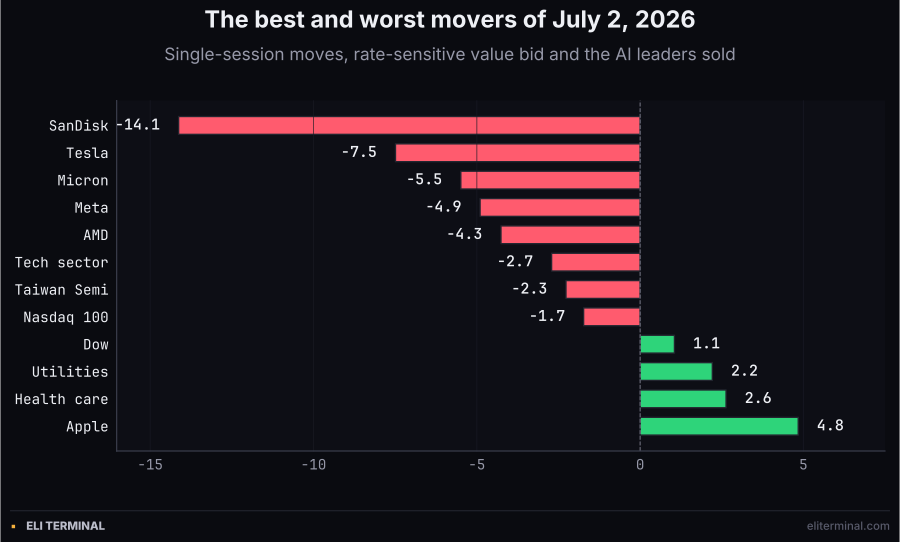
The bid went to Apple and rate-sensitive defensives, the selling to the semiconductor and mega-cap names that led the first half.
Micron entered Thursday up 209% in 2026 and SanDisk up 534%, the two best names of the year by a wide margin, both riding a memory shortage that made scarce chips the most valuable link in the AI chain.
Micron fell 5.49% to 975.56 and SanDisk 14.13% to 1,745, extending a two-session slide of roughly 15% and 23% from Tuesday's close, with Western Digital down 9.9% alongside. The one trade that had shrugged off every AI-spending wobble all year finally broke.
The trigger arrived two days earlier, when reports said Meta will resell its own surplus computing power, spending toward 145 billion dollars on infrastructure this year and finding it has more than it needs. Meta jumped almost 9% on that news Wednesday, then fell 4.90% Thursday, the same story reading as bullish optionality one day and as evidence of an overbuild the next.
45 million dollars of stock sold by Micron's chief executive, disclosed this week, and a class action accusing the memory makers of restricting output added specific reasons to sell. Michael Burry is now short Micron, betting on a correction near 30% and flagging the most extreme stretch above its 200-day average since 1984.
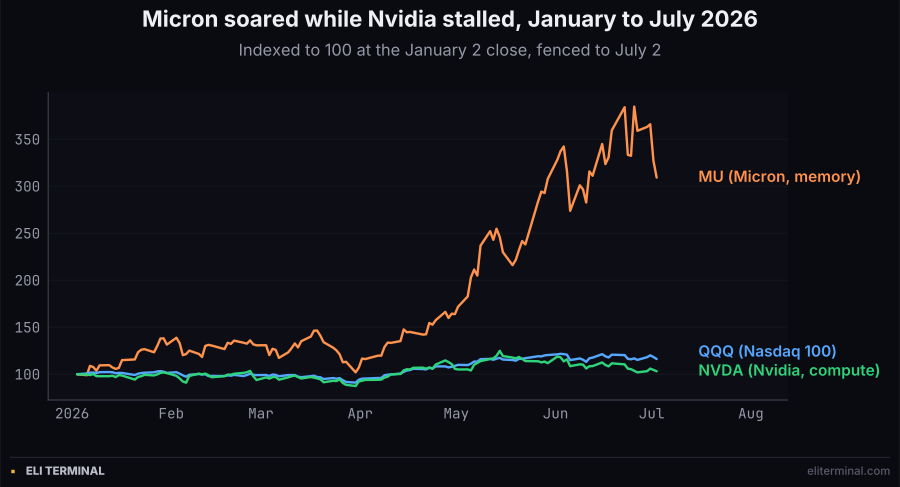
Micron more than tripled this year while Nvidia, the compute name at the center of the AI story, gained 3% and the Nasdaq 100 rose 16%.
Nvidia is up 3% in 2026 and sits near a 4.7 trillion dollar valuation, and those two facts sit awkwardly together, because the second number is not money the company ever received.
A market value is the price of shares changing hands between existing holders, and Nvidia's swing from a 5.5 trillion peak in May to 4.7 trillion now moved almost a trillion dollars of paper with no cash crossing the company's books. The capital that actually funds the build is revenue and borrowing, and there Nvidia raised 25 billion dollars in its first bond sale since 2021 on June 15, three times oversubscribed, against roughly 298 billion dollars of trailing revenue.
Alphabet showed the same split in June, raising about 85 billion dollars of fresh equity and pairing it with an 80 billion dollar borrowing program to fund capital spending guided near 185 billion dollars this year, double last year's. SpaceX turned paper value into 75 billion dollars of real cash in the largest listing on record on June 12, and Meta is spending toward 145 billion dollars on infrastructure it may have to rent out.
40% is the share of operating cash flow that hyperscalers historically spent on capital projects, and one bank now puts 2026 near 100%, a break that means the build has crossed from self-funded to borrowed. That is the real risk the record valuations obscure, not that the numbers are large but that the marginal dollar now arrives as debt, against equipment that depreciates in a few years and whose demand the market just started to question.
Two of the most capable AI systems yet reached users over this same window, one relaunched July 1 after a 19-day government-ordered shutdown, another released to 20 partners under staggered national-security review. The payoff end of all this spending got visibly better and visibly more fragile in one week, carrying a political off-switch that did not exist in earlier capital build-outs.
Tesla fell 7.49% to 393.45, its worst day in nearly a year, even though second-quarter deliveries of 480,126 beat the roughly 406,000 the Street expected and set a company record, up 25% from a year earlier.
The stock had climbed about 13% in the four sessions into the release, so the beat was already in the price, and Thursday was the third straight delivery day it has fallen on. A record quarter met a stock that had run into it, and the sellers won.
Gold closed Thursday at a record 4,113, touched 4,157 in the payrolls hour, and kept climbing over the long weekend to about 4,194, up another 1.4%.
Bitcoin firmed to about 63,600, up 3.3% since Thursday, and the July hike bet slipped further to 9.5%, so every market that trades through a US holiday held or extended the softer-Fed read. Nothing across three days argued the tape got Thursday wrong.
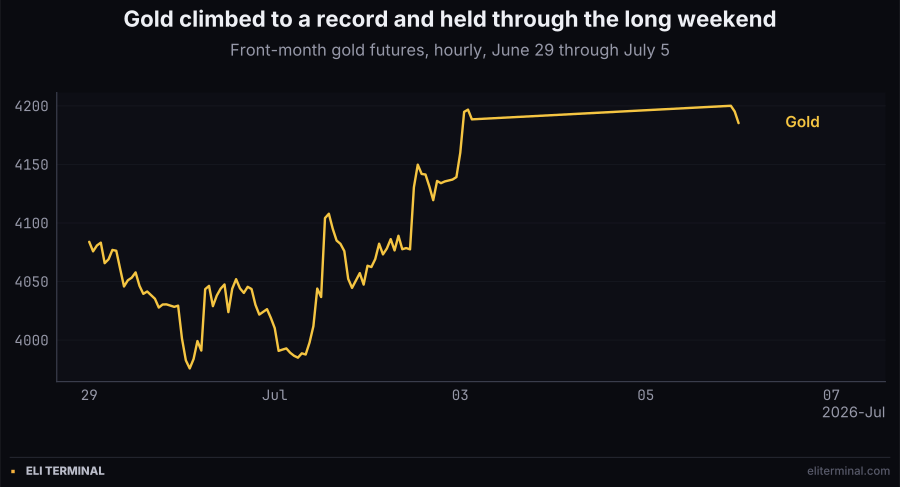
Gold made its record in the payrolls hour Thursday and added to it through the holiday, every off-hours market keeping the softer-Fed read.
July 6 reopens into an empty calendar, no major data and no large earnings, so the week's direction falls to positioning and single-stock stories rather than a scheduled release. Thin holiday liquidity tends to exaggerate whatever the crowded trades do first.
6% is the least I expect SanDisk to fall on Monday, and I do not think it bounces. Up 534% on the year, swinging 20% intraday as recently as Friday, it carries a fresh short from one of the market's best-known bears, no supportive news on an empty calendar, and Samsung's preliminary quarterly read due Tuesday to reawaken the supply-glut fear. I expect SanDisk to close Monday July 6 under 1,640 and Micron under 940, while Apple holds most of its 4.84% gain, the Thursday split running again the moment traders come back.