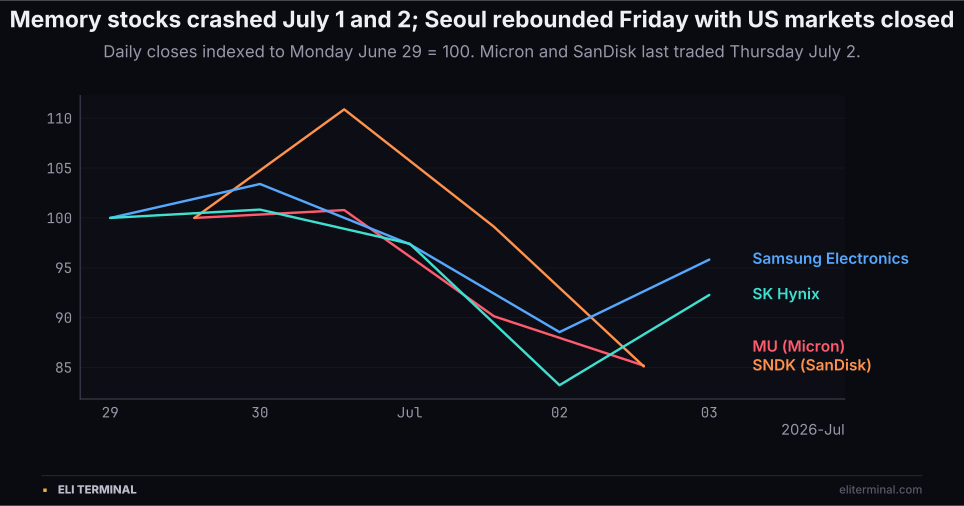
Micron and SanDisk stopped trading Thursday about 15% below Monday's close. Samsung and SK Hynix, hit by the same selling, recovered most of it Friday.
A 57,000 jobs report sent the Dow up 595 points to a record; the deeper story was day two of the memory unwind, and it reversed in Seoul while US markets were closed.
Micron and SanDisk stopped trading Thursday about 15% below Monday's close. Samsung and SK Hynix, hit by the same selling, recovered most of it Friday.
57,000 jobs is what the US economy added in June, against a forecast near 115,000, when the Bureau of Labor Statistics released the report at 8:30 ET Thursday, a day early because Friday was the Independence Day holiday. Revisions removed another 74,000 jobs from April and May.
4.2% was the new unemployment rate, down from 4.3%, and it fell for the wrong reason: participation dropped to 61.5%, the lowest since March 2021. Fewer people looking for work is not the same thing as more people finding it.
18% was the odds-market chance of a July rate increase just before the release; it traded 12% within the hour and 11% by the close. The September market fell from 34% to 25%, and the bet that the Warsh Fed raises rates at all in 2026 slid toward 47% by the weekend, while the 2026 recession market held near 9%. The market read the miss as a hike-killer, not a growth scare.
3.50% to 3.75% is where the federal funds rate has sat since June, and Kevin Warsh spent his Sintra debut on July 1 declining to signal July either way while calling inflation too high. BMO's Ian Lyngen wrote after the release that the data makes a July increase difficult to envision. That is the whole rate story in one line: a tightening debate lost its evidence.
52,900.07 was the Dow's record close, up 595 points or 1.14%, with Apple's +4.84% the biggest single push, McDonald's up 4.07% and Disney 3.84% behind it. Health care rose 2.63% and utilities 2.21%. The S&P finished unchanged at 7,483 and the Nasdaq 100 fell 1.73%, so the average set a record on the same tape that sold the year's leaders.
14.13% is what SanDisk lost Thursday, closing at 1,745, with Seagate down 10.38% and Western Digital down 9.92%. Micron fell 5.49% to 975.56 on top of Wednesday's 10.6% drop, leaving it 19.6% below the June 25 record of 1,213.56. It came into the week up more than 300% on the year; it is still up roughly 240%.
14.57% is what SK Hynix lost in Seoul the same day, with Samsung Electronics down 9.06%, roughly $290 billion of combined market value in one session. The Kospi fell far enough intraday to trigger a trading halt, its fifth circuit breaker of 2026, before closing at 7,648. Single-stock leveraged funds on Samsung and SK Hynix, approved in late May, amplified the slide on the way down.
Five dated headlines built the move, and none of them was the jobs report. June 25: a US class action accused Samsung, SK Hynix and Micron of restricting conventional DRAM output. June 26: Micron's chief executive sold $32.8 million of stock under a January trading plan.
June 29: South Korea unveiled a plan for four new memory fabs. June 30: Michael Burry disclosed shorts against the semiconductor complex. July 1: Bloomberg reported Meta is building a cloud business to sell excess AI compute.
8.8% was Meta's gain Wednesday on that last report, the one that mattered. A company that spent two years as the marginal buyer of compute told the market it may soon be a seller of it, and every supplier of chips, memory and rented GPUs fell while Meta rose. By Thursday's close Meta had given most of it back, down 4.90% to 582.90, but the reframing survived: scarcity stopped being the default assumption.
2,500 is where Bank of America moved its SanDisk target during the crash, up from 2,100, arguing the NAND shortage runs through 2027. Contract DRAM prices rose about 90% in the first quarter and researchers guided second-quarter increases near 60%. The physical shortage did not change last week. The price of believing in it did.
$725 billion is the combined 2026 capital spending guided by Amazon, Microsoft, Alphabet and Meta, up about 77% in a year. The gap between AI capex growth and AI revenue growth is running near 46%, wider than the 32% peak the telecom buildout reached in 2001 before it broke.
$84.75 billion is what Alphabet's June 1 equity raise grew to, its first share sale since 2010, with Berkshire taking $10 billion and the stock falling about 2.5% on the announcement. That came after roughly $49 billion of Alphabet bond sales earlier in the year, including a 100-year sterling note. SpaceX raised $75 billion in its June 12 listing, the largest offering ever.
$25 billion is what Nvidia borrowed on June 15, its first bond sale in five years, and more than $120 billion of data-center spending now sits off balance sheets in special purpose vehicles run for Oracle, Meta, xAI and CoreWeave. Analysts project $250 to $300 billion of AI-related bond issuance in 2026 alone. The funding mix of the buildout moved from cash toward credit in about six months.
$4.7 trillion, Nvidia's rough market value, is not capital: nobody wired it to the company, and the cash Nvidia actually receives arrives as revenue, $81.6 billion last quarter. That is why it is the one company in the buildout that borrows for convenience rather than need, generating $96.7 billion of free cash flow last fiscal year while authorizing $80 billion of buybacks. Nearly everyone upstream of that revenue line is raising money to keep spending: equity once, then debt, then vehicles that keep the debt off the reported balance sheet.
One raise per window is the practical limit: a bigger market cap lets a $4 trillion company sell $85 billion of new stock without breaking, but a company that has just tapped shareholders that hard cannot easily come back this year. Valuations matter to the buildout mainly as collateral for the next raise, so the financing window opens and closes with the caps themselves. Thursday's memory selling was that mechanism running in reverse: infrastructure priced for permanent shortage has no cushion when one large buyer hints at becoming supply, because the shortage is the valuation.
19 days is how long Anthropic's Fable 5 spent suspended under export controls before returning to full availability on July 1, and OpenAI previewed GPT-5.6 to about 20 government-approved partners on June 26. The demand at the far end of all this spending is not the fragile part; the models keep improving on schedule, now under federal supervision. The question the tape asked Thursday is whether the financing chain that pays for them, increasingly debt-shaped and off balance sheet, holds its price while they do.
+8.2% and +10.9% are what Samsung and SK Hynix returned on Friday, with the Kospi up 5.76% to 8,088 and the Nikkei up 1.47%, a snapback the US memory names have not been open to price. Europe's Stoxx 600 rose 0.7% the same day to a record. The crash kept trading after the US went home, and it traded higher.
Saturday, OPEC+ approved another 188,000 barrels per day of output for August, the third straight monthly increase, and WTI sat near 68.23 Sunday night, 0.3% below Thursday's close. The six-day funeral for Ali Khamenei runs through July 9 with his successor yet to appear publicly, and 258 tankers transited Hormuz last week under Iran's safe-passage arrangement. Oil is treating all of it as manageable.
By Sunday at 8pm ET the futures reopen had picked a side: Nasdaq 100 futures up 1.5% from Thursday's close, S&P futures up 0.6%, Dow futures up just 0.1%. Thursday's rotation out of the leaders and into the average was already reversing before Monday's opening bell.
Gold reached 4,195 Sunday night, 1.4% above Thursday and 3.7% above Wednesday, though still 25% below its January 29 peak of 5,586. Silver rose 3.0% to 63.25, bitcoin 3.5% to 63,641 and ether 5.2% to 1,786. The soft-jobs, softer-Fed read kept buying hard assets straight through the holiday.
11% to 58% is the weekend path of the odds-market bet that GPT-5.6 is released by July 9, a climb that started late Saturday night and ran through Sunday evening. A companion market on whether Anthropic's newest model holds the top leaderboard spot on July 11 collapsed from 44% at Friday's open to 5%. On the same exchanges the July hike bet drifted from 11% to 9%.
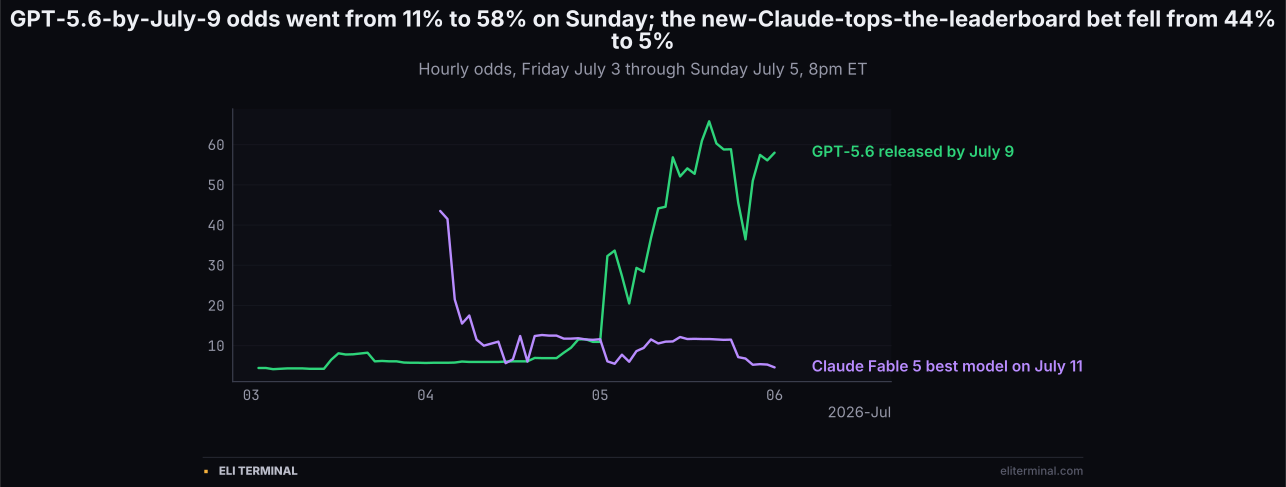
Both moves are the same trade: money betting the next leaderboard king arrives from OpenAI this week. As of Sunday 8pm ET.
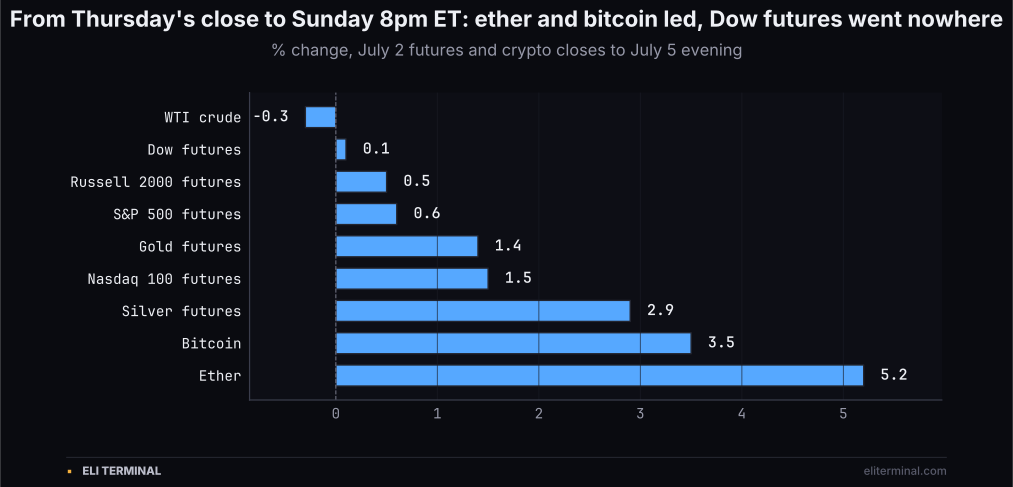
Everything that reprices around a softer Fed moved over the closed weekend; the Dow, Thursday's winner, did not.
Zero is the number of major US economic releases and mega-cap earnings reports scheduled for Monday July 6, so the session belongs entirely to the weekend's information. The next hard catalyst lands Monday night ET, when Samsung publishes preliminary second-quarter results in Seoul; consensus sits near 85.5 trillion won of operating profit, roughly an 18-fold increase from a year earlier and a record, driven by the same memory prices the market spent two days selling.
975.56 is where Micron is still marked, Thursday's panic close, while the Korean companies on the identical trade have already recovered most of the crash and index futures lean toward the growth side. Micron's near-dated options price roughly 100% annualized volatility, so the derivatives market already expects Monday to be violent. It just has not picked a direction.
1,020 on Micron and 1,850 on SanDisk are the Monday marks this report commits to: Micron rises aggressively and closes above 1,020, at least 4.5% from 975.56, and SanDisk closes above 1,850, at least 6% from 1,745, both by the 4pm ET close on July 6. A one-session options bet placed at Monday's open points at calls on those two names, not puts. Seoul has already published the answer; the US market just has not been open to read it.