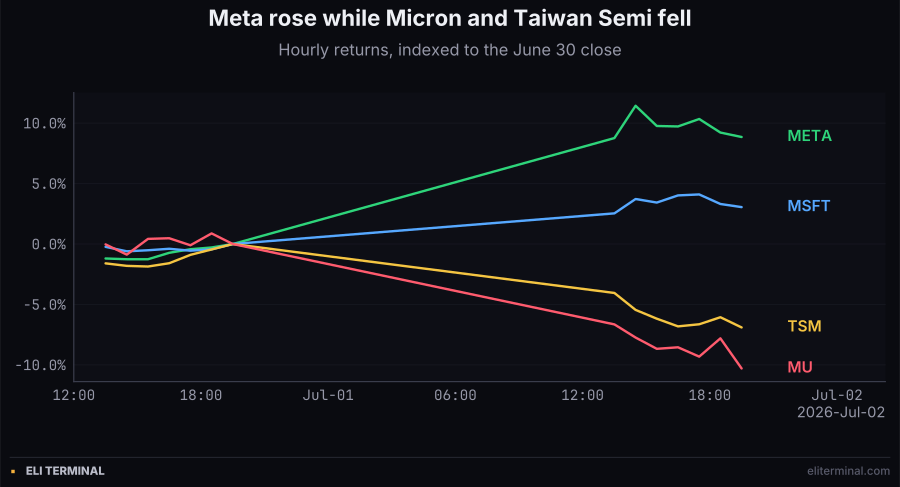
Both sessions are indexed to Tuesday's close. The gap opened at Wednesday's bell and never closed, splitting the tape by which side of the compute invoice each name sits on.
META rose 8.81% while Micron fell 10.57% and Nebius 17.01%, after Meta said it will resell its spare AI compute.
Both sessions are indexed to Tuesday's close. The gap opened at Wednesday's bell and never closed, splitting the tape by which side of the compute invoice each name sits on.
META rose 8.81% to 612.91 on Wednesday after Meta said, before the open, that it will launch a cloud business to sell its excess AI computing power to outside customers. The venture, run under Meta's infrastructure and superintelligence teams, would rent out capacity Meta had bought to train its own models, turning the market's template for runaway AI spending into a seller of compute.
META opened at 607.91, already up 7.9% over Tuesday's close, then spiked to 628.28 for an intraday gain near 11.5% before settling at 612.91. The gap said the news broke overnight, and the market did not wait for the bell to reprice it.
Nebius fell 17.01% to 229.18 and CoreWeave 13.92% to 85.69, the two names whose entire business is renting out GPU capacity. Meta as a reseller becomes their direct competitor, so the threat landed on them first and hardest.
Micron fell 10.57% to 1,032.28 and SanDisk 10.62% to 2,032.22, the memory makers whose chips fill those data centers. A record memory run met its first real crack, though Micron is still up 262% for the year even after Wednesday.
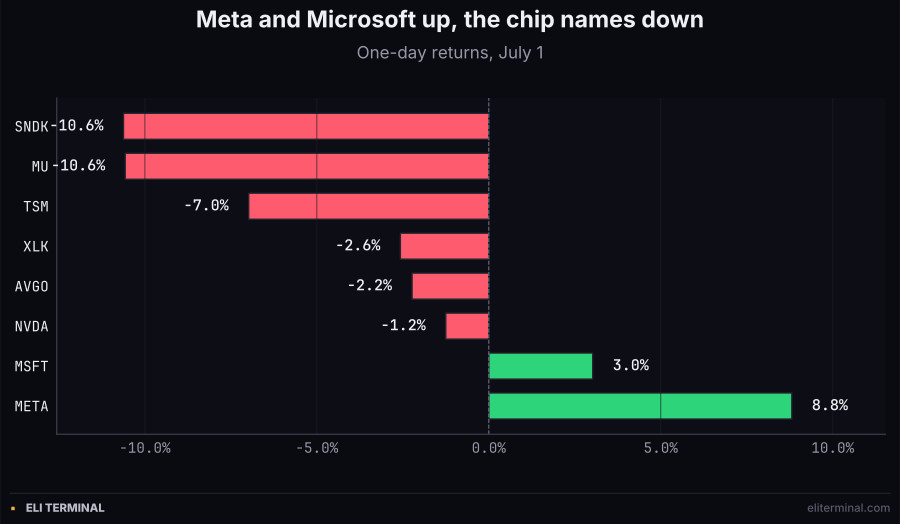
The day sorted the AI chain by role. The two names that buy and resell compute gained, while every layer whose revenue is somebody else's capex fell, memory taking the deepest cut.
Taiwan Semiconductor fell 6.98% to 444.23, Intel 9.03%, Advanced Micro Devices 6.89% and Marvell 8.67%. The selloff reached Asia, where Samsung closed 5.84% lower, so the repricing hit every layer that sells the build-out, not one name.
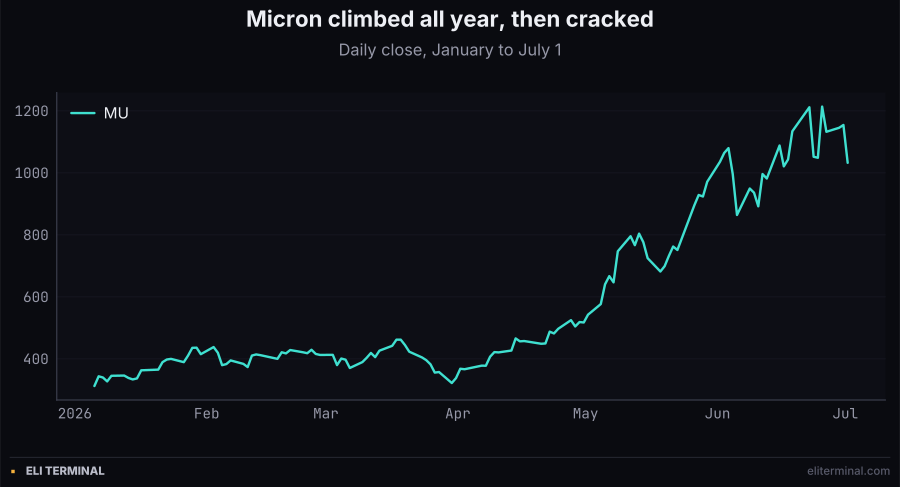
Micron ran from about 285 at the start of the year to a late-June peak before Wednesday's 10.57% drop. This is the first double-digit down day in the whole climb.
Microsoft rose 3.02% to 384.28, the clearest confirmation in the tape. If reselling spare compute is a real business, the hyperscalers that already run one get more valuable, not less, and Microsoft caught that bid while the chip sellers cratered.
Nvidia held to a 1.25% loss at 197.58 while the memory names fell more than 10%. The market did not treat the maker of the accelerators as a build-out proxy the way it treated the memory and the renters, and that gap is the day's cleanest read on who investors think keeps pricing power.
The S&P 500 closed at 7,483.23, down just 0.22%, the Dow at 52,305.24, down 0.03% after fading 0.83% from an intraday record of 52,742.66, and the Nasdaq Composite 0.66% lower. Two green megacaps were enough to mask a double-digit collapse across half the chip complex, so the index looked like a non-event.
The odds market that pays out if Meta trades at 640 in July jumped from 27% to 76% during Wednesday's session, a 49-point move that tracked the cash gap almost candle for candle. The forward layer repriced Meta's ceiling faster than the stock itself.
The rate market barely moved by contrast: the market for a Fed hike by the July meeting sat near 20% all day even as the 10-year yield backed up 5.7 basis points to 4.47%. Duration sold alongside tech, with the long-bond ETF down 1.04%, so this was a supply-glut scare in compute, not a growth scare that sends money into bonds.
Gold rose 1.13% to 4,068 and the financials caught the rotation, the regional-bank ETF up 1.78% and the broad financial sector 2.18%. The money that left the chip sellers stayed in the market and moved down the risk stack.
Nebius and CoreWeave, down 17.01% and 13.92%, are the first test: whether they stay below Tuesday's closes tells you if a reselling hyperscaler is a lasting threat to the pure compute-renters or a one-day panic that reverses.
Micron above or below 1,000 is the second: a break of that round number would confirm the memory run has turned, while a reclaim toward the June highs would mark Wednesday as profit-taking after a 262% year.
Nvidia's 1.25% loss against Micron's 10.57% is the third: if the accelerator maker keeps outperforming the memory names, the market has decided the resale glut hits the commodity layers of the build-out and spares the one part with pricing power.