One Shortage, Two Bills
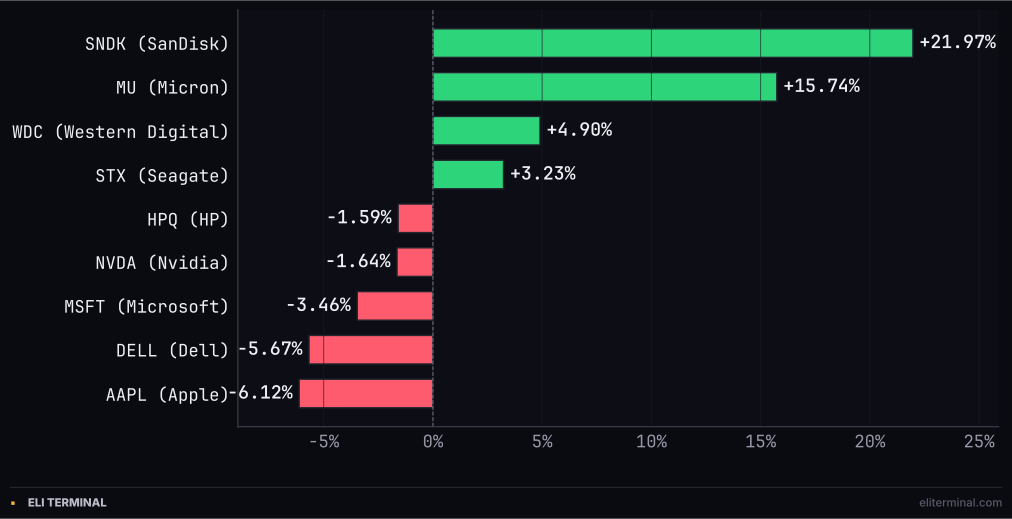
The makers of memory rose and the assemblers that buy it fell on the same June 25 session. Even Nvidia closed lower, which marks the day as memory-specific rather than a broad chip selloff.
Apple fell 6.1% to its worst day in a year after raising Mac and iPad prices up to 200 dollars, while SanDisk jumped 22% and Micron 15.7% on the same memory shortage.
The makers of memory rose and the assemblers that buy it fell on the same June 25 session. Even Nvidia closed lower, which marks the day as memory-specific rather than a broad chip selloff.
SanDisk rose 22.0% to 2,335 and Micron 15.7% to 1,213.56, the day's two biggest movers, while Apple fell 6.1% to 275.15 and Dell 5.7% to 409.45. One memory shortage paid the makers and billed the assemblers in the same six and a half hours.
Nvidia fell 1.6% to 195.74, the detail that names the move. The stock the market treats as the AI trade dropped alongside the hardware buyers, so this was not chips rising together; it was memory makers rising while everyone who solders memory into a finished product fell.
SK Hynix added 11.3% and the broad semiconductor ETF rose 2.9%, the gain concentrated in the storage and DRAM names. The dispersion inside one industry was the whole story, and it ran along a single line: who sells the chip and who pays for it.
Apple raised hardware prices before Thursday's open, lifting the 13-inch MacBook Air with 512GB by 200 dollars to 1,299, the MacBook Pro with 1TB to 1,999, the iPad Air to 749, and the 11-inch iPad Pro to 1,199. The company tied the increases directly to memory, and the stock had its worst session in about a year on roughly twice its normal volume.
One line carried it: the company called this "an unprecedented challenge" for consumer electronics, and Tim Cook said "price increases are unavoidable." Apple held the iPhone price flat for now, deferring the hike on its highest-volume product even as it raised the Mac, the iPad, the Vision Pro and the HomePod.
Microsoft raised the Xbox by 100 dollars on the 512GB model and 150 on the 1TB version, effective August 1, citing soaring component costs. Two of the largest hardware sellers in the world moved the memory bill onto the customer on the same morning.
Memory contract prices have run far ahead of the finished goods that use them: Gartner sees 2026 DRAM up 125% and NAND up 234% year over year, with no relief until late 2027. The chip is appreciating faster than anything built around it.
Memory is now 23% of a PC's bill of materials, up from 16%, and more than 20% of a smartphone's, so a doubling in the part rewrites the price of the whole device. The maker captures that as margin and the assembler eats it as cost, which is why Micron printed an 84.6% gross margin while Apple printed a price increase.
The cause sits in the data center: high-bandwidth memory for AI uses three to four times the wafer capacity per bit, so building it pulled fab lines off the commodity DRAM and NAND that go into laptops and phones. Micron's HBM is sold out through 2026 and the company guided next quarter toward 50 billion in revenue at an 86% margin, the supply going to the build-out before it goes to the shelf.
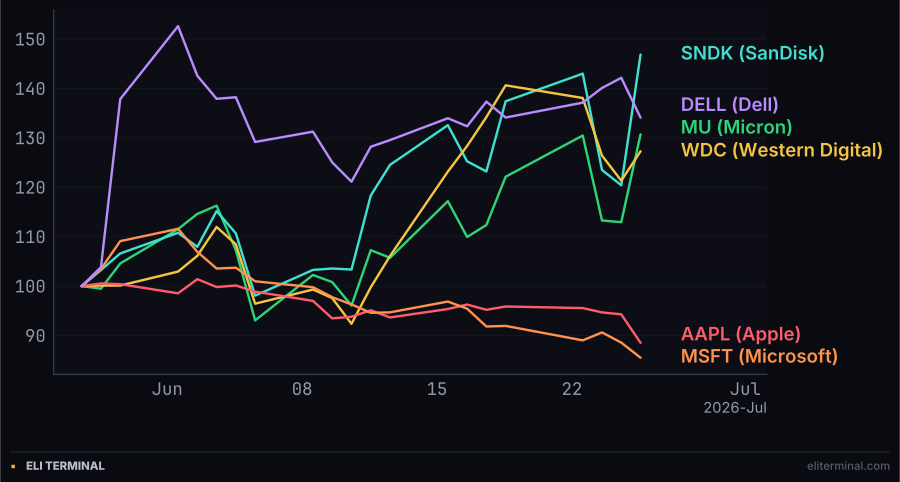
Over 30 days the memory makers SanDisk and Micron pulled away to the top while Apple, Nvidia and Microsoft sank. The AI capex dollar kept landing on the supplier that locks demand by contract.
The S&P 500 closed at 7,357.49, down 0.01%, while the Dow set a record at 51,920.62, up 0.14%, and the Nasdaq fell 0.46% to 25,358.60. The headline averages said almost nothing happened.
The Nasdaq logged its fourth straight down day, the first four-session losing streak since February, the slow bleed of the largest technology weights against a flat-to-green broad tape. The damage was specific to the names that pay the memory bill.
The VIX sat at 18.89, the calm that marks a rotation rather than a selloff. Money moved from the assemblers to the makers inside the same index, which is why the average barely twitched while individual names moved 6% and 22%. The information was in the dispersion, not the close.
May PCE ran 4.1% year over year, the highest since April 2023 and the first reading above 4% in three years, with core at 3.4%. Both came in line with estimates, and energy did much of the work, up 23.5% from a year ago on the Iran and Hormuz oil move.
The 10-year yield fell anyway, from 4.402% to 4.392%, touching 4.363% just after the 12:30 UTC release, and the long-bond ETF rose 1.46%. An in-line print on a loaded bet moves yields the other way.
The bet was the hawk: Kevin Warsh's first FOMC on June 17 held rates but flipped the dot plot higher, with 17 of 18 officials seeing upside inflation risk, and CME odds of a September hike had climbed from about 29% toward 68% with BofA moving to three hikes. The in-line PCE pared that, so the duration buyers covered.
The day's real inflation was not in the data series the desk watched at 8:30. It was in two press releases from Cupertino and Redmond, the part of the AI build-out that finally reached a consumer price list.
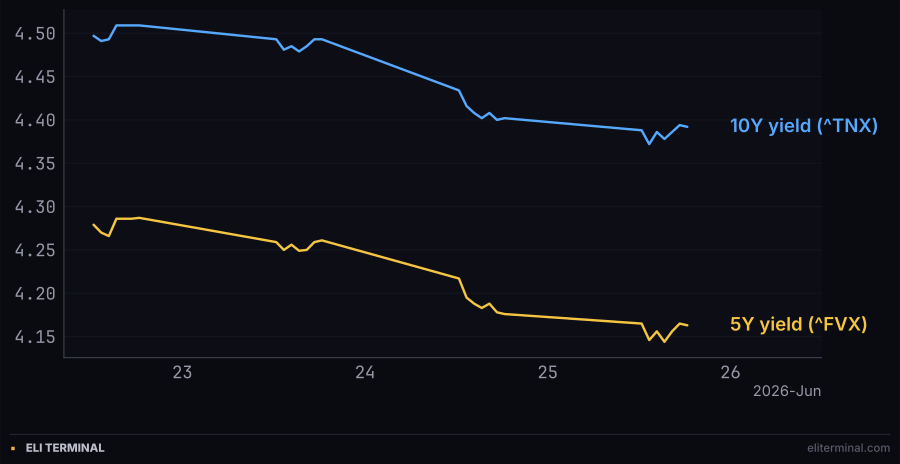
The 10-year and 5-year yields fell into and through the May PCE release despite a 4.1% headline. An in-line print on a fully loaded September-hike bet sent yields down, not up.
The deferred iPhone hike is the next domino: Apple held its highest-volume product flat, so whether and when that price moves will say how much of the memory bill the company is willing to absorb before passing it on.
The memory cycle runs to late 2027 on every forecast, which makes the question whether SanDisk and Micron hold these gains or give them back as the market debates how long the shortage lasts. A single record quarter is a print; a multi-year contract is a regime.
The last test is the consumer: a 200-dollar increase on a laptop and a 100-dollar increase on a console either get paid or dent unit demand. If more hardware makers follow Apple and Microsoft, the memory shortage stops being a margin story and becomes a measured price level.