The Relief Lasted An Hour
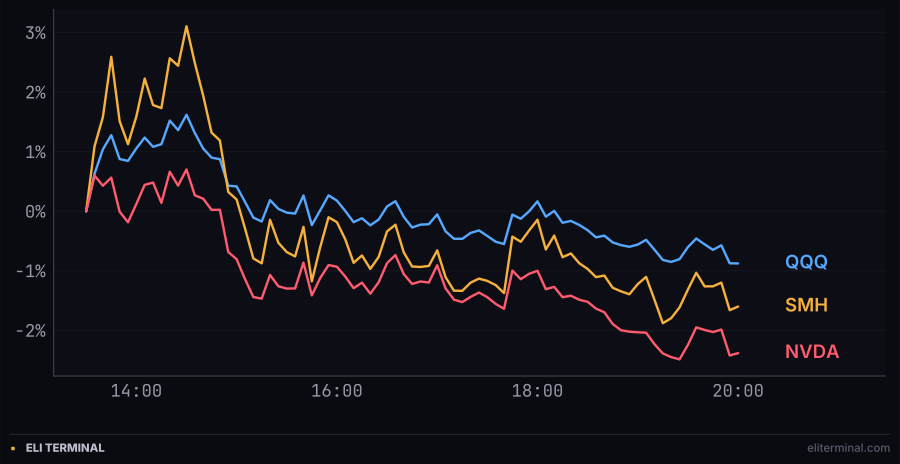
Stocks rallied after the soft core CPI print, the chip ETF up 3% intraday, then gave it all back and more by the close.
Oracle beat on everything, a backlog up 85 billion to 638 billion and cloud infrastructure up 93%, then fell as much as 7% after hours on capex that blew past guidance to 55.7 billion. The chips sold off a third time this week and oil jumped 4%, even as core inflation came in soft.
Stocks rallied after the soft core CPI print, the chip ETF up 3% intraday, then gave it all back and more by the close.
May core CPI rose just 0.2% on the month and 2.9% on the year, below the 0.3% the desk had feared, and the chips ripped at the open, the semiconductor ETF up 3% within the hour. By the close it had given all of it back and finished down 3.4%.
The broad tape went with it. The S&P 500 closed off 1.6% and the Nasdaq 100 2.0%, a full reversal of a morning that had started green.
Headline CPI ran 4.2% on the year, the hottest since 2023, with energy accounting for more than 60% of the monthly gain and gasoline up 40.5% from a year ago. The cool core says underlying inflation is contained; the headline says the energy shock is not.
Oil settled the argument in favor of the headline. WTI jumped 4.1% to 91.85 and Brent 3.6% to 94.71, so the very force driving inflation got worse on the same day the core looked better.
Marvell fell 5.4%, Broadcom 5.1%, AMD 4.9%, Micron 4.7%, and Nvidia 3.7% back to 200, the third leg down for the AI-chip trade in five sessions. None of it was about rates, which barely moved, and all of it was about a trade the market has decided to keep trimming.
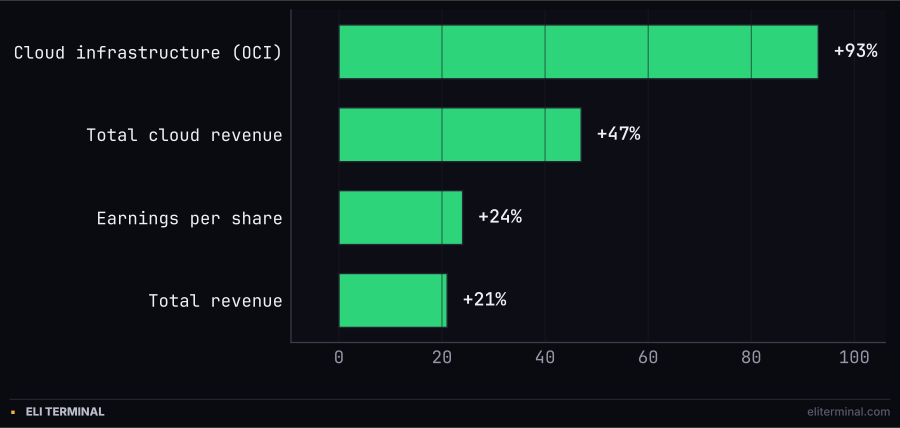
Records across the board, and the stock fell as much as 7% after hours. The market punished the spending, not the demand.
After the close Oracle reported record revenue of 19.2 billion, up 21%, with total cloud up 47% to 9.9 billion and cloud infrastructure up 93% to 5.8 billion. Non-GAAP earnings of 2.11 beat the 1.96 the Street wanted.
The backlog was the headline. Remaining performance obligations jumped 85 billion in a single quarter to a record 638 billion, proof that the demand for Oracle's AI capacity is not the problem.
Capital spending hit 15.9 billion in the quarter and 55.7 billion for the year, well past the 50 billion Oracle had guided, and the stock fell as much as 7% after hours. A company that beat every line lost a tenth of its value on one number, the one that measures the bill.
The balance sheet is why that number bites. Oracle carries more than 124 billion of debt against deeply negative free cash flow, and Mizuho's Siti Panigrahi framed the whole print before it landed as one question, whether the borrowing needed to fund the servers can stay below 100 billion.
This is the AI trade in June. The demand is settled, Oracle's 638 billion backlog and 93% infrastructure growth put that beyond doubt, and the market sold the stock anyway. What it is repricing is not whether the revenue comes, but how much debt has to be raised to chase it.
That is why a soft core CPI could not hold a bid. The thing weighing on the highest-multiple names is no longer just the discount rate; it is the dawning sense that the buildout has to be paid for, and the cash is not there yet.
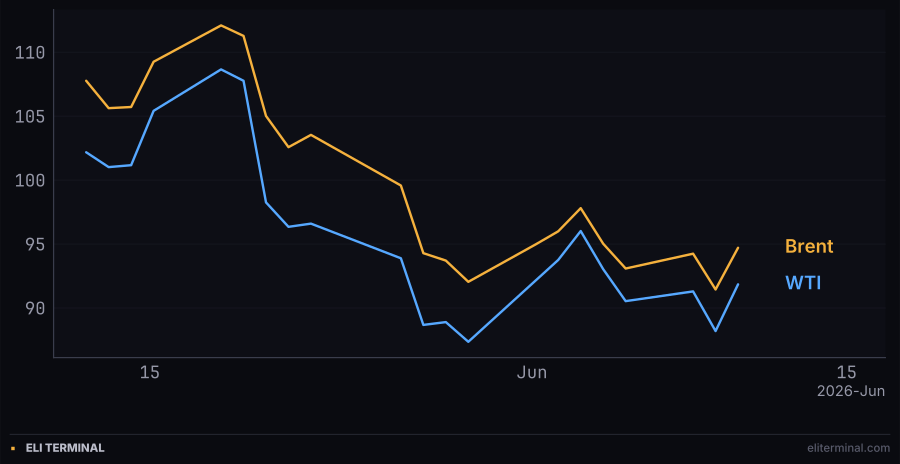
WTI rose 4% on June 10 after US strikes on Iran and Iranian attacks on Gulf states, with the Strait of Hormuz still disrupted.
Crude jumped because the conflict escalated. The US carried out strikes after this week's downed helicopter, Iran retaliated against Bahrain, Jordan and Kuwait, the Strait of Hormuz stayed largely blocked, and US crude inventories drew for a seventh straight week, down 7.2 million barrels.
The rest of the tape was a clean de-risk. Gold fell 3.9% rather than catching a haven bid, the VIX rose 12% to 22.2, and the only green mega-cap was Apple at 0.4%, the one with the least to fund.