Friday's Worst Were Monday's Best
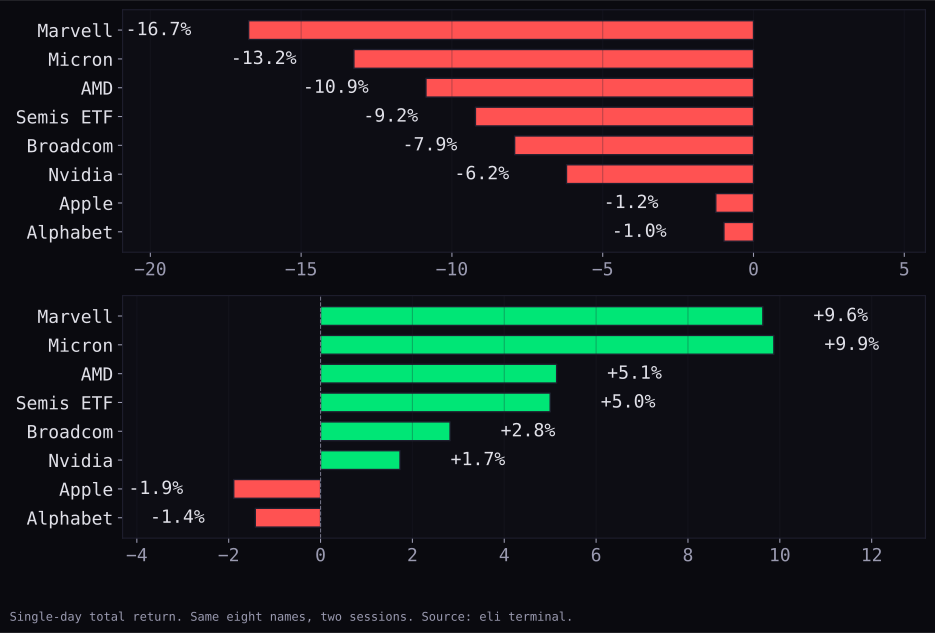
The names the jobs shock hit hardest Friday led the rebound Monday, almost in rank order. The two that held Friday, Apple and Alphabet, kept falling.
Micron rose 9.9%, Intel 11.2%, the chip group 5.0%, reversing a slice of Friday's wreck. But the Fed never relented, a 2026 hike still sits at 55% and the 10-year held at 4.55%. The bounce ran on an index ticket, two upgrades and a vol unwind, not rate relief.
The names the jobs shock hit hardest Friday led the rebound Monday, almost in rank order. The two that held Friday, Apple and Alphabet, kept falling.
Micron rose 9.9% and Marvell 9.6%, the exact two names that fell 13.3% and 16.7% on Friday's jobs shock, and Intel rose 11.2%. The chip group gained 5.0%, Applied Materials 8.6%, Lam Research 7.0%.
The index barely moved. The S&P 500 closed up 0.2% and the Dow fell 0.2%, so this was a narrow recovery in the most-sold names, not a broad risk-on day.
The 10-year yield held at 4.55%, up slightly, and the 2-year stayed near 4.20%, a step from Friday's multi-year high. Nothing in the rate market said the jobs print had been forgotten.
The bets agreed. A hold at next week's meeting is priced at 98%, a 2026 rate hike still sits at 55%, and a single cut this year is down to 12%. The chips bounced inside a macro that, if anything, had grown more hawkish, which means rate relief was not the reason.
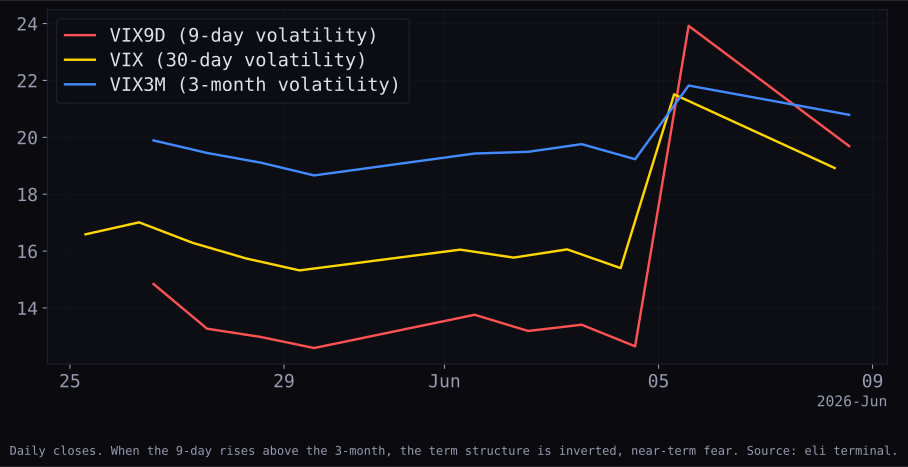
Friday the 9-day VIX rose above the 3-month, an inversion that marks acute near-term fear. By Monday it had fallen 18% and slipped back below, the term structure re-normalizing.
Marvell's 9.6% had a hard mechanical cause. S&P Dow Jones Indices announced Friday after the close that Marvell joins the S&P 500 on June 22, which forces index funds to buy the stock, and that buy program opened into a name that had just been flushed 16.7%.
The catch is that Flex, added to the index in the same announcement, fell 0.7% on Monday. So index buying alone does not explain Marvell.
The other half is the story. Jensen Huang called Marvell a future trillion-dollar company on stage at Computex on June 2 and disclosed a $2 billion Nvidia stake tied to its NVLink Fusion work, and Stifel had moved its target to a Street-high $321. Index buying met an AI narrative, and the two together moved the stock.
Micron's 9.9% came with fresh paper. Wells Fargo raised its target to $1,220 from $550 and Cantor Fitzgerald's CJ Muse went to $1,500 from $700, both Monday, both citing memory sold out under long-term hyperscaler contracts ahead of the June 24 earnings call, where consensus looks for $19.33 in earnings against $1.91 a year earlier.
Intel's 11.2% came from a scoop. The Information reported that Google has ordered more than 3 million of its tensor chips from Intel for 2028 delivery and that Nvidia is evaluating Intel's 18A process as a hedge against relying on a single Taiwanese foundry. A supply chain that has been a one-name risk suddenly had a second source.
Speaking in Seoul before the US open, the Nvidia chief called Friday's selloff a huge buying opportunity and said the industry is at the outset of the AI build. Bloomberg ran it early, and the line carried across the morning.
That endorsement is why names with no catalyst of their own, AMD 5.1% and the broad chip group, moved with the leaders. A CEO telling the market the weakness is a discount lands hardest on the names that were oversold, not the ones with the best numbers.
The 9-day VIX fell 18% to 19.69 and the term structure that inverted Friday slipped back to normal. That compression is itself a buy signal for the machines.
The mechanism is positioning, not fundamentals. Dealers who were forced to sell into Friday's drop flipped to buyers as the worst of the gamma cleared, the roughly $350 billion in vol-targeting funds that cut equities when volatility spiked began re-leveraging as it fell, and trend models that had just gone short semiconductors were squeezed. Nomura's Charlie McElligott has long called this the slingshot: the faster volatility falls, the larger the mechanical buying. The chip index entered Monday with its relative-strength reading at 28, deeply oversold, which is the fuel a slingshot needs.
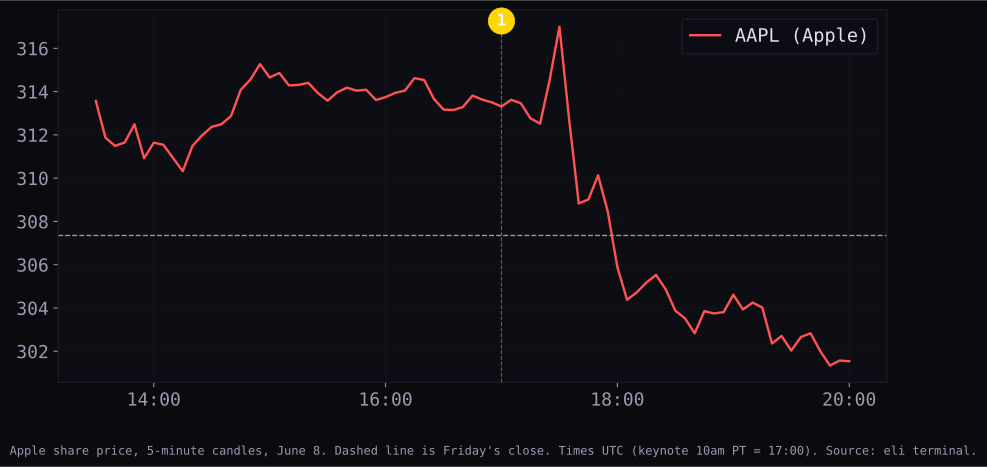
Apple opened up 2%, peaked up 3.1% as the keynote began, then sold off through the afternoon to close down 1.9%, a five-point round trip in one session.
Apple fell 1.9% on the day it controlled the headlines. It opened up 2%, ran to up 3.1% as the WWDC keynote began, then sold off all afternoon, a textbook buy-the-rumor sell-the-news that Deepwater's Gene Munster named in real time.
The substance underwhelmed a stock priced for a breakthrough. Apple's rebuilt Siri runs on Google's Gemini under a reported billion-dollar-a-year deal rather than Apple's own model, with no launch in the EU or China and no monetization date. UBS's David Vogt, at Neutral, had said before the open that the event was unlikely to be a positive catalyst.
The point is broader than Apple. The mega-caps that held Friday all gave it back, Alphabet 1.4%, Meta 1.3%, Microsoft 1.2%, because Monday's bid was funded by selling exactly what had been the safe place to hide.
Chinese tech did not recover. The Shanghai Composite fell 1.7% and Shenzhen 3.2%, both reacting to the same hot US jobs print with no index-buy machinery to reverse it. Marvell up 9.6% while the CSI 300 fell 1.7% on the same day is the cleanest sign the rebound was mechanical, not a global turn in risk.
The tape held other tells. Qualcomm rose just 0.8%, lagging its peers with no catalyst of its own, and crude round-tripped from near 95 to 91.28 after President Trump posted that Israel and Iran were looking at an immediate ceasefire. Oracle, which reports Wednesday, slipped 0.9% into the print.