The Longest-Duration Trade Broke
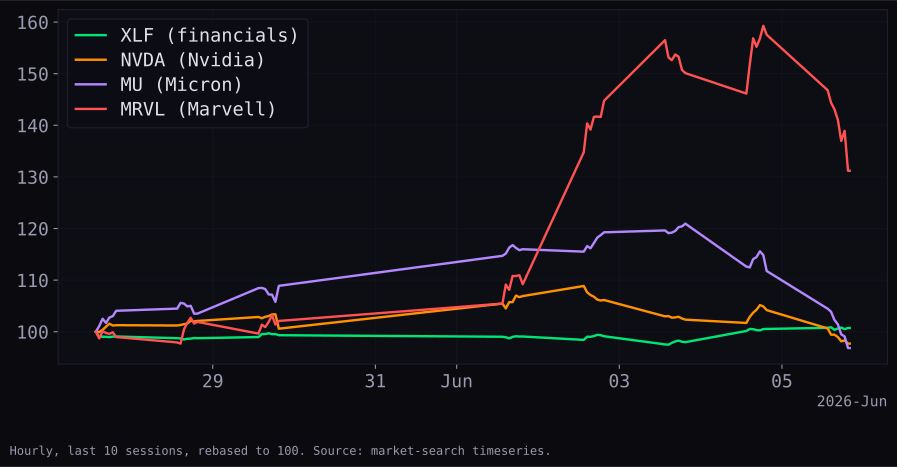
Hourly, rebased to 100. The hot jobs print sent rates up, and the most rate-sensitive names in the market fell hardest while financials held.
May payrolls printed 172,000 against an 80,000 forecast, the 2-year yield spiked to a multi-year high, and Fed hike odds jumped to 52%. The longest-duration trade in the market broke: Marvell fell 16.7%, Micron 13.3%, the chip group 9.2%. Good news became bad news.
Hourly, rebased to 100. The hot jobs print sent rates up, and the most rate-sensitive names in the market fell hardest while financials held.
May nonfarm payrolls printed 172,000 against an 80,000 consensus, a 115% beat, with March and April revised up a combined 93,000, unemployment steady at 4.3%, and wages up 3.4% over the year. As one economist put it, the hiring recession is over.
The bond market repriced in minutes. The 2-year yield jumped 11 basis points to 4.16%, its highest since February 2025, the 10-year rose to 4.54%, and the 30-year touched 5.01%. A strong labor market with core inflation still at 3.3% removes the case for cuts, and the curve said so before the equity open.
The prediction markets moved further than the curve. Kalshi's probability of a Fed rate hike in 2026 jumped from 25% to 52% intraday and Polymarket matched at 51%, while the odds of any 2026 cut fell to near zero. The conversation flipped from when the Fed eases to whether it tightens.
That puts Chair Warsh's first meeting on June 16 and 17 in the spotlight. With the labor market hot, inflation sticky, and the market pricing a coin flip on a hike, the meeting is a live event. PNC's Gus Faucher framed the Fed's position plainly: with job growth this good, there is no need to support the labor market, and inflation is the problem.
The selling concentrated exactly where a rate shock should land. Marvell fell 16.7%, Micron 13.3%, AMD 10.9%, the chip fund 9.2%, Nvidia 6.2%, and the Nasdaq 100 4.8% against the S&P's 2.6%. AI-capex names carry the longest implied duration in equities, all terminal value, so a higher discount rate hits them first and hardest.
This is the good-news-is-bad-news regime in its purest form. The labor strength that would normally lift cyclicals instead crushed the growth trade, because the only variable that matters right now is the rate that discounts it.
Marvell's 16.7% was the sharpest in the chip group, and it fell the day after rising 4.9%. The setup was the trap. Broadcom's Wednesday guide and the Macquarie downgrade over Google diversifying its custom-chip supply had already put the custom-silicon names on watch, and a stock that had run into the jobs print on the second-source thesis had no cushion when the rate shock hit. CFRA called the broader move a very high bar cleared imperfectly.
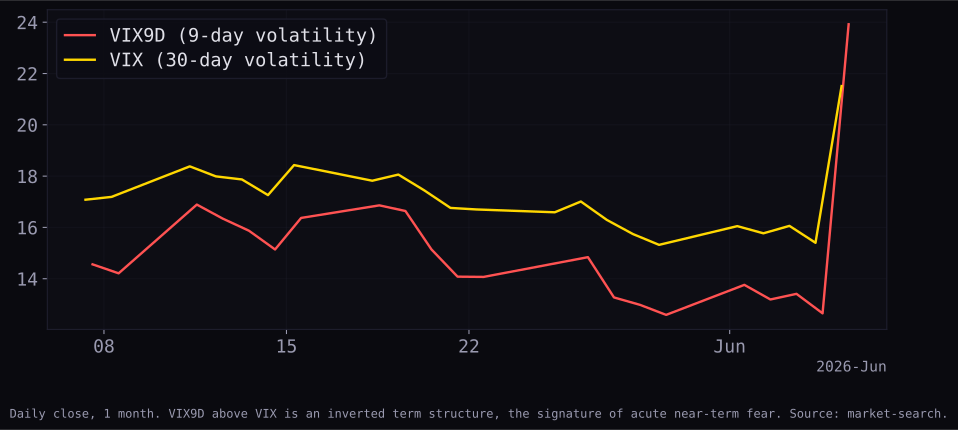
Daily. The 9-day VIX rose above the 30-day, an inverted term structure that marks acute, immediate fear rather than a slow grind.
The VIX9D rose 89% to 23.92 while the VIX rose 40% to 21.51 and the 3-month measure rose only 14%. The 9-day reading closing above the 30-day inverts the term structure, the signature of fear priced as immediate rather than gradual, and the market treating this as a regime print, not a dip.
The mechanics amplified it. Dealers were positioned short gamma into the break, which forces them to sell into weakness, and systematic vol-control and trend funds cut equity exposure as realized volatility jumped. The 16% move in Marvell and the 13% in Micron are not fundamental reactions; they are what forced deleveraging looks like in the most crowded names.
The tell that this was deleveraging, not rotation, is that almost nothing worked. Gold fell 2.7%, oil 3%, long bonds 0.5%, and small caps 3.6%, all lower together as the dollar rose 0.7%. When stocks, bonds, and gold sell at once, the driver is positions being reduced across the board, not capital moving from one place to another.
The only green on the board was the part of the market that wants higher rates. Financials rose 0.2% and regional banks 0.3%, since a steeper curve and no cuts widen net interest margins, and the lower-duration mega-caps held up best, with Alphabet down 1% and Apple 1.3% against the chip group's collapse. The dispersion is the whole story in one line: the more terminal value a name carried, the more it fell.