Broadcom Crashed, the Rest of the Chip Trade Did Not
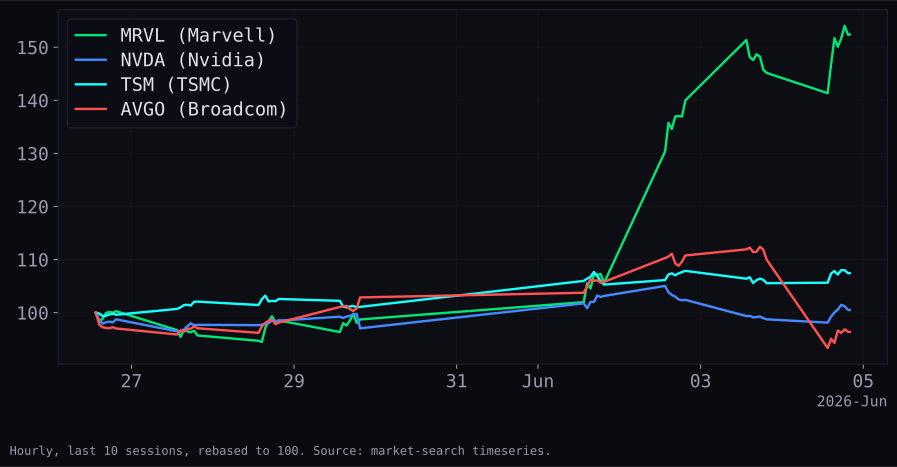
Hourly, rebased to 100. Broadcom drops alone; Marvell climbs and Nvidia and TSMC hold, the mark of a single-name repricing.
Broadcom fell 12.6% on a guide it did not raise and a downgrade over Google diversifying its chip supply. But Marvell rose 4.9%, Nvidia and TSMC held, and the money rotated into a Dow record. This was the market re-sorting who wins in AI, not rejecting it.
Hourly, rebased to 100. Broadcom drops alone; Marvell climbs and Nvidia and TSMC hold, the mark of a single-name repricing.
Broadcom fell 12.6% to 418.91 on 74.7 million shares, more than twice the prior day's volume, after gapping down 14% at the open. The quarter was fine: adjusted EPS of 2.44 beat, revenue of 22.19 billion was a touch light, and AI chip revenue more than doubled to 10.8 billion.
The guide was the problem. Broadcom guided next-quarter AI revenue to 16 billion against a whisper near 17.2 billion, and chief executive Hock Tan reiterated rather than raised the fiscal 2027 target of more than 100 billion in AI chips. The stock had run 10.6% in the five sessions into the print and was priced for an acceleration, not a reaffirmation. Options had priced a 9% move; the realized 12.6% drop cleared the leveraged longs that built into the run.
Macquarie cut Broadcom to neutral and its target to 437 from 513, on a specific structural worry: Google is diversifying its custom-chip supply toward MediaTek and its own internal capability, ending Broadcom's position as Google's sole ASIC partner, with "meaningful market-share decline in 2027 and 2028." That is the difference between a missed quarter and a re-rating.
The timing compounds it. Anthropic's larger custom-chip program, roughly 3.5 gigawatts of capacity, does not begin until 2027, so the AI-revenue acceleration has a gap year in 2026, and the 100-billion target now leans on the back half of the decade. A name priced near 30 times forward revenue needed the moat to widen, and it heard the opposite.
Marvell rose 4.9% to 316.43 on the same session, the clearest tell of the day. If Google is taking its ASIC business to more suppliers, the second source wins what the first loses, and the money moved straight across, helped by Nvidia chief Jensen Huang naming Marvell the next trillion-dollar company at Computex two days earlier. The day repriced who captures the custom-silicon cycle, not whether the cycle is real.
Nvidia rose 1.8% to 218.66 and TSMC 1.9%, the two names with no single-customer concentration risk, while Micron fell 7.7% below a trillion and AMD 3.6% on read-through alone, with no news of their own. The semiconductor fund lost just 1.9%, almost all of it Broadcom's weight. CFRA called it a high bar cleared imperfectly, and Jefferies, Deutsche Bank and Wells Fargo all raised targets into the drop, framing it as a catalyst gap rather than a demand collapse.
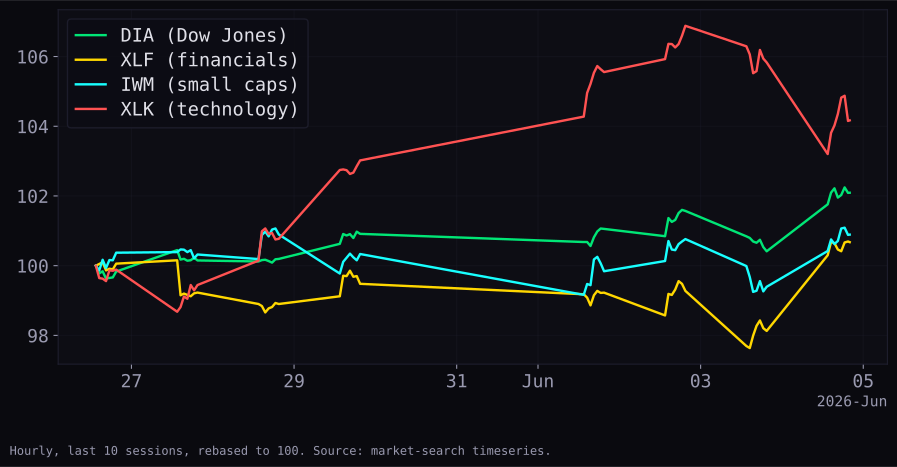
Hourly, rebased to 100. On June 4 the Dow, financials and small caps rose while technology fell, the broadening the bulls have wanted.
The Dow rose 1.7% to a record close near 51,561, up about 875 points, even as the Nasdaq 100 slipped 0.5%. UnitedHealth led on upgrades from Bank of America to buy with a 450 target and Morgan Stanley to 453, both citing improving medical-cost trends, and financials added 2.6% with small caps up 1.5%. The capital that left the crowded AI-semis names did not leave the market; it rotated into everything the AI trade had starved.
The rotation had a macro tailwind. Goldman Sachs pushed its first Fed cut to December 2026 on persistent inflation, and some strategists are floating a July hike under the incoming Warsh Fed to satisfy bond markets. The ten-year held at 4.48%. Higher-for-longer rates favor banks and value over the most long-duration trade in the market, and the tape on June 4 paid exactly that way.
Ciena reported before the bell with revenue of 1.57 billion, up 40%, EPS of 1.64 against 1.49 expected, backlog up 600 million to 7.7 billion, and a raised full-year guide, and the optical-networking names held while the custom-ASIC names fell. The split inside AI hardware was precise: the parts whose demand is broad-based held, the part with single-customer concentration cracked.
Bitcoin is down 14% on the week and 21% over four, its sharpest drawdown of 2026, with 3.97 billion in spot-ETF outflows over twelve sessions and Strategy making its first sale since 2022. The speculative end of the risk complex sold with the crowded AI trade, and even Michael Saylor called the move an AI rotation. The same de-risking that hit Broadcom's longs hit the highest-beta asset on the board.