Nvidia Got Massive, and the Field Is Catching Up
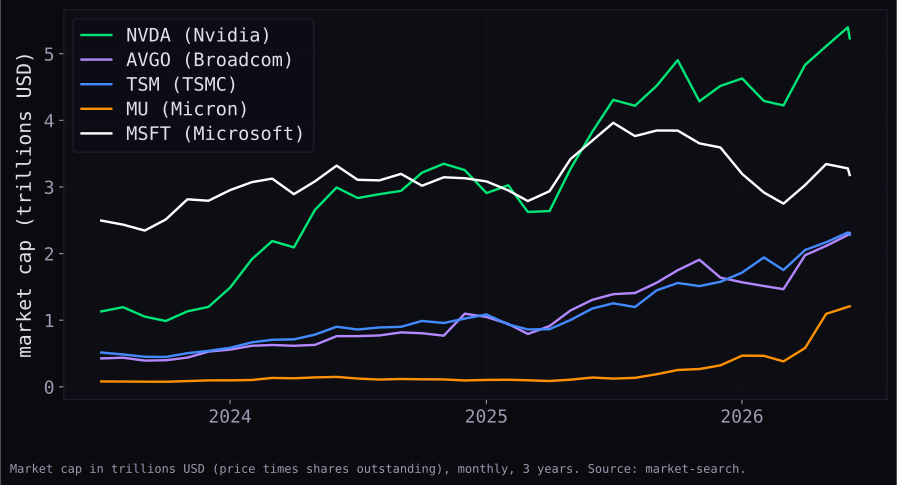
Market cap in trillions, three years. Nvidia added 4.1 trillion, a quarter of this group's gains; the recent steepening below it is the catchup.
The AI bottleneck moves on a schedule: chips in 2026, the grid in 2027, power in 2028. The market paid any price for the first and sold the last.
Market cap in trillions, three years. Nvidia added 4.1 trillion, a quarter of this group's gains; the recent steepening below it is the catchup.
The four largest builders carry 746 billion dollars of leases not yet commenced, and Alphabet guides 2026 capex to 180 to 190 billion with 2027 set "significantly" higher. The spending is take-or-pay and signed, not a forecast that revises away.
So the question is not whether the build happens. It is what you physically cannot get, and when. Read the dollars, not the percentages: Nvidia added 4.1 trillion of market value in three years while cooling to +41% this past year, and the parts beneath it went vertical, Micron +763%, Broadcom and TSMC catching up on scale. When the field reaches the leader, the leader has usually stopped leading.
The visible constraint is packaging. TSMC's CoWoS runs near 130,000 wafers a month by year-end, up from 13,000 in 2023, still fully booked, and Blackwell lead times sit at 36 to 104 weeks. HBM is allocated through 2027.
The constraints nobody charts are tighter. Helium is in open crisis: Qatar's Ras Laffan, a third of world supply, has been offline since March 2, spot is above 600 dollars, and TSMC's buffer runs out around September. One substrate input, T-glass, is 90% a single Japanese supplier into a 40% gap. And Nvidia's purchase agreements have locked the 200-gigabit lasers for next-generation optics through 2027, foreclosing every rival transceiver maker. The prediction: the chip-scarcity premium holds through Q1 2027, not the year-end easing TSMC guides.
The constraint then moves from the rack to the substation. A large power transformer takes 128 to 160 weeks, the new US factories do not ship until 2028, and on April 20 the White House invoked the Defense Production Act to call domestic capacity "dangerously limited."
The grid itself runs out first. PJM's own forecast puts it below its reliability standard before June 2027, and ERCOT has 410 gigawatts of mostly-data-center load queued against a system that peaks under 90 and energized 2.2 in the past year. Of the 21.5 gigawatts of US capacity with 2027 open dates, the lead times say fewer than 10 actually energize.
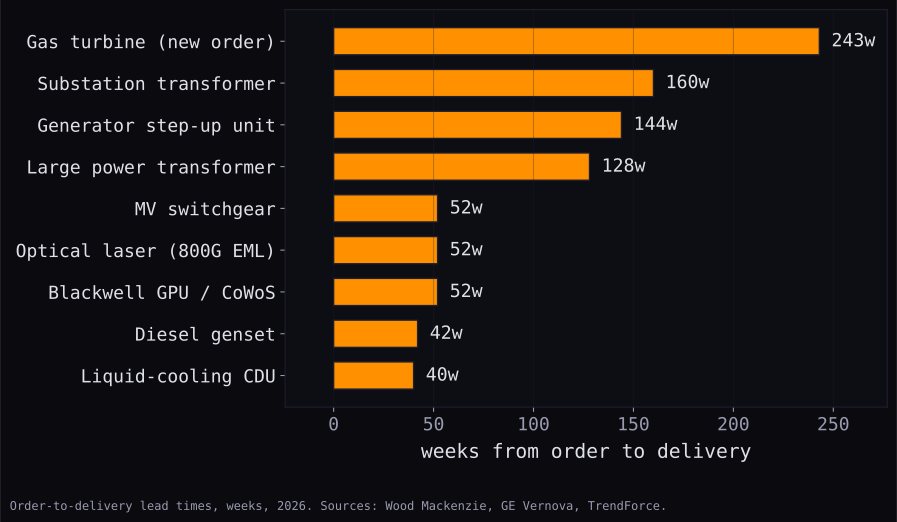
Weeks from order to delivery, 2026. The grid and generation gear run two to five times the lead time of the chips the market obsesses over.
Generation is the last and longest. A gas turbine ordered today reaches commercial operation around 2031, GE Vernova has roughly 10 gigawatts of slots left before 2030 against a 100-gigawatt backlog, and new gas plants do not come online before 2031 to 2033. Power, not silicon, is the 2028 bottleneck.
And the memory cycle turns underneath it, but not the way the bulls think. Four fabs land in 2028, Micron Idaho, SK Hynix Yongin, Samsung P5 and Micron Japan, tipping conventional DRAM and NAND toward glut. Yet HBM stays tight: its market grows from 35 billion to 168 billion by 2028 as HBM4 uses four times the wafer per bit. The split is the trade. Commodity memory floods while high-bandwidth memory holds, and the names priced for permanent 80% margins are levered to the half that breaks.
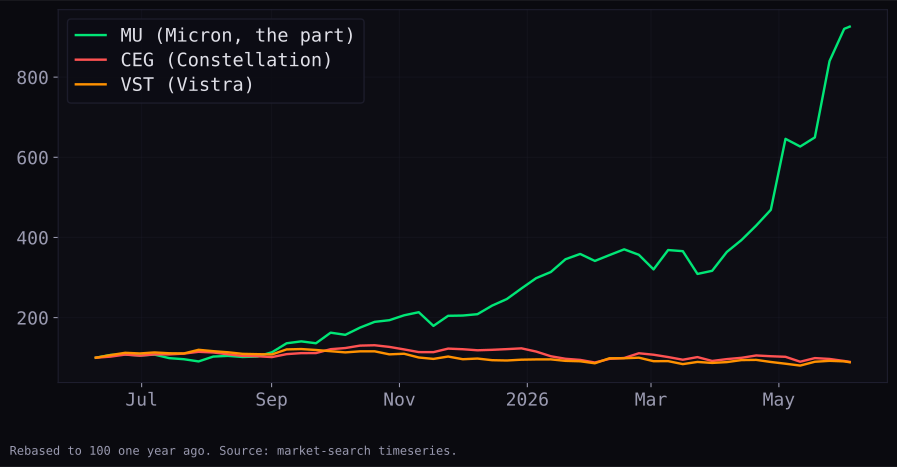
Rebased to 100 one year ago. The market bid the part the build needs now and sold the power it needs in 2028.
Policy moves these dates more than any earnings call. Nvidia's China revenue is now zero, and it remits 15% of H200 sales to the US Treasury, an unprecedented royalty. The Commerce semiconductor review due July 1 can reset tariffs and caps in a single stroke, the Q3 wildcard.
China cannot yet train a frontier model on its own silicon, DeepSeek's latest run failed on Huawei Ascend hardware, so the US compute premium holds for now. But Huawei takes more than 65% of China's domestic chip deployments this year, and Beijing is likely to re-impose gallium and germanium controls when the suspension lapses on November 27. The premium is dated, not permanent.
OpenAI and Anthropic lose tens of billions a year, and the disclosure will be read as proof the AI economy does not work. The reading is backwards.
Capability is not free; it is produced by spending real compute, energy and capital, and the loss is the exchange for it. The version that should frighten the market is the opposite one, where capability arrives with no spend, because that means no cost, no scarcity and no moat. The bill is what makes the capability ownable. The losses are the cost of the only product that matters; the only risk is the week the market calls the spend waste, which is sentiment, not economics, and the spark that lights the fuse the calendar already laid.
2026 belongs to the chip. TSMC makes every accelerator and owns the CoWoS packaging that is the real chokepoint, sold out through 2027, and it trades at 28 times forward earnings, below its own customers AMD at 73 and Marvell at 75. Nvidia at 24 times against 85% revenue growth is the other holder.
2027 belongs to the grid. Eaton, GE Vernova, Vertiv and Quanta carry the transformer, turbine and turnkey-power backlogs the build runs through, with visibility that now stretches to 2031. The discount is gone, though: GE Vernova trades at 63 times forward, Vertiv 51, Quanta 51.
2028 belongs to power. Vistra, Constellation, Talen and NRG are the independent producers that energize the data centers, and they are the cheapest group in the chain, Vistra at 18 times, NRG 15, Constellation 23, after falling 22 to 24% over the past year.
The power producers are the clearest gap, and the filings confirm it rather than imply it. Vistra has signed 20-year contracts for 2,609 megawatts of nuclear to Meta and 1,200 megawatts to Amazon, and its own 8-K and earnings call state that both are excluded from the 6.8-to-7.6-billion 2026 guidance and the 2027 range, a disclosed 700 to 750 million of 2027 EBITDA sitting outside the numbers. Constellation has the same with Microsoft and Meta at Three Mile Island and Clinton, Talen an 18 billion contract with Amazon at Susquehanna that does not reach full revenue until 2032. The group trades at utility multiples, Vistra 18 times forward and NRG 15, with the chain's largest analyst upside, 47% and 51%, after falling 22 to 24% in a year, on revenue that is signed and dated but not yet booked.
TSMC is a toll booth priced like a chipmaker. It collects per wafer whether memory floods or power binds, the one name no outcome breaks, at 28 times against 43 to 75 for the merchant parts the cycle can break.
Micron's cheap multiple is the trap. At 18 times forward it screens as value, but those are peak-cycle earnings, and the analysts who cover it already set their average target 32% below the price. The merchant accelerators carry the same mark: AMD and Marvell at 73 and 75 times with street targets 11% and 26% under the tape.
The pattern is plain. The market has fully paid for the bottleneck it can see, the chip, and is ignoring the two it cannot yet, the grid in 2027 and the power in 2028.
The buyers are wider than the four hyperscalers, and Nvidia is one of them. It does not buy power; it funds the demand that does, gating 100 billion for OpenAI on each gigawatt deployed, backstopping CoreWeave, seeding xAI and Nebius, each chasing several gigawatts by 2030. The neoclouds and the labs are power buyers now in their own right.
And a rising share never touches the grid. xAI runs its Colossus clusters on roughly 900 megawatts of on-site gas turbines, Stargate's Abilene campus on 29 GE Vernova units, Oracle on 2.3 gigawatts of behind-the-meter generation. That demand skips the regulated producers and pays the turbine makers directly, GE Vernova and Caterpillar, sold out and already valued at 63 times. The fork is the whole story: grid contracts flow to the cheap, signed, unbooked nuclear producers, the off-grid build flows to the expensive turbine makers. Both win. Only one is on sale.