Money Went to the Plumbing, Not the Box
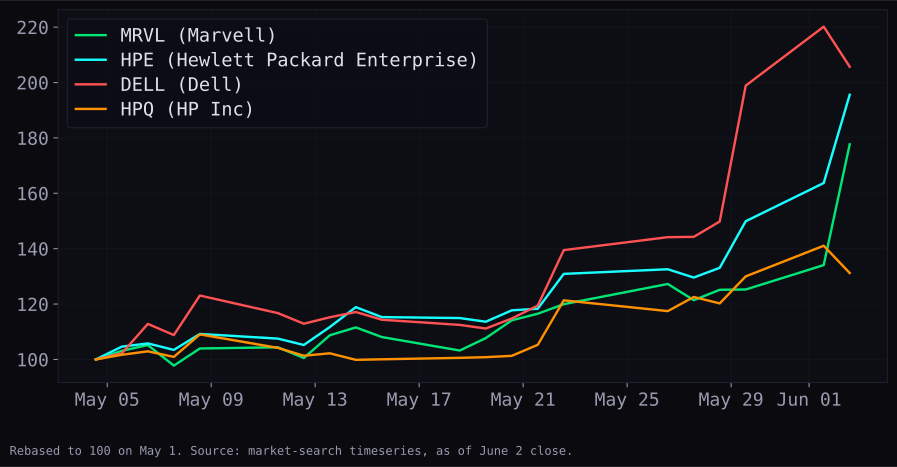
Rebased to 100 on May 1. The AI-infrastructure names go vertical on June 2; the PC-hardware names give back their Monday pop.
HPE jumped 19.5%, its best day ever, on an AI-server blowout. Marvell soared 32.5% on Jensen Huang's trillion-dollar call. The AI-PC trade reversed: Dell 6.6%, HP 7%, Microsoft 4.2%. The S&P closed above 7,600 for the first time.
Rebased to 100 on May 1. The AI-infrastructure names go vertical on June 2; the PC-hardware names give back their Monday pop.
HPE closed up 19.5% at 56.15, the largest one-day gain in the company's history, after fiscal second-quarter revenue of 10.68 billion grew 40% and beat the 9.82 billion consensus, with non-GAAP EPS of 0.79 against a 0.54 estimate.
Networking revenue, the segment carrying the Juniper acquisition, rose 148% to 2.69 billion. The Cloud and AI segment grew 22.9% to 7.71 billion and nearly doubled its operating margin to 12.4%, and HPE entered the quarter with a 5.9 billion AI-systems backlog.
The guide was the bigger move. HPE raised fiscal 2026 non-GAAP EPS guidance to 3.35 to 3.45 from 2.30 to 2.50 and said its fiscal 2028 long-term targets are being reached two years early. Five firms lifted their targets the next morning, with the new average near 64.
Marvell soared 32.5% to 290.79 after Nvidia chief executive Jensen Huang, on stage at Computex in Taipei, called Marvell the next trillion-dollar company. The endorsement put the day's single largest move on a custom-silicon name that designs the connectivity and accelerators inside AI data centers.
The read-through carried the rest of the AI-infrastructure shelf: Broadcom rose 4.7% to 481.57, the semiconductor fund SMH gained 4.0%, and the day's bid went to the companies that build the data center rather than the ones that sell the laptop.
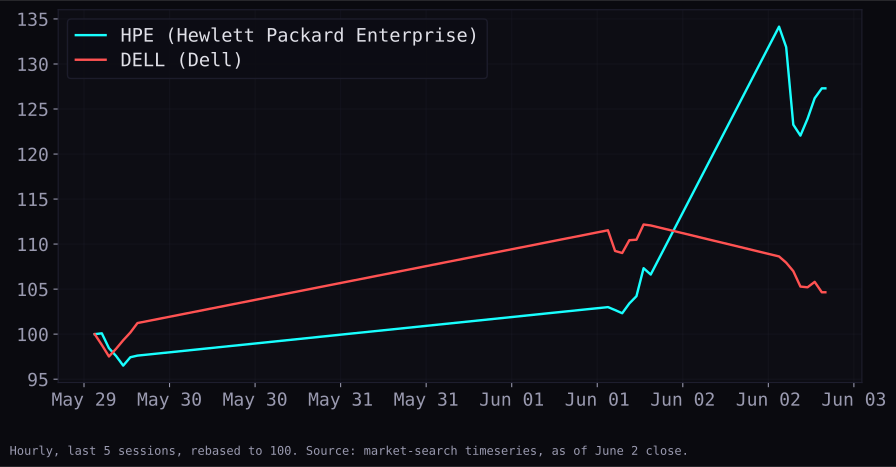
Hourly, rebased to 100. HPE gapped higher on its print; Dell sold from the open with no overnight defense.
Dell fell 6.6% to 435.31 and HP Inc fell 7.0% to 27.29, giving back most of the gain they posted Monday when Nvidia launched its RTX Spark PC chip and both confirmed they would ship it. Dell's decline came entirely after the open, with no overnight gap, the mark of a position being unwound rather than a fresh headline.
Goldman Sachs reiterated a sell on HP Inc late Monday with a 19 target against Monday's 29.55 high, citing PC margin pressure. With HPE taking the day's networking spotlight, the market priced its Juniper edge as share taken from rivals, not a tide lifting the group.
Microsoft dropped 4.2% to 441.31, two-thirds of it a gap before the open, the worst large-cap move on a green day for tech. At its Build conference Microsoft unveiled seven in-house MAI models led by a reasoning model built without OpenAI data.
The market read the launch as the OpenAI partnership loosening rather than a capability win, and sold the most OpenAI-linked mega-cap on a session when the rest of the AI complex rallied. The move was Microsoft-specific: every other trillion-dollar name except Nvidia, flat at 222.82, finished higher.
The S&P 500 closed above 7,600 for the first time, with the fund up 0.1% at 759.57, as Qualcomm rose 5.2% to 240.84, Apple 2.9% to 315.20, and Micron 2.8% above 1,060. The Russell 2000 added 0.9% and the VIX eased to 15.77.
The calm index masked an unusually split tape. Microsoft, Dell, and HP all fell hard inside an index that set a record, and the gap between the AI-infrastructure winners and the AI-PC losers was the widest single-day dispersion in tech since the memory move two weeks earlier.
WTI crude rose 1.7% to 93.76 and Brent 1.1% to 96.00 as optimism over a deal to reopen the Strait of Hormuz faded. Around midday President Trump rejected Iran's counteroffer to end the conflict, dismissing it as garbage and warning the ceasefire was on life support, and the crude bid built through the afternoon.
The move shows in the clock: WTI sat at 91.80 through 15:15 UTC, then stepped to 93.31 by 16:30 UTC while the S&P held flat, oil running on its own catalyst. The WTI curve is now 19.6% backwardated over twelve months, the futures market pricing real near-term scarcity rather than a passing headline.
April job openings jumped to 7.618 million, roughly 738,000 above the 6.88 million consensus and the highest since May 2024, a hot labor print that on its own argues against rate cuts. The vacancy rate rose to 4.6% and quits climbed to 3.05 million.
The ten-year Treasury yield still fell to 4.45%, down six basis points, as an overnight rally absorbed the data, and the market on no change at the June Fed meeting held near 98%. The bond market treated the AI-led equity tape and the oil bid as the day's signal, not the labor surprise.