May in one frame
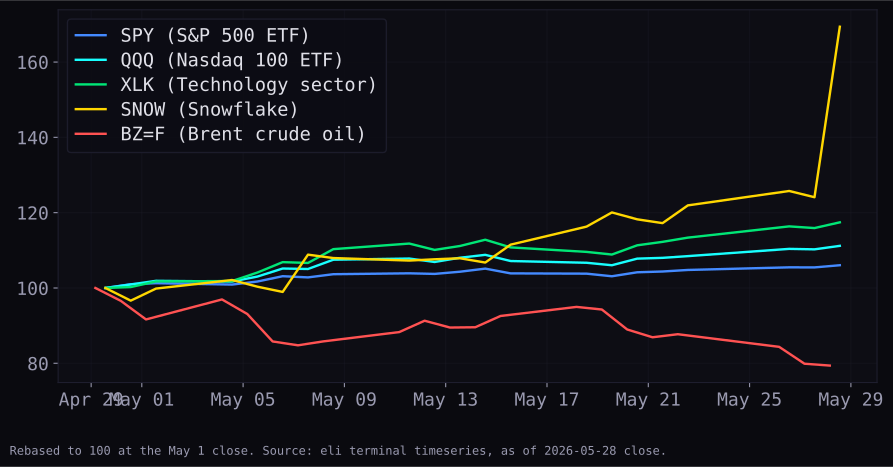
Rebased to 100 at the May 1 close. Software and tech finished the month at their highs while Brent slid.
Records on the close as software led: Snowflake +36%, the S&P +0.55%, while April PCE ran 3.8% year over year.
Rebased to 100 at the May 1 close. Software and tech finished the month at their highs while Brent slid.
The S&P 500 rose 0.55% to 754.60 on the SPY, the Nasdaq 100 proxy QQQ gained 0.84% to 735.60, and both finished at the top of their month, each within a fraction of fresh highs. The Russell 2000 proxy IWM added 0.57% and the Dow proxy DIA was flat at +0.03%.
The advance came hours after the April PCE price index, the Federal Reserve's preferred inflation gauge, printed 3.8% year over year at 8:30 a.m. ET, up from 3.5% in March and the hottest reading in nearly three years. The second estimate of first-quarter GDP was revised to a 1.6% annual rate, down from the 2.0% advance estimate.
Volatility fell rather than rose into the data: the VIX dropped 3.4% to 15.74, its lowest close of the month, and the 10-year Treasury yield eased 6 basis points to 4.45%. A hot inflation number and a softer growth number landed together, and the tape took the growth signal.
Snowflake closed up 36.5% at 239.20, the single largest move on the board, after reporting first-quarter revenue of $1.39 billion and adjusted earnings of 39 cents a share late on May 27, against Street estimates near $1.32 billion and 32 cents. The stock opened May 28 at roughly 236.55, gapping straight up from its 175 close the prior session.
Management framed AI as a current revenue driver rather than a future one, citing accelerating platform consumption. The reaction split the software group: Salesforce slipped 0.8% to 176.17 after guiding current-quarter revenue to a range whose midpoint sat below consensus, and Marvell ended 3.1% higher at 204.83 after a narrower beat.
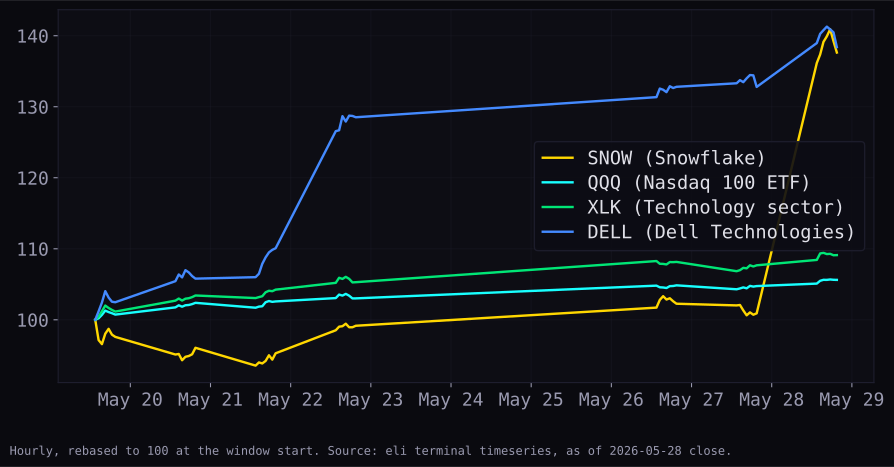
Hourly, rebased to 100 at the window start. Snowflake gapped at the open; the index moves alongside it are an order of magnitude smaller.
Dell reported fiscal first-quarter revenue of $43.8 billion, up 88% year over year, with non-GAAP earnings of $4.86 a share, in an 8-K accepted at 4:15 p.m. ET, after the regular close. AI-optimized server revenue reached $16.1 billion, up 757% from a year earlier, and the company booked $24.4 billion in AI orders during the quarter.
Dell raised full-year fiscal 2027 revenue guidance to about $167 billion at the midpoint, up from a prior outlook near $140 billion, and lifted its full-year AI-server revenue expectation to roughly $60 billion. The Infrastructure Solutions Group reported $29.0 billion in revenue, up 181%.
Group gross margin was 17.8% of revenue, down from 21.1% a year earlier, as the lower-margin AI-server mix grew. Dell shares had risen 3.8% to 317.05 in the regular session before the release; the after-hours reaction to the print falls into the next trading day.
Brent crude settled near 93.71, down 0.6% on the day and down about 9.5% across the prior week, while WTI held near 88.90. The energy sector ETF XLE was roughly flat at 56.95 after a 4.3% weekly decline.
The prediction-market read on Iran swung through the week. The market on a US-Iran permanent peace deal by June 30 reached 76% on May 24, then fell to 46% by May 28 after the White House on May 27 called a memorandum reported by Iranian state media a fabrication. The companion market on a US-Iran nuclear deal by June 30 peaked at 48% on May 27 and eased to 34% on May 28.
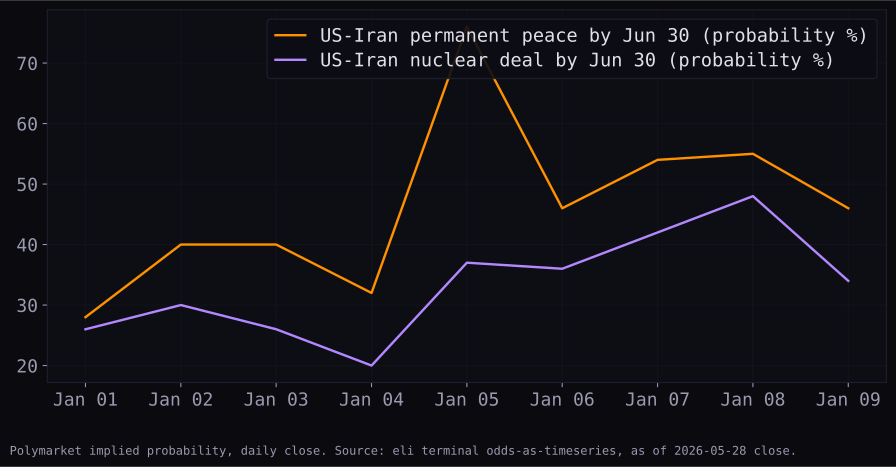
Polymarket implied probability, daily, May 20 to May 28. Both deal markets spiked mid-week, then faded after the May 27 fabrication denial.
Costco reported fiscal third-quarter net sales of $69.15 billion, up 11.6% year over year, with diluted earnings of $4.93 a share against a Street estimate near $4.92. Comparable sales rose 9.8%, or 6.6% excluding gasoline and currency effects, and digital comparable sales rose 21.5%.
The stock closed 0.9% lower at 995.20, slipping below 1,000 even with the headline beat, as revenue of $69.15 billion came in under the consensus near $69.64 billion. Costco entered the session near the bottom of its monthly range.
The Nasdaq 100 proxy finished the month up about 9.1% from the May 1 close, with the technology sector ETF XLK up roughly 15.4% over the same stretch, while Brent fell about 13.6% from its mid-May high. The records on May 28 sat on software and semiconductors, not on a broad market: AMD rose 4.6% and the semiconductor ETF SMH gained 0.7%, while financials and energy lagged.
The 10-year yield at 4.45% closed the month at its low even after the 3.8% PCE print, and the VIX at 15.74 closed near its low. Whether that pricing holds depends on how the next inflation reading and the Dell and Snowflake follow-through land in the sessions after the close.