Memory Ran While the Index Leader Stalled
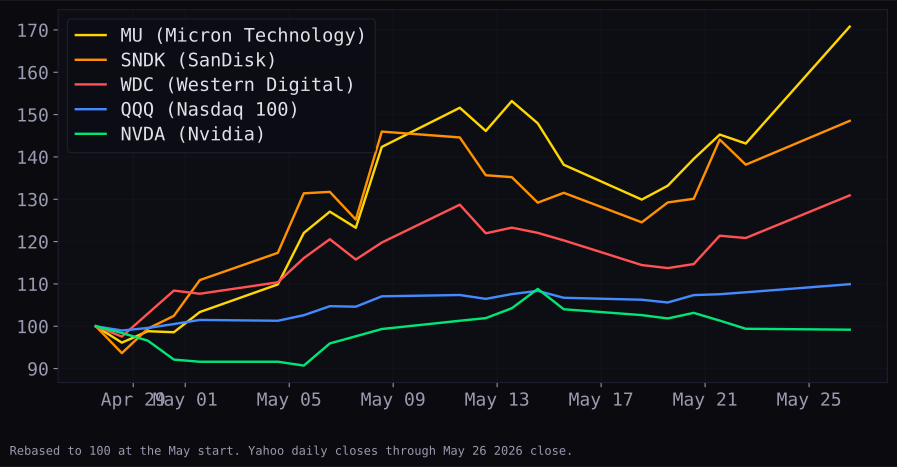
Rebased to 100 at the May start. Micron, SanDisk and Western Digital separated from the Nasdaq 100, while Nvidia drifted lower over the same stretch.
A memory upgrade carried the Nasdaq to a record while energy and oil sank: Micron +19.3% to a trillion-dollar cap, the Nasdaq +1.19%, Brent −3.8%.
Rebased to 100 at the May start. Micron, SanDisk and Western Digital separated from the Nasdaq 100, while Nvidia drifted lower over the same stretch.
Micron closed up 19.3% at 895.88, lifting its market value above a trillion dollars for the first time, after UBS tripled its price target to 1,625 from 535. The hourly tape shows the stock gapping from a Friday close near 751 to a 9:30 a.m. ET open around 820, then grinding to roughly 910 by early afternoon before settling.
UBS framed the move around supply rather than a single quarter: its note said Micron's 2026 high-bandwidth memory capacity is sold out under long-term agreements with partially fixed pricing, and that DRAM prices have risen 58% to 63%. The 1,625 target implies a value near 1.8 trillion, three times the prior 535 mark.
Three other memory and storage names ran double digits: Western Digital closed up 8.3% at 524.65, SanDisk up 7.5% at 1589.55, and Advanced Micro Devices up 7.8% at 503.89. Qualcomm rose 4.5% to 248.82, and Taiwan Semiconductor added 1.9% to 412.32.
The move was concentrated in memory and storage, not the broader chip group. The tech sector fund XLK rose 4.5% on the session, more than three times the S&P 500's 0.61% gain, and the gap traces back to the same DRAM and high-bandwidth memory pricing story UBS cited.
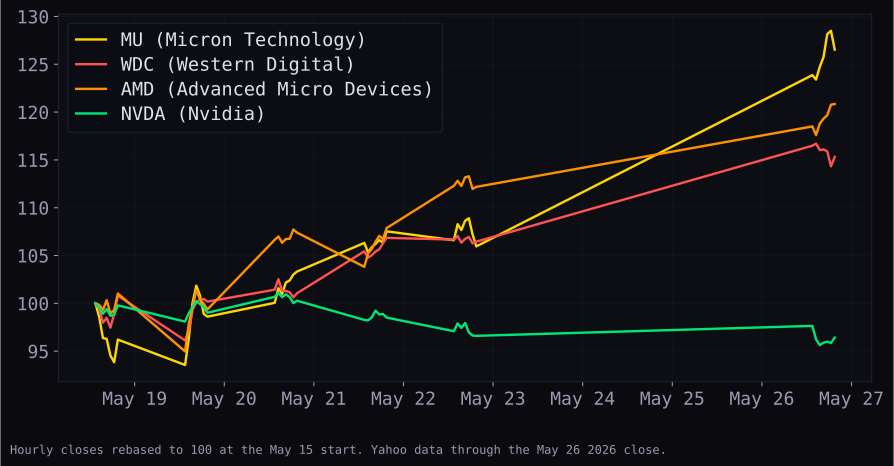
Hourly closes rebased to 100. Micron, Western Digital and AMD gapped up at the May 26 open; Nvidia held flat through the session.
Nvidia closed down 0.2% at 214.86 even as the names it supplies and competes with surged. Over the trailing ten sessions the stock is down 3.6%, against a 26.5% gain for Micron, the widest split inside the AI-hardware complex this month.
At a market value above 5.2 trillion, Nvidia is the heaviest weight in the S&P 500, so its flat session capped the index's gain at 0.61% while the more memory-heavy Nasdaq ran 1.19% to a record close of 26,656.18.
The Dow Jones Industrial Average slipped 0.23% to 50,461.68, the only major index lower on the day. UnitedHealth fell 3.0% to 376.86 and Merck dropped 2.2% to 119.72, and those two healthcare names plus a weak energy group pulled against the tech-led tape.
The energy sector fund XLE fell 2.8% to 57.85, the worst-performing major sector group, tracking a slide in crude. Small caps went the other way, with the Russell 2000 fund IWM up 1.9% to 290.51 as falling yields helped rate-sensitive names.
Brent crude closed down 3.8% at 99.58 and West Texas Intermediate fell 2.8% to 93.89, both gapping lower from Friday after President Trump signaled over the weekend that a deal with Iran to reopen the Strait of Hormuz was close. Brent is now down roughly 19% for May.
The drop held even as the US military conducted self-defense strikes in southern Iran on May 26, targeting vessels allegedly laying mines and missile launch sites. The ten-year Treasury yield eased to 4.49% from 4.56% and the thirty-year to 5.03%, with TLT up 0.5%.
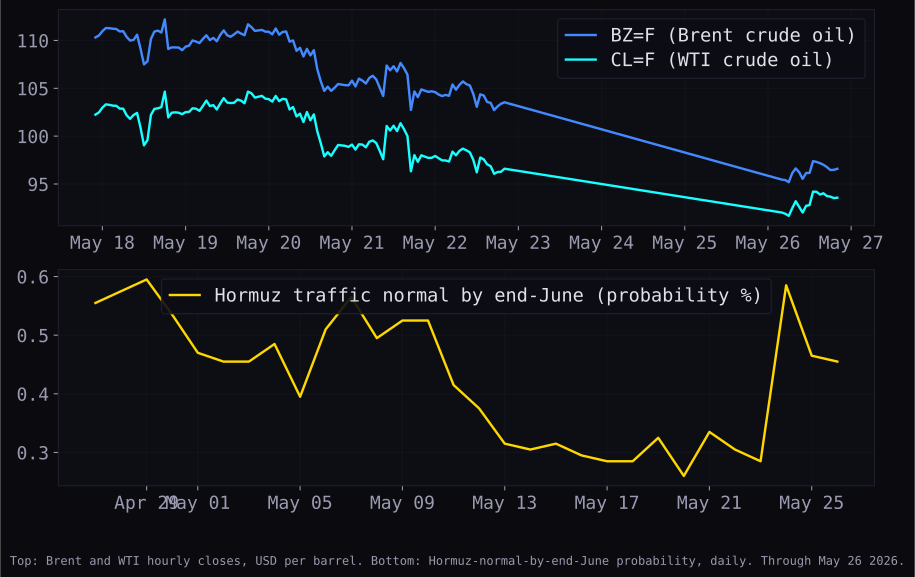
Top: Brent and WTI hourly closes, dollars per barrel. Bottom: the market-implied odds that Hormuz traffic returns to normal by end-June jumped from 29% to 59% around the weekend deal signal, then eased to 46% by May 26.
The market that Hormuz traffic returns to normal by end-June sat at 46% into the close, up from 29% on May 23 but off the 59% spike that followed the weekend deal signal. A deeper market that the strait normalizes only by year-end held near 74%, a reminder that traders expect reopening to take months even with a deal.
The contract on a new US-Iran agreement or ceasefire extension by June 30 traded near 81%, while the narrower market on Iran surrendering its enriched uranium stockpile sat at just 21%. On the rate side, the market on no change at the June Fed meeting held at 98%, leaving the day's bond rally as a growth-and-oil story rather than a policy one.