Summit air pocket vs the bid that didn't move
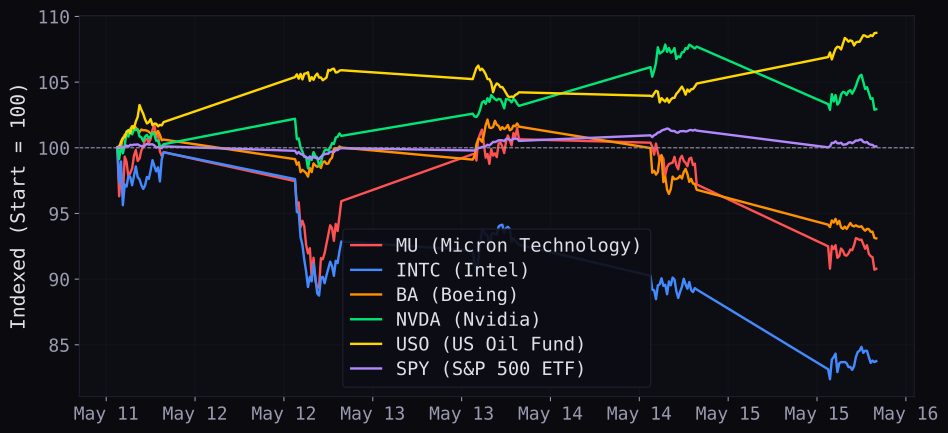
Trump left Beijing after an underwhelming two-day summit. Micron dropped 6.6%, Intel 6.2%, AMD 5.7%. The summit-priced names gave it back. Polymarket repriced the US-China tariff deal probability from 64% to 22%.
Trump departed Beijing Friday after two days with Xi. Both sides claimed progress. Neither produced a tariff cut, a Blackwell approval, a Section 301 exclusion list, or any new market-access concession. The Day 1 deliverables (Boeing 200 jets, NVDA H200 cleared to ten Chinese firms, the "constructive strategic stability" three-year framework) were everything the summit produced. A second meeting was scheduled for fall.
Polymarket priced a US-China tariff agreement by May 31 at 22% by Friday close, down from 64% Thursday. A 42-point drop in 24 hours. The probability that the China import tariff falls below 10% by July 1 sits at under 12%. The current 47% rate, lowered from 57% at the October Busan meeting, is the new equilibrium.
MU closed at $724.66, down 6.6% on the day. The stock has now lost $94 from Monday's peak of $818, a 11.5% drawdown in four sessions. INTC closed at $108.77, down 6.2%. AMD closed at $424.10, down 5.7%. NVDA closed at $225.32, down 4.4%, giving back the H200-approval rally that ran Thursday morning.
BA closed at $220.49, down 3.8% for a second consecutive session. The two-day decline since the 200-jet announcement runs 8.5%. The pattern is the classical sell-the-news air pocket that holds across every priced-in deliverable from the summit.
Intel's Q1 2026 10-Q mentions "foundry" 246 times and "China" 35 times. The rally that took INTC from $63 in April to $132 last week was a foundry-revival trade, not a summit-leverage trade. Intel Foundry Q1 2026 revenue ran $5.42 billion, up 16% year over year, against $7.86 billion of cost of sales and operating expenses. That is an operating loss of roughly $2.4 billion, which the market priced as future operating leverage as the foundry scales. Apple is mentioned 5 times in the filing. The rumored Apple foundry deal that has fueled the rally has not appeared in formal disclosure. CHIPS Act funding (34 mentions) is the disclosed catalyst. Lip-Bu Tan as new CEO is mentioned 11 times.
Today's 6.2% drop is the air-pocket layer of that rally unwinding. The foundry catalyst stack is intact. The summit-leverage layer that the market had assumed was real is not. The stock is back at $108.77, off the $132 peak.
LVS closed at $51.16, up 1.0% on the day but down 10.0% over the past month. WYNN at $95.42, flat on the day, down 10.7% over the past month. The casino segment got nothing from the summit. The Macau concession is not the variable.
LVS's 10-K confirms the operating concession runs through December 2032, locked in the December 2022 renewal. That is six and a half more years of operating rights. The 10-K also discloses that all Gaming Assets revert to the Macao government without compensation at concession expiry. That is the terminal-value liability the equity is pricing. Not concession renewal risk. Not summit risk. The 2032 reversion clock plus the $19.3 billion non-gaming investment commitment the operators agreed to in 2022 is the structural drag.
The hidden positive in WYNN's filing: Wynn Palace casino revenue Q1 2026 ran $564.9 million, up 27% year over year from $444.5 million Q1 2025. Macao gaming revenue is recovering. The stock is not pricing that recovery. Macau is 71% of WYNN's casino revenue, and Wynn Palace alone is half of WYNN's casino segment. A 27% growth print at the largest single property is asymmetric to the equity's negative trajectory.
USO closed at $148.23, up 3.7% on the day. XLE at $59.44, up 2.4%. WTI futures closed at $105.66, up 4.4%. Brent at $109.24, up 3.3%. The summit produced vague language about China buying more US energy. The summit also did not close the Iran situation; the Strait of Hormuz remains effectively choked through summer per Polymarket pricing. The energy bid Friday is residual Iran risk plus the rare-earth and energy purchase commitments China is reportedly considering.
Physical Mars Gulf Coast crude pulled back to $116.98, down 3.5% after a multi-week run. Murban at $107.82, up 3.0%. The physical grade dispersion is narrowing as front-month futures catch up.
TLT closed at $83.66, down 1.5% on the day. The bond market continued to back away from the rate-cut path. Tuesday's CPI at 3.8% and Wednesday's PPI at 6.0% had already broken the range; Friday's continuation of TLT weakness confirms higher-for-longer. Polymarket prices a 2% probability of a June FOMC rate cut and 69% probability of no Fed rate cuts at all in 2026.
LMT closed at $516.01, down 0.5%. NOC at $540.69, down 1.6%. RTX at $171.18, down 2.2%. The Taiwan arms decision was the single summit lever Trump did not pull. Trump stated he had not made a decision on whether to proceed. That decision remains the outstanding catalyst for defense names that have run modestly over the week.
Monday: Trump rejected Iran's response over the weekend, the S&P closed flat at +0.1%, memory ran. Tuesday: April CPI printed hot at 3.8% YoY, chips gave back, defense finally caught a bid. Wednesday: PPI printed 6.0% YoY (the hottest since December 2022), memory bounced, bonds kept bleeding. Thursday: Day 1 of the Trump-Xi summit, NVDA got H200 approval and rallied, Boeing got the 200-jet order and sold the news. Friday: summit ended underwhelming, the priced-in names air-pocketed across the board.
Five trading days, two hot inflation prints, one summit that produced atmospherics. The bond market priced higher-for-longer in steps; the equity market priced the summit in advance and gave it back when nothing surprised in. The names that ran the most are the names that gave the most back today.
Next week brings April Retail Sales follow-through, Empire State Manufacturing, Existing Home Sales, and the Philly Fed survey. Walmart and Cisco follow-up commentary from earnings calls last week. AMAT reported after close Thursday and tomorrow morning's pre-market reaction will set the equipment tape for the new week. The fall Trump-Xi meeting is the next negotiation window.