AMD, Intel and the S&P, one week
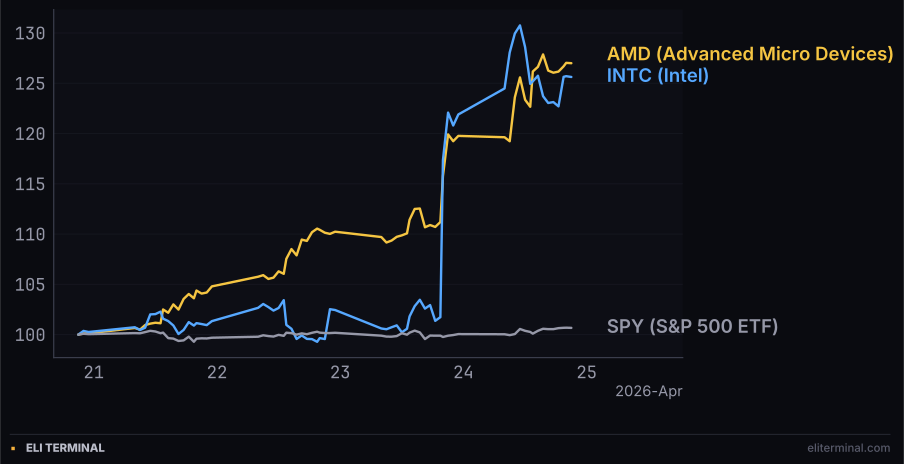
One earnings report, two stocks, one of which didn't report anything.
AMD closed up 13.91% Friday on no news of its own, riding Intel's Thursday beat to the chip index's 18th straight winning session, while Procter & Gamble gave back most of a premarket pop by the bell.
One earnings report, two stocks, one of which didn't report anything.
"AMD shares soared more than 12% on no company news," CNBC's own headline read Friday, stating outright what usually stays implicit. AMD closed at 347.81, up 13.91% from Thursday's 305.33. The company filed nothing, said nothing, and reported nothing between the two closes.
D.A. Davidson's Gil Luria supplied the actual catalyst. He upgraded AMD to Buy from Neutral Friday, raised his price target 70% to 375 from 220, and lifted his 2026 revenue estimate for AMD by 2 billion dollars and his gross profit estimate by 1.5 billion, putting both above AMD's own guidance. The new target rests on 32 times his 2027 earnings estimate for the company.
Intel reported first-quarter results Thursday afternoon, right at the close: revenue of 13.6 billion dollars against a Wall Street estimate of 12.42 billion, and adjusted earnings per share of 0.29 against an expected 0.01. Data center revenue climbed 22% to 5.1 billion, and AI-related businesses, now 60% of Intel's revenue, grew 40% year over year. Intel shares jumped 20% in after-hours trading within the hour.
AMD gapped up in sympathy before Friday's open even arrived, opening the regular session at 336.76, already 10.3% above Thursday's 305.33 close, before climbing to an intraday high of 352.99 and settling at 347.81. Luria's note, published Friday morning, called Intel's results "a precursor for a huge step-up for AMD's CPU franchise," pointing to a shift toward agentic AI workloads pulling demand back into server CPUs.
Intel opened Friday's regular session at 82.13, already up 22.9% from Thursday's 66.78 close. The stock spent the entire cash session chopping between 79.62 and 85.22, and closed at 82.54, up just 0.5% from its own opening print. Whatever the market had to say about Intel's quarter, it said before 9:30am Eastern.
The Philadelphia Semiconductor Index closed higher for an 18th consecutive session Friday, the longest winning streak in the index's 32-year history. The prior record, 15 sessions, ran from May into June of 2014 and produced about an 8% gain. This one has produced far more: SOXX, the tracking ETF, closed at 461.60, up 4.67% Friday alone and roughly 40% since late March.
The streak's origin sits weeks before Friday. Chip stocks were the hardest-hit corner of the market when the U.S.-Iran conflict shut parts of the Strait of Hormuz and pushed oil above 100 dollars a barrel in early April; when a ceasefire took hold April 7 and oil fell back under 90, semiconductors snapped back the hardest of anything that had sold off. Intel's beat Thursday extended a rally that already carried five weeks of momentum.
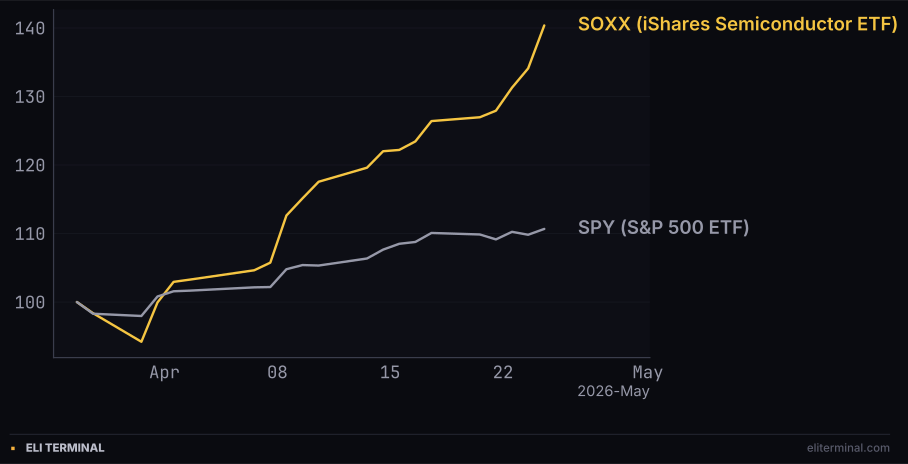
SOXX outran the S&P by four to one over the month, and Friday was its single steepest day.
Procter & Gamble reported fiscal third-quarter results before Friday's open: net sales of 21.2 billion dollars, up 7%, and diluted earnings per share of 1.63, up 6%, helped by a gain from dissolving the Glad joint venture. The stock gapped from Thursday's 145.71 close to a premarket high of 152.42, a jump of more than 4.6%, inside the same half hour the report crossed the wire.
The premarket buyers didn't stay. P&G opened the regular session at 152.01 and sold for the next six and a half hours, closing at 148.18, up just 1.69% on the day and roughly 60% off its own morning high. The company's own guidance carried the likely explanation: a 500 million dollar pretax tariff headwind for the year and a new 150 million dollar after-tax charge tied to Middle East conflict costs, both pulling full-year earnings toward the low end of P&G's range.
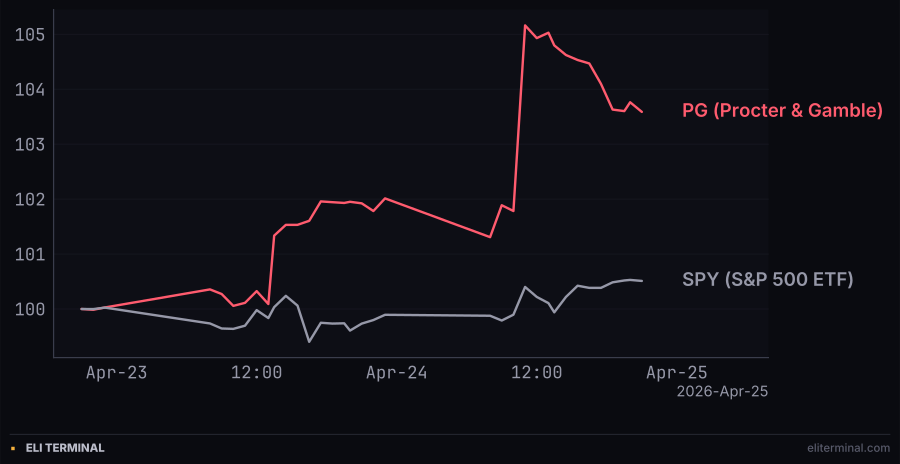
The premarket bought the beat. The regular session sold the guidance.
U.S. Attorney Jeanine Pirro announced at 10:16am Eastern Friday that her office was closing its criminal investigation into the Federal Reserve's headquarters renovation and Chair Jerome Powell, handing the matter to the Fed's own inspector general instead. "I have directed my office to close our investigation," Pirro wrote, adding she would "not hesitate to restart" it if warranted. The move was reported as removing the objection Senator Thom Tillis had cited for withholding support on Kevin Warsh's nomination to succeed Powell, whose term as chair runs out in mid-May.
The bank-heavy XLF gave no sign of noticing. Its half hour immediately after Pirro's statement opened at 51.50 and closed at 51.47, and the sector fund finished the full session down 0.73%, the only major sector index lower on a day the S&P 500 and Nasdaq both closed at records. A political story built for a market reaction produced none the tape shows.
One contract moved opposite the headline's implication. The market pricing whether Powell leaves the Fed board entirely by year-end rose to 70.5% Friday from 67.5% Thursday, ticking up the same day the case that had supplied Republican leverage against him closed. Powell's chair term expiring on its own calendar in mid-May may be doing more work in that price than Friday's announcement did.
X-energy, the Amazon-backed developer of small modular reactors, priced its Nasdaq debut at 23 dollars a share Friday, 21% above the top of its marketed range, selling 44.3 million shares to raise just over 1 billion dollars in the largest nuclear-sector IPO on record. The offering was covered 15 times over. Shares opened at 30.11, up 31% from the offer price, under the ticker XE.
Amazon has committed to buy up to 5 gigawatts of X-energy's power by 2039, tying the day's two biggest stories together: investors bid up the chip that trains the models and the reactor that might power the data center holding them, in the same nine-hour session. Nothing about X-energy's Friday pop touches AMD's directly, but both trace back to the same buyer's demand curve.
The Federal Reserve's Open Market Committee meets Tuesday and Wednesday, April 28 and 29, with Powell, still chair, holding a press conference at 2pm Eastern on the 29th. That meeting is the next scheduled test of whether Friday's chip rally and its Washington undercurrent were two separate stories or pieces of the same one.