Brent crude and the S&P, Monday through Wednesday
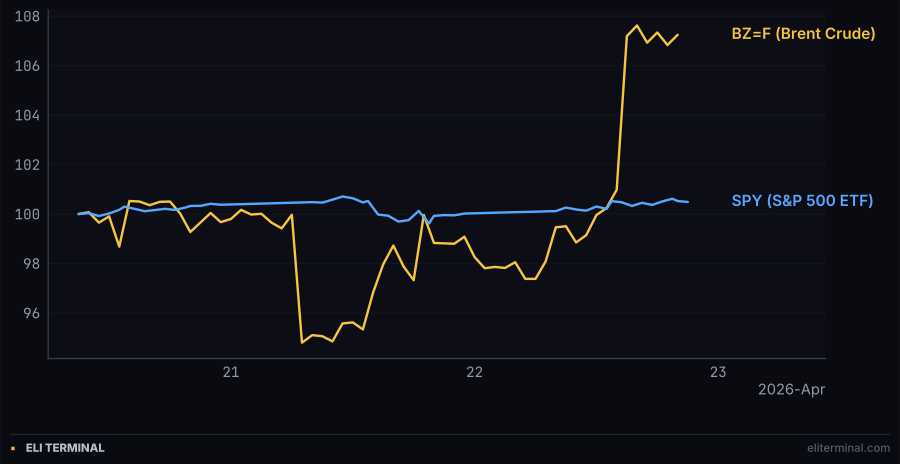
Brent broke away from the S&P inside a single hour Wednesday afternoon and never came back.
The S&P 500 closed at a record, up 1.01%, the same day Iran seized two ships in the Strait of Hormuz and Brent crude jumped 3.5% in a single hour.
Brent broke away from the S&P inside a single hour Wednesday afternoon and never came back.
President Trump posted Tuesday evening that the United States would extend its ceasefire with Iran, reversing a position he had held earlier the same day, until Tehran submits what he called a "unified proposal" from a government he described as "seriously fractured." Trump said the extension came at the request of Pakistan's Field Marshal Asim Munir and Prime Minister Shehbaz Sharif, according to CNBC.
S&P 500 futures carried that relief through Wednesday's open. The index closed at 7,137.90, a record, up 1.05%. The Nasdaq Composite closed at 24,657.57, also a record, up 1.64%. Neither index gave any of that gain back by the bell.
The S&P and Nasdaq have climbed in a fairly straight line over the past month, with the VIX grinding down from the high 70s to the high 60s on a rebased scale over the same stretch. Brent, by contrast, spent that same month chopping in a 90-to-100 band with no direction. Wednesday's break to 108 on a rebased basis was the one clean departure from trend any of the four lines made all month.
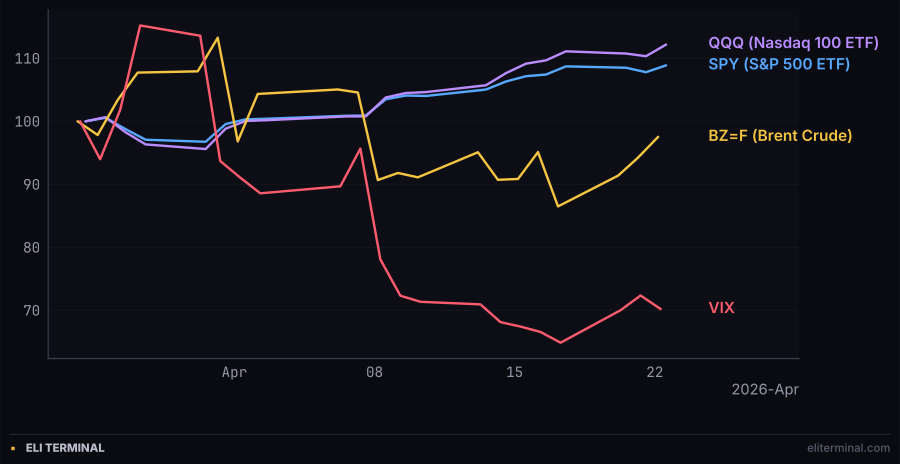
Stocks and volatility moved in a straight line all month. Oil didn't move at all until Wednesday afternoon.
03:55 UTC Wednesday, an Iranian gunboat approached a Liberian-flagged container ship roughly 15 nautical miles off the Omani coast and opened fire, damaging its bridge with no injuries reported. Iran's Revolutionary Guard Corps then seized two additional vessels inside the Strait of Hormuz, telling state media the ships had entered the waterway "without coordination." The IRGC framed both actions as retaliation for what it called a prior American seizure of an Iranian commercial vessel, per the Washington Post and Al Jazeera.
Both incidents landed within hours of the ceasefire extension the equity market had just rallied on. The strait both events occurred in carries roughly a fifth of the world's seaborne oil.
Brent crude sat near 96 through the New York morning Wednesday, then broke violently higher inside the 15:00 to 16:00 UTC hour, trading as high as 102.06 before settling the session at 101.91, up 3.48%. WTI settled at 92.96, up 0.90%. Tanker traffic through the strait stayed light all session, shippers unwilling to test a waterway two of their peers had just been pulled out of, per CNBC.
The S&P 500 did not move in that same hour. Between 14:30 and 15:30 UTC, the index held a tight 709 to 711 band on its way to the closing bell. A ceasefire extension had been enough to send equities to a record twelve hours earlier; an actual seizure of ships in the strait that carries a fifth of the world's oil moved a commodity and nothing else.
Micron closed up 8.5%, the single best day among the index's mega-cap names. AMD rose 6.7%, Taiwan Semiconductor 5.3%, Broadcom 5.1%. The move traced to continued optimism over high-bandwidth memory demand for AI data centers, a story that had been building for weeks and needed no ceasefire to run on Wednesday.
Nvidia, sitting at the center of that same AI buildout, closed up only 1.3%, in line with the broader Nasdaq rather than with its memory-chip peers. The rally concentrated in the names supplying the AI stack's bottleneck component, not the stack's biggest name.
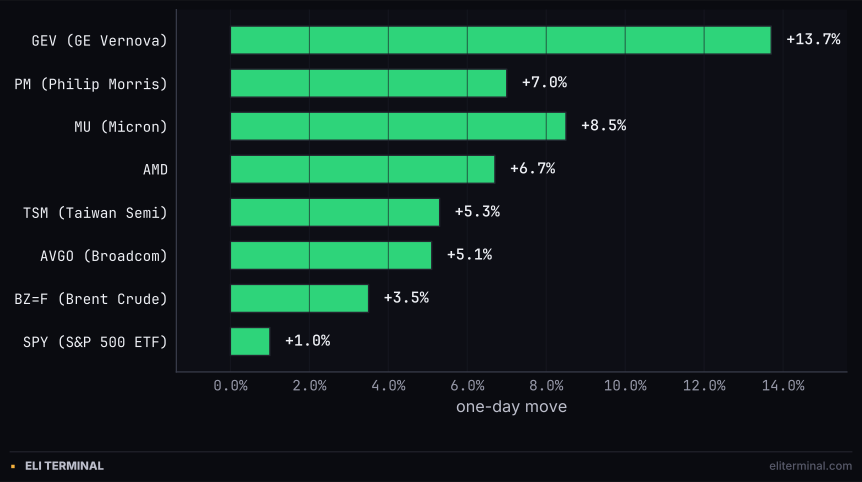
The two biggest gainers in the report weren't chips. They were an earnings beat from a power-equipment maker and one from a tobacco company.
GE Vernova closed up 13.7%, more than any chip name in the tape, after posting adjusted earnings per share of 2.01 against a 1.67 estimate. First-quarter orders hit 18.3 billion, up 71% from a year earlier, pushing total backlog to 163 billion from 116 billion at the company's 2024 spin-off from General Electric. Chief executive Scott Strazik told analysts on the call that "in the last 90 days, we've added 13 billion to our total backlog and now expect to reach 200 billion in backlog in '27 versus our previous expectation of '28," according to a transcript carried by Investing.com.
Philip Morris International gained 7.0% on an earnings-per-share beat of 1.96 against a 1.83 estimate, driven by smoke-free product growth, per Invezz. The company trimmed its own full-year guidance in the same release, citing higher input and transportation costs. The stock rose anyway. The quarter that just printed outweighed the year that lies ahead of it, at least for one session.
Tesla and Texas Instruments both release earnings minutes after the closing bell, and both were still ahead of this report at the moment of publication. Tesla's headline numbers were already out: revenue of 22.39 billion against a roughly 22.3 billion estimate, adjusted earnings per share of 0.41 against roughly 0.35 expected, a beat on both lines. Shares rose as much as 4% in the opening minutes of after-hours trading.
Texas Instruments beat as well, with first-quarter revenue of 4.83 billion against a 4.53 billion estimate and second-quarter guidance of 5.0 to 5.4 billion in revenue and 1.77 to 2.05 in earnings per share, both well above the roughly 4.86 billion and 1.57 analysts had penciled in. The stock jumped as much as 6.2% in the same early after-hours window, per Bloomberg.
Neither company had held its earnings call by this report's close. Whatever gets said on either call, about Tesla's spending plans or about how durable Texas Instruments' data-center demand actually is, is still unwritten. Thursday's open is where both stories get their first real test.