Gold and silver break from oil and the dollar, February 16 – March 19
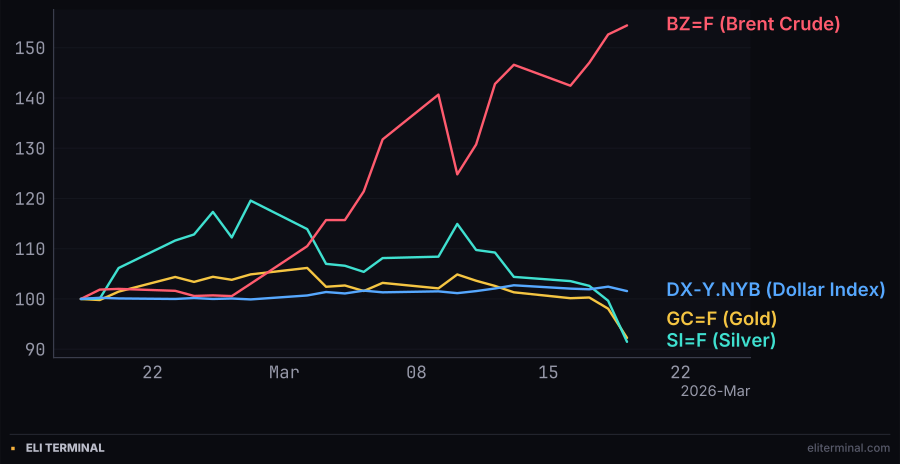
Gold and silver ran together for three weeks, then broke together in the final two sessions, while Brent kept climbing on its own path.
Gold cratered 5.91% to 4,600.70, its sharpest drop in months, and Alibaba sank 7.09% on an earnings miss, the day a hawkish Fed hold met a widening war in the Gulf.
Gold and silver ran together for three weeks, then broke together in the final two sessions, while Brent kept climbing on its own path.
4,600.70 is where Comex gold settled Thursday at 4,600.70, down 5.91% on the day and a seventh straight losing session, the longest such streak since 2023. The break was not a New York event. Gold held near 4,850 as late as 04:00 UTC Thursday, then fell almost without pause through the European morning, bottoming near 4,533 in the 12:00-13:00 UTC hour, nearly two hours before the 13:30 UTC cash open.
Silver fell harder. The metal closed at 70.90, down 8.20% on the day, worse than gold in percentage terms and a signal this was a precious-metals unwind rather than a gold-specific story.
The Federal Reserve held its policy rate for a second straight meeting on Wednesday. The statement's only substantive change, per the Fed's own transcript, was to acknowledge that developments in the Middle East had made the inflation-versus-employment tradeoff harder to assess, an unusual admission that the war itself was complicating policy rather than just prices.
The 10-year Treasury yield closed Wednesday near 4.259%, then jumped again overnight to 4.295% by 12:20 UTC Thursday, the same window gold was posting its steepest losses, before settling near 4.281% for the rest of the session. A rate-cut case built on falling inflation odds does not usually survive two straight moves in the wrong direction inside 24 hours.
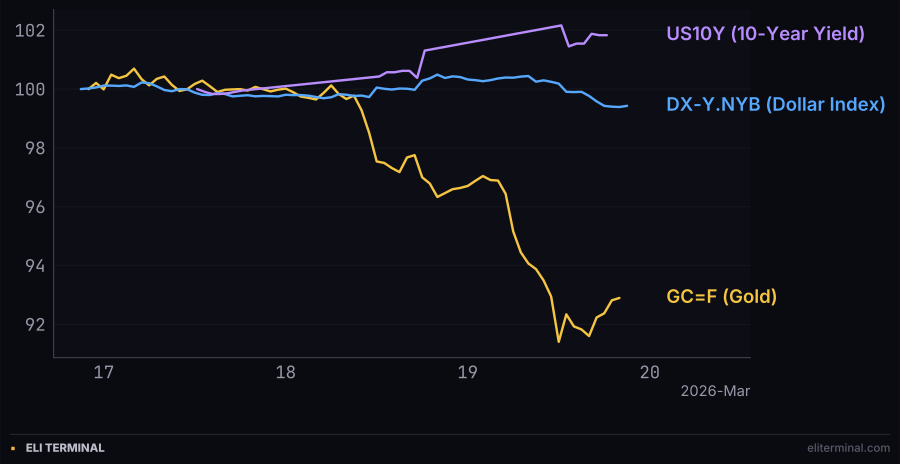
Gold's break started while yields were already climbing and the dollar was still bid, not after.
Between Wednesday's Fed decision and Thursday's early Asia hours, the dollar index held between 100.0 and 100.3, the same stretch gold was cratering, consistent with a stronger-dollar drag on the metal. Then the dollar gave almost all of it back, falling from 99.99 at noon UTC to 99.23 by the 21:00 UTC close, down 0.86% on the day.
Gold never recovered with it. The metal traded in a tight band near its lows for the rest of Thursday's session, closing at 4,600.70 against an intraday low near 4,505, even as the currency that was supposedly weighing on it gave up most of its own gain. The relationship broke in one direction and didn't reset in the other.
Wednesday, Israeli strikes hit Iran's South Pars gas field and the Asaluyeh complex, cutting an estimated 12% of Iran's gas production and pushing Brent toward 110 a barrel. Thursday, the United States opened an air campaign alongside Israeli aircraft against Iranian naval vessels and drones, an operation aimed at reopening the Strait of Hormuz that Iran had closed since the war began on February 28 with the strikes that killed Iran's Supreme Leader.
Brent's own Thursday was not a straight line: the contract spiked to a session high of 112.06 by 09:00 UTC, then round-tripped all the way down to roughly 99.62 by 19:00 UTC before closing back at 108.65, up 1.18% on the day. Oil's own war premium could not hold a bid inside the same session gold was breaking, which is the honest read: energy-driven inflation fear was real enough to move the Fed's language and the bond market, but gold's crash began building before Thursday's fighting crossed the wire in detail, and the clean version of the story, "war pushes gold higher," simply did not happen this week.
Alibaba reported RMB284,843 million in revenue for the December quarter, up 2% year over year but short of the roughly RMB289.7 billion analysts wanted. Adjusted earnings per American depositary share came to RMB7.09 against a RMB10.94 estimate, and net income fell 66% to RMB15,631 million as spending on quick commerce and technology investment cut adjusted EBITA by 57% to RMB23.40 billion, according to the company's own filing.
Cloud Intelligence Group revenue grew 36% year over year, with AI-related product revenue posting a tenth straight quarter of triple-digit growth. None of it mattered to the open: shares started New York trading at 123.02, down 8.47% from Wednesday's close, hours after the 7:30am ET call. From there the stock barely moved, holding a tight 124 to 126 band the rest of the day and closing at 124.90, down 7.09%. The damage was entirely a premarket event; New York neither added to it nor bought it back.
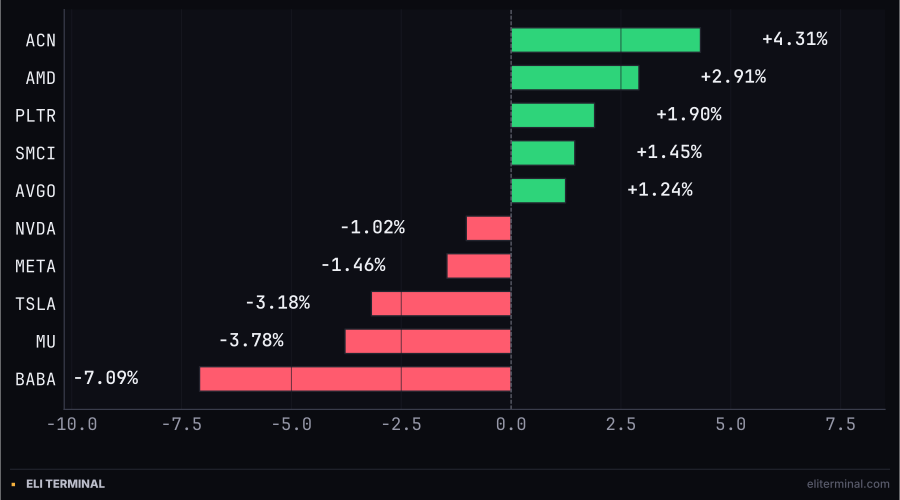
Alibaba's earnings miss was the day's largest single-stock move, ahead of Micron's sell-the-news and well ahead of the chip names that closed green.
Micron earned $12.20 per share for its fiscal second quarter, against a $9.31 estimate, on revenue of $23.86 billion versus $20.07 billion expected. The company guided fiscal third-quarter revenue to a record $33.5 billion, plus or minus $750 million, with gross margin near 81% and earnings per share of $19.15, plus or minus 40 cents.
The stock fell anyway. Micron traded down to a premarket low near 424 by 13:00 UTC Thursday, roughly 8% below Wednesday's 461.73 close, then spiked to 449.79 in the first half hour of cash trading before fading through the rest of the session to close at 444.27, down 3.78%. A beat-and-raise that gets sold after a large run into the print is a familiar pattern; Thursday's session fit it.
Accenture beat on both lines, reporting earnings of $2.93 per share against $2.87 expected and revenue of $18.04 billion against $18.01 billion expected. Full-year guidance called for local-currency revenue growth of 2% to 5%, or 3% to 6% excluding a 1 to 1.5 point drag the company attributed to its U.S. federal business, with GAAP earnings per share of $13.19 to $13.57.
The stock's path was the story. Accenture fell to a premarket low of 183.36 by 13:00 UTC, more than 6% below Wednesday's 195.15 close, opened the cash session at 187, and then rallied straight through the first half hour to 204.20. It touched a session high of 207.98 by mid-morning and closed at 203.55, up 4.31%. Premarket low to session high covered roughly 13 percentage points inside one trading day.
205,000 initial jobless claims were reported for the prior week Thursday morning, below the 215,000 forecast and the Labor Department's lowest reading since January. New home sales for February came in at a 635,000 annual rate, up 8.9% from January's revised 583,000. Both beats landed and barely registered against the gold and oil story.
The S&P absorbed the session without matching the chaos in commodities: SPY opened at 656.97, found a floor at 655.17 in the first half hour, then climbed through the day, including a push from 657.18 to a session high of 662.98 inside the 18:30 UTC hour that no filing or wire story from Thursday explains. The VIX fell 4.11% to 24.06 on a day the S&P closed lower, a volatility gauge easing while gold and silver were posting some of their sharpest one-day drops in the window.
Sources: Federal Reserve, March 18 press conference transcript; CNBC, gold and the Fed hold; Alibaba Group, December Quarter 2025 Results (SEC filing); CNBC, Micron fiscal Q2 2026 earnings; Bloomberg, jobless claims; South Pars field attack, March 18.