Micron and the Russell 2000 break from the pack in March
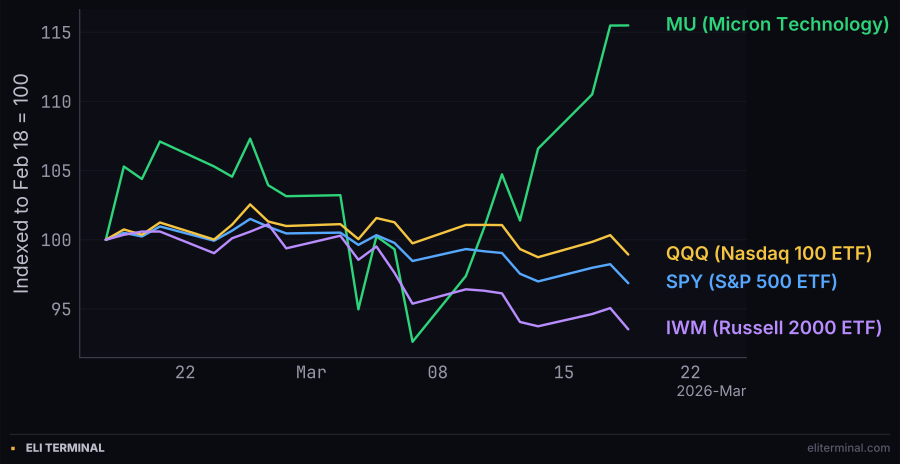
A month of small-cap weakness and a memory stock climbing against it, both intact heading into Wednesday.
The S&P 500 fell 1.4% after Israel struck Iran's largest gas field hours before the Fed's hawkish hold, Brent crude jumped 3.8%, and Micron beat every estimate then slipped 1.8% after hours.
A month of small-cap weakness and a memory stock climbing against it, both intact heading into Wednesday.
Wednesday's statement was the first FOMC release in this cycle to name the Middle East directly. The Federal Open Market Committee kept the federal funds rate at 3.50%–3.75% on an 11-1 vote, and its risk assessment added that "the implications of developments in the Middle East for the U.S. economy are uncertain," with upside risk to inflation and downside risk to employment both judged to have increased because of them.
Governor Stephen Miran cast the lone dissent, preferring a 25 basis point cut. He was outvoted by a committee that, three weeks into Operation Epic Fury, chose to treat a live war as a reason for caution rather than a reason to ease.
One cut for the rest of 2026, one more in 2027: that was the median projection in December, and it was still the median projection Wednesday. Underneath it, four or five participants who had penciled in two cuts moved to one, and seven of nineteen officials now see no cuts at all this year, up from six in December.
The committee also raised its core PCE inflation forecast to 2.7% for 2026. Powell told reporters that "the forecast is that we will be making progress on inflation, not as much as we had hoped, but some progress on inflation," and tied part of that directly to the morning's news: "in the near term, higher energy prices will push up overall inflation."
At 2:10pm Iran Standard Time, 10:40 UTC, the Israeli Air Force struck Iran's South Pars gas field in Bushehr province, the world's largest, in a strike coordinated with U.S. forces. Iranian state media reported a parallel hit on the Asaluyeh processing complex, and the combined damage knocked out roughly 12% of Iran's total gas production and halted output at two refineries with a combined capacity near 100 million cubic meters a day.
Brent crude was trading near 104 in the hour before the strike and reached 109.95 by 14:00 UTC, a move of more than 5% inside three and a half hours. Iran's government vowed the same day to hit Gulf energy infrastructure in Qatar, Saudi Arabia, and the UAE in response, a threat that had not been carried out by Wednesday's close.
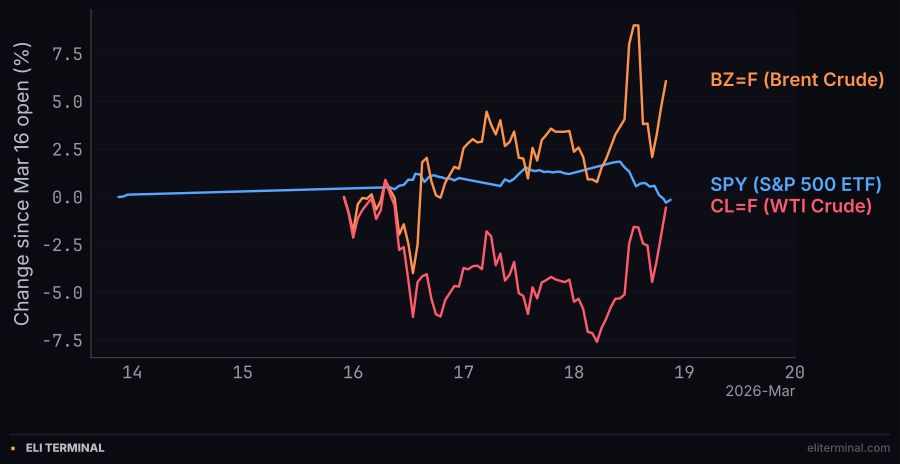
Two benchmarks, one war. Only one of them moved the way the headline suggested it should.
Brent settled at 107.38, up 3.83% on the day after giving back roughly half of its intraday spike through the U.S. afternoon. West Texas Intermediate settled at 96.32, up just 0.11%, after a session that took it as high as 98.67 and as low as 91.96.
South Pars sits in the Persian Gulf, and the crude and condensate benchmarked against Brent trades through the same waterways the strike touched. WTI prices landlocked and Gulf Coast domestic supply that a single Iranian gas field cannot reach, and Wednesday's settle drew that line more clearly than a week of commentary could.
The rate move told the same story from the other side. The 10-year yield rose from 4.202% to 4.259% in the hour spanning the FOMC statement and the start of Powell's press conference, a climb of 5.7 basis points that lines up with the release far better than it lines up with the morning's oil strike. Gold, which usually catches a geopolitical bid, fell 2.22% to 4,889.90, the loser when a hawkish Fed lifts real yields on the same day a war lifts oil.
Micron's fiscal second-quarter release, filed after Wednesday's close, reported adjusted earnings of $12.20 a share against a Street estimate of $9.31 and revenue of $23.86 billion against $20.07 billion expected. The company guided fiscal third-quarter revenue to $33.5 billion, plus or minus $750 million, non-GAAP earnings to $19.15 a share, and gross margin near 81%, all above where analysts had modeled the quarter.
None of it held. Micron closed the regular session at 461.73, essentially flat against Tuesday's 461.69, then popped as high as 476.32 in the first minutes after the release, a gain of 3.16%. By 5pm ET the stock had round-tripped to 453.52, down 1.78% on the day, after touching an after-hours low of 445.25, down 3.57%.
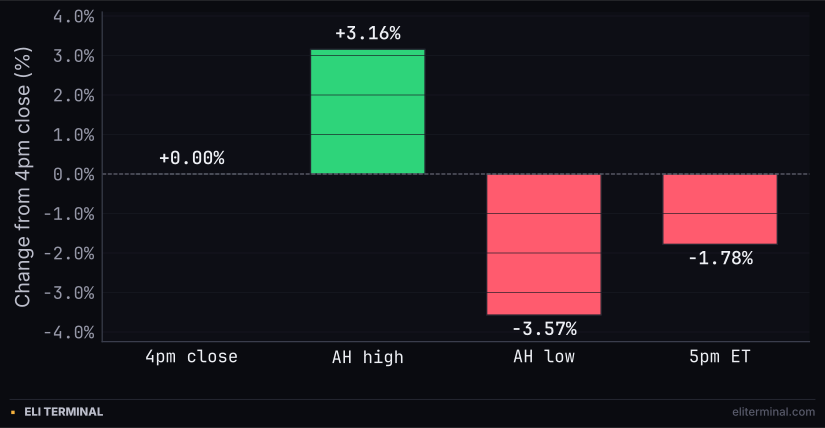
A pop on the headline numbers, then a reversal before the call had run its course.
Micron came into the print up 354% over the trailing year on the same AI memory story Nvidia and its peers have ridden, and a report with no soft line in it still could not hold the after-hours bid. That combination, a clean beat with guidance above the Street on every metric and a stock that sold off anyway, is what a market priced for perfection looks like when it meets a real number instead of a rumor.
The prediction market on whether the U.S. formally declares war on Iran by year-end sat at 10.5% on Tuesday and 10.5% on Wednesday, unmoved by a coordinated Israeli-American strike on the country's largest gas field. The prediction market on a 2026 U.S. recession closed at 33% both days, flat through an oil shock and a hawkish Fed on the same afternoon.
The market's own odds on a single 2026 rate cut actually rose, from 28% Tuesday to 30% Wednesday, a two-point gain that argues the "hawkish" read came from Powell's tone and the dot plot's internal shift, not from a probability-weighted repricing of the base case. Whatever moved equities and oil, it did not move the numbers the prediction markets use to keep score.
AMD closed up 1.60%, the only gainer among the day's largest technology names. Broadcom fell 1.67%, Taiwan Semiconductor fell 1.85%, Apple fell 1.69%, Microsoft fell 1.91%, and Amazon fell 2.48% on the same afternoon. Nothing in Wednesday's filings or wires singled out AMD, and the divergence sits unexplained.
The Commerce Department publishes Personal Income and Outlays, which carries the core PCE reading the Fed just cited, on March 27 at 8:30am ET. Wednesday's projection put that measure on a path toward 2.7% for the year; a print materially above or below that path will say whether Powell's caution was forecasting the data correctly or getting ahead of it. Alibaba and Accenture report Thursday, and weekly jobless claims land the same morning, but neither carries the weight of the Fed's own scorecard.