The week that flipped, March 10–16
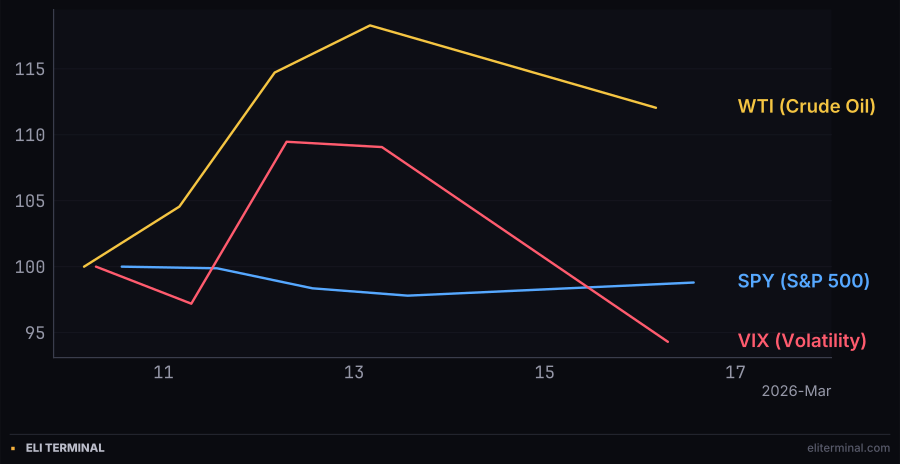
Oil and volatility took the whole week on a round trip. Stocks barely moved.
Meta swung from a 3.83% Friday plunge to a 2.24% Monday rally on the identical layoff report, while the VIX posted the sharpest one-day drop of a five-week losing stretch and WTI crude fell 5.28%.
Oil and volatility took the whole week on a round trip. Stocks barely moved.
6,699.38 is where the S&P 500 closed Monday, up 1.01% on the session and enough to snap a run of losses that had run five straight weeks, back to February 28, when Israel and the United States opened a bombing campaign against Iran. The Dow added 387.94 points, or 0.83%, to 46,946.41. The Nasdaq Composite gained 1.22% to 22,374.18.
The prior week alone had cost the S&P more than 2%, from 677.18 the Tuesday before down to 662.29 by Friday's close. A hot February producer price report landed mid-week, with core PPI up 3.9% year over year, its largest annual gain in thirteen months, and Fed Chair Jerome Powell told reporters that without progress on inflation the central bank "won't see a rate cut." Stocks fell on the data, oil rose on the war, and the week closed in the red for a fifth straight time.
Monday's reversal did not arrive on a single headline. WTI crude opened at 100.93 a barrel and slid nearly without pause through the day, down to a low of 92.93 by mid-afternoon before closing at 93.50, off 5.28%. The VIX moved on the same rhythm, opening near 26 and grinding down to 23.51 by the close, a 13.53% drop and the sharpest one-day decline of the five-week stretch.
The decline tracked a real change in the war's pace. Defense Secretary Pete Hegseth told reporters the prior week that Iranian missile attacks had fallen 90% and one-way drone attacks 83% since the campaign began, even while promising the "most intense day of strikes inside Iran" was still to come. By Monday, oil and volatility were pricing the missile math, not the rhetoric.
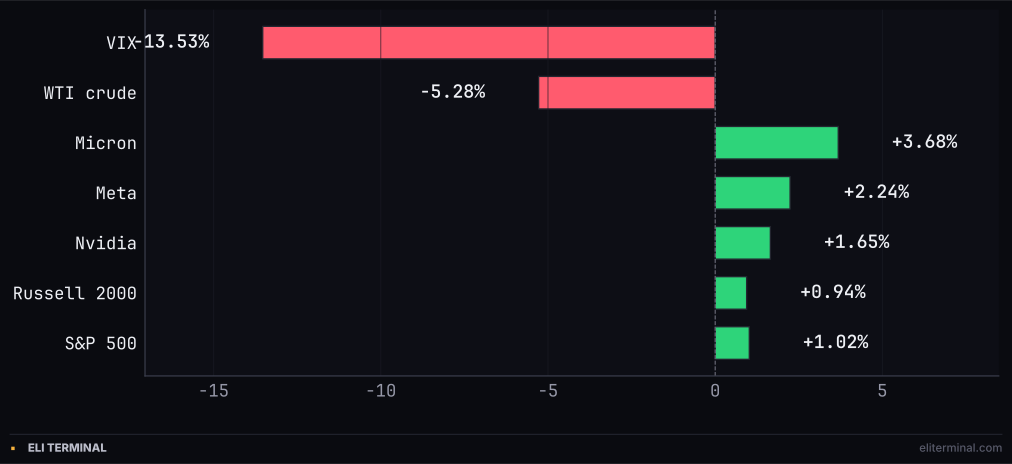
Every asset in the war-premium trade moved the same direction Monday, and by a lot.
Retail sales for February landed at 8:30 a.m. and beat: $738.4 billion, up 0.6% from January against a 0.4% consensus. Sales excluding autos and gasoline rose 0.4% against a 0.2% forecast. Industrial production followed at 9:15 a.m., up 0.2% for the month, with capacity utilization holding at 76.3%. Neither report argued for a rate cut; both described an economy still spending through a shooting war.
The White House told a different story the same day. President Trump, holding a model B-2 stealth bomber in the Oval Office after signing an executive order creating a fraud task force, told reporters, "Had we not done this, there would have been a nuclear war, World War 3," defending February's strikes as the campaign entered its third week. The tape had already spent the session pricing the opposite read, that the war was winding down rather than needing further justification.
A Reuters exclusive broke Friday afternoon reporting Meta was weighing layoffs of 20% or more of its roughly 79,000-person workforce, nearly 16,000 jobs, to help fund a $600 billion data center commitment running through 2028. Meta fell 3.83% that day, closing at 613.71. A company spokesperson called the report "speculative reporting about theoretical approaches."
The same story, absorbed over a weekend, produced the opposite trade Monday. Meta opened near 630, gapped as high as 634.74 in the first half hour, dipped to a session low of 623.10 by late morning, then held its gain into the close at 627.45, up 2.24%. Nothing in the underlying report changed between Friday's selloff and Monday's rally, and the Meta spokesperson gave reporters the identical "speculative" line both days.
What changed was the market's read, not the news. Friday's sellers treated 16,000 potential job cuts as a sign of AI-spending strain. Monday's buyers treated the identical number as a sign Meta would find the efficiency to fund its own capex. Both trades used the same figure to reach opposite conclusions three trading days apart.
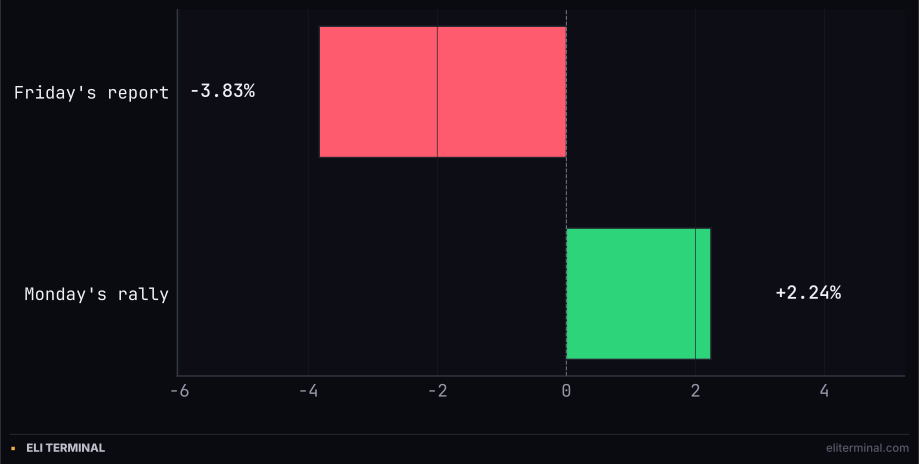
Sixteen thousand potential jobs read as a warning Friday and an efficiency signal Monday.
Nvidia's GTC conference opened Monday at 11 a.m. Pacific time, 18:00 UTC, with Jensen Huang unveiling the Vera Rubin computing platform as Blackwell's successor and raising the company's AI compute-demand outlook to 1 trillion dollars through 2027, up from a prior 500 billion through 2026. Nvidia's stock had already climbed to an intraday high of 188.88 earlier in the session, on optimism ahead of the keynote.
In the half hour the keynote began, Nvidia swung from 184.94 up to 188.87 and back down to 181.68, then kept fading into the close at 183.22, up 1.65% on the day but more than 3 points off its best level. Micron moved on the same rhythm: it touched 454.86 that morning on a DRAM and NAND pricing story, Counterpoint Research had clocked both chip categories up 90% quarter over quarter, then gave back more than half that gain to close at 441.80, up 3.68%, with its own earnings due Wednesday.
The pattern repeated across the chip and memory basket that afternoon. Money came in on the broad story ahead of the specific announcement, and came back out once the announcement, and the earnings date behind it, were on the record.
Peloton supplied the session's cleanest single-name story: a real product on a real morning. The company launched its Commercial Series Monday, its first bikes and treadmills built for gyms, developed with Precor, the equipment maker Peloton acquired in 2021. Shares closed at 3.87, up 4.3% from Friday's 3.71.
The launch gives Peloton access to a commercial distribution network spanning more than 60 countries, with shipments starting in the United States, United Kingdom, Canada, Germany, Australia and Austria in late 2026. It was a small, real catalyst inside a session otherwise driven by macro repricing, and the tape treated it that way: a clean gain with no afternoon fade.
Not every market read Monday as risk-on. The 10-year Treasury yield fell to 4.22%, down roughly 6 basis points from Friday's 4.285%, and the 20-plus-year Treasury fund closed marginally higher. A session where the S&P gained 1%, the VIX fell 13.53% and oil fell 5.28% would typically push yields up, not down.
Gold and the dollar moved together instead of against each other, another break from the usual pattern. The Dollar Index fell 0.65% to 99.71 while gold fell 1.16% to 4,994.00. A weaker dollar is normally a gold tailwind; Monday, gold traded like a war hedge being unwound, a bigger force than the currency move working in its favor.
The Federal Reserve's two-day meeting begins Tuesday and ends with a rate decision and Jerome Powell's press conference Wednesday afternoon, the first test of whether Monday's dip in yields was positioning or conviction. Micron reports fiscal second-quarter results after Wednesday's close, the test of whether the DRAM and NAND pricing story Monday's buyers paid for was real demand or a rumor they front-ran into the keynote.