Twelve days of war, indexed to February 11
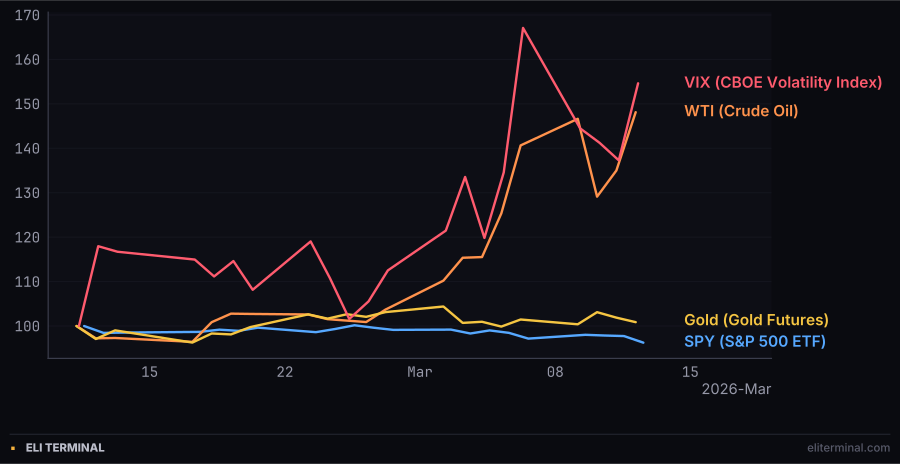
Oil and volatility have both roughly doubled since the war began February 28. The S&P and gold barely moved on the month, even as Thursday cut a fresh low into that flat line.
Mojtaba Khamenei's first address as Iran's supreme leader demanded the Strait of Hormuz stay closed, the S&P 500 fell 1.52% to its lowest close since the war began, oil jumped 9.7%, and Adobe sank as much as 8% after its chief executive said he would step down.
Oil and volatility have both roughly doubled since the war began February 28. The S&P and gold barely moved on the month, even as Thursday cut a fresh low into that flat line.
213,000 first-time jobless claims for the week, against a forecast of 215,000, and a January trade deficit of 54.5 billion dollars against a forecast of 66.6 billion: both landed at 12:30 UTC Thursday from the Labor Department and the Commerce Department, and both beat by a wide margin. The trade gap narrowed 25% from December's revised 72.9 billion as exports hit a record high.
The S&P 500 opened the New York session at 671.16, ticked up to a session high of 671.65, and spent the rest of the day sliding to a close of 666.06 on the SPY-tracked reading, equivalent to 6,672.62 on the index itself, down 1.52% and the lowest close since the war began February 28. Data that would ordinarily support a bid found no market willing to take it.
The decline wasn't broad in the same way across every name. Taiwan Semiconductor fell 5.0%, AMD 3.5%, Micron 3.2%, and Meta 2.5%, while the energy sector ETF closed higher on the day, up 0.9%.
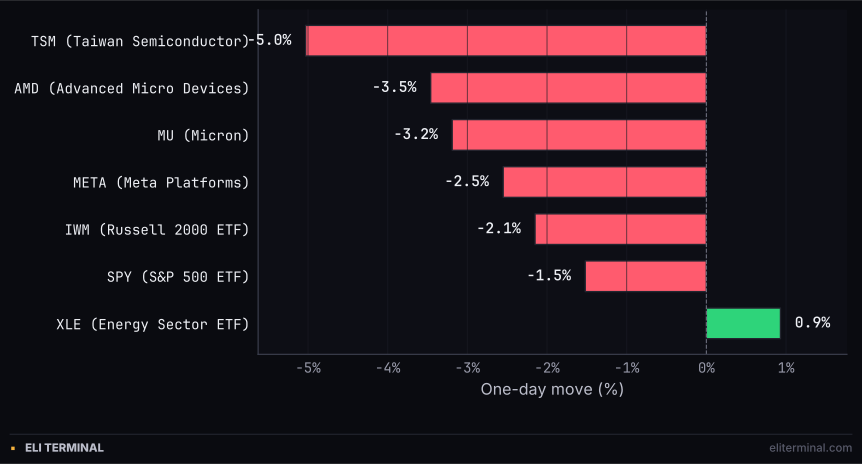
Semiconductors carried the session's losses. Energy was the only sector in the basket that closed green.
Ali Khamenei, Iran's supreme leader for 37 years, was killed February 28 in a joint US-Israeli strike that opened the war. His son Mojtaba was installed as the country's third supreme leader on March 9 by an interim leadership council, and Thursday brought his first public address in the role, read by a state television anchor on Press TV.
The statement, first published at 6:07am ET and updated through the afternoon, said the closure of the Strait of Hormuz "must definitely continue to be used" as leverage against the United States and Israel, and called for every American military base in the Middle East to shut immediately, warning that "those bases will be attacked" if they did not.
WTI traded near 91 through the earliest hours of the New York morning, still below Wednesday's close. By the 13:00 UTC hour, thirty minutes before the opening bell, it had already reached 94.78, and it kept climbing to an intraday high near 97 in the early afternoon before settling at an official close of 95.73, up 9.72% on the day. Brent crossed 100 dollars a barrel for the first time in the war, closing at 100.46, up 9.22%.
Equities moved the other way in the identical window. The S&P fell from 671 to 668 in the hour spanning 13:30 to 14:30 UTC, the same hour oil recorded one of its sharpest legs higher. Khamenei's statement had crossed the wires roughly three hours earlier. Whether that statement, the overnight tanker attacks, or the opening bell itself was driving the oil bid, the equity market read the combination as a cost shock rather than a reason to buy the dip.
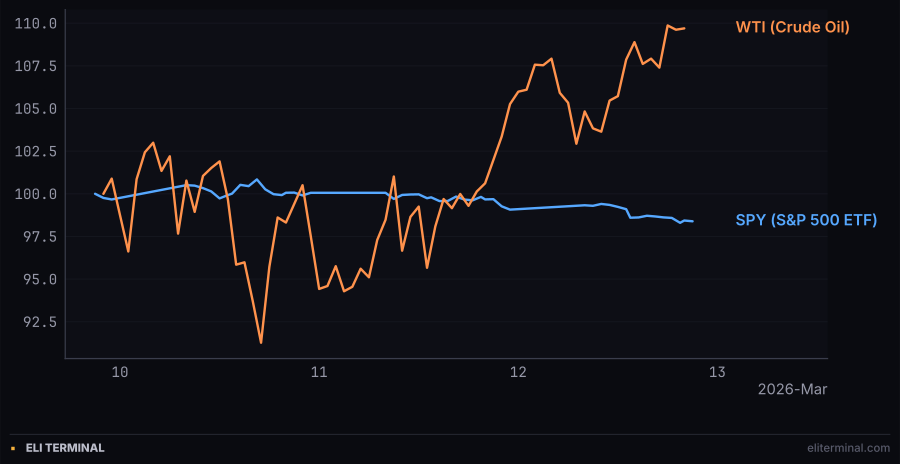
Oil's steepest hour of the week and the S&P's steepest hour of the week were the same hour.
CNBC reported that Iranian explosive-laden boats struck two fuel tankers in Iraqi waters overnight, setting them ablaze, with three more foreign-flagged ships damaged elsewhere in the Persian Gulf. Shipping traffic through the Strait of Hormuz has fallen more than 90% since the war opened, and Gulf producers have been cutting output as storage fills: Iraq cut its main southern fields 70% to 1.3 million barrels a day, Kuwait declared force majeure, and Saudi Aramco cut production at two oilfields, with total curtailment across the Gulf estimated near 10 million barrels a day by March 10.
Wednesday, Ebrahim Zolfaqari, spokesman for Iran's Khatam al-Anbiya military command, told the world to "get ready for oil to be 200 dollars a barrel." Traders carried that framing into Thursday's session; Onyx Capital Group's Greg Newman said a run to 200 "isn't ridiculous at all."
"The United States is the largest Oil Producer in the World, by far, so when oil prices go up, we make a lot of money," President Trump posted on Truth Social Thursday. It marked a reversal from his State of the Union boast a month earlier about gas at 2.30 dollars a gallon, a price that has since risen more than 50% to a national average near 3.60. White House press secretary Karoline Leavitt had told reporters two days earlier that the increase was "temporary" and would give way to lower prices once the operation concluded.
Adobe's first quarter brought 6.40 billion dollars in revenue, up 11% year over year, and non-GAAP earnings of 6.06 dollars a share against a Street estimate of 5.87. Monthly active users passed 850 million, up 17%, and AI-first application revenue more than tripled from a year earlier.
Underneath the beat, net-new Digital Media annualized recurring revenue came in at 400 million dollars, short of the 450-to-460-million range analysts had modeled. Alongside the results, Adobe announced that chief executive Shantanu Narayen, 18 years in the role, will step down once a successor is named and will remain as board chair; lead independent director Frank Calderoni will run the search.
None of it showed up during the regular session. Adobe closed at 269.78, down just 1.44%, roughly in line with the broader market's 1.52% decline. The earnings release and the leadership announcement both crossed after the bell, and inside the same hour the stock fell as low as 248, before settling near 249.60 by 5pm ET, a decline of about 7.5% from the closing price three hours earlier.
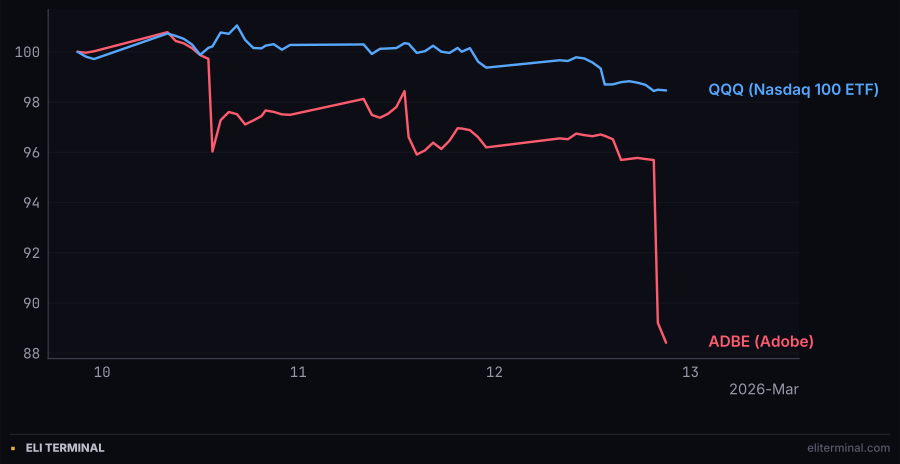
A flat line for six hours, then a cliff in the last one, the moment the earnings release and the CEO announcement both crossed at once.
The prediction market on a Fed rate hike in 2026 priced 11.5% Thursday, up just one point from Wednesday's 10.5%, despite the day's oil shock. The market on a US invasion of Iran before 2027 stood at 28.5%, down slightly from Wednesday and well off the 34.5% high it hit March 9, the day Mojtaba was installed. Neither layer of the odds market treated Thursday's rhetoric as a step toward wider war.
Gold fell 1.0% to 5,115.80, extending a slide that started March 10, even as everything else in the market pointed toward risk aversion. The 10-year Treasury yield rose 6.5 basis points to 4.273% on the same day the S&P fell 1.52%, the opposite of the flight-to-quality bid a stock selloff usually produces. Stocks, bonds, and gold all moved together Thursday, in the direction that fits an oil-driven inflation scare rather than a growth scare.
The VIX closed at 27.29 Thursday, its highest level since March 6, when it touched 29.49 in the war's first acute spike. Thursday didn't top that high; what it produced instead was the S&P's lowest close since the fighting began February 28, twelve trading days earlier. The next scheduled test is the Federal Reserve's March 18 policy decision, six days out, the first since the war began.