Oil's wildest day of the war
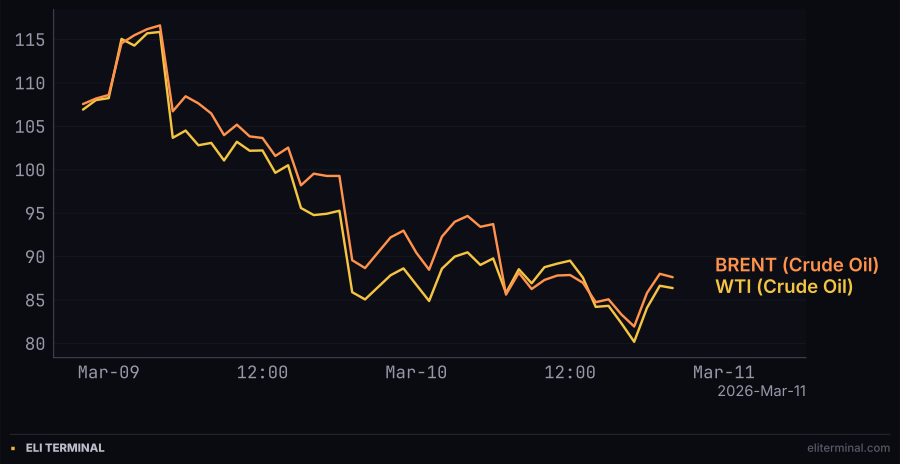
Two days, one nearly unbroken slide, and one violent reversal in the final hours.
WTI crude closed at 83.45, down 11.9%, on the day Defense Secretary Pete Hegseth called the war's most intense round of strikes yet, while gold rallied 2.7% to a record 5,229.70 and the S&P 500 barely moved.
Two days, one nearly unbroken slide, and one violent reversal in the final hours.
8:15 a.m. ET, 12:15 UTC: Defense Secretary Pete Hegseth told reporters at the Pentagon that "today will be, yet again, our most intense day of strikes inside Iran, the most fighters, the most bombers, the most strikes," adding that Iranian intelligence was "more refined and better than ever." It was the eleventh day of the war Washington and Israel opened against Iran on February 28.
West Texas crude was already down more than 10% for the week by the time Hegseth spoke. It fell further after his briefing, not in sympathy with it. A war narrative built entirely from the wires would expect crude to spike on a promise of heavier bombing. Tuesday did the opposite.
At his Doral golf club Monday, Trump told Republican lawmakers the Iran campaign was "a little excursion to get rid of some evil" and predicted "a short-term excursion," then posted hours later that Iran would be hit "20 times harder" if it moved to close the Strait of Hormuz to shipping. Hours after that, reports surfaced that G7 governments and Washington were weighing a release of up to 400 million barrels from strategic reserves to cap prices.
WTI had already touched 119.48 a barrel early Monday on the war's initial shock. By the time the reserve-release reports spread through Monday evening and the Tuesday Asian session, crude had round-tripped: still near 94 at Monday's US close, down near 85 by the first hours of Tuesday in Asia, all before Hegseth said a word about Tuesday's strikes.
Crude opened the New York morning firm, ticking up to a local high of 91.10 around 12:00 UTC as Hegseth's briefing aired. It then broke down through the US session, falling from 89.53 at 13:00 UTC to 84.22 by 14:00 UTC, then to a floor of 76.73 sometime in the 17:00 UTC hour, roughly 1 p.m. ET, its lowest print of the war.
From there it reversed hard: 79.62 to 86.68 inside the 18:00 UTC hour, then higher again to close near 86.39 by 20:00 UTC. A saturated search of Tuesday's wires for a 1 p.m. ET headline that would explain the bounce turned up nothing dated to that window. The reversal happened in the same hour the dollar index jumped from 98.65 to 98.91 and gold slipped off its session high of 5,248.70 to a low near 5,169. Oil, gold, and the dollar all broke stride in the same sixty to ninety minutes; no single Tuesday article ties the three together, so this stays adjacency, not an explained cause.
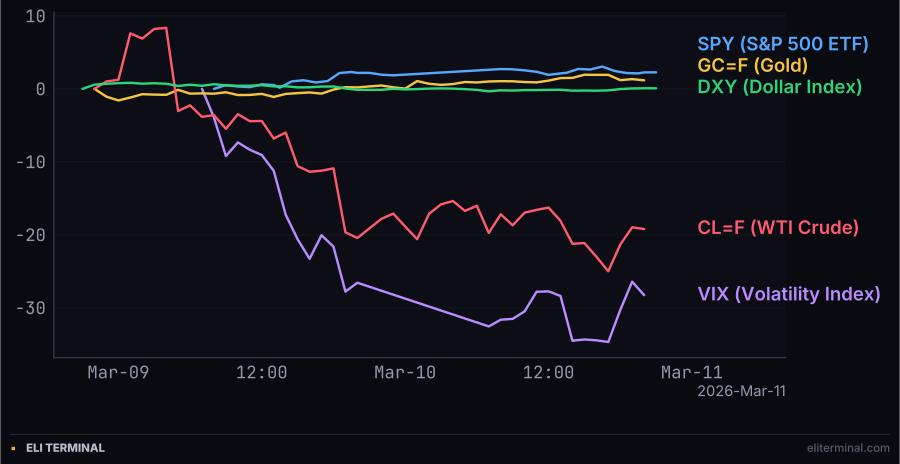
The two-day scale that fits crude and the VIX flattens everything else into a nearly straight line.
Tokyo's Nikkei 225 closed Tuesday at 54,248.39, up 2.88% from Monday. Seoul's Kospi jumped 5.35% to 5,532.59. The Euro Stoxx 50 added 2.67% to 5,837.17. All three sessions closed before the New York open and were pricing the overnight crude collapse as unambiguous relief.
The S&P 500 opened Tuesday's session already carrying Monday's damage and closed at 6,781.48, down 0.21%. A 10% overnight drop in oil that sent Asian and European equities up several points apiece moved the S&P by barely a fifth of a point in the other direction.
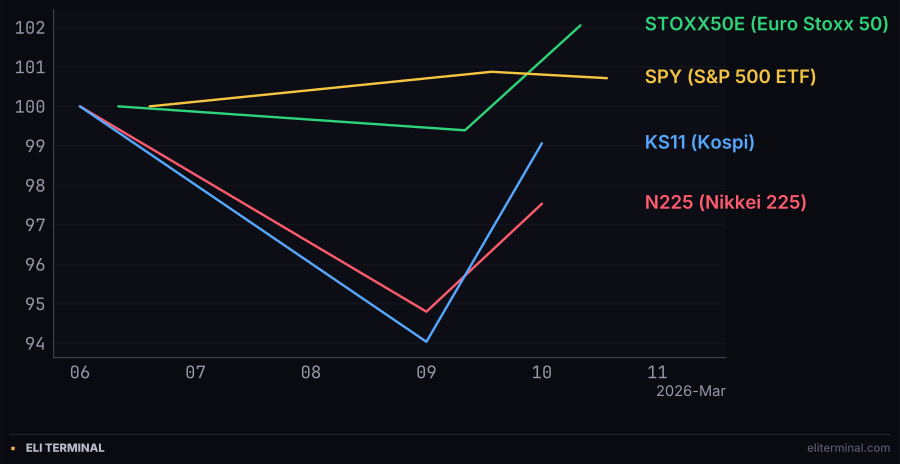
Tokyo and Seoul round-tripped the whole week on oil. New York barely left the line.
Gold closed at 5,229.70, up 2.71% and a fresh record, helped by the dollar index's 0.35% slide to 98.83. On Kalshi, the contract on a 2026 recession had traded as high as 36% on Monday alongside oil's spike to 119; by Tuesday's close it had fallen back to 27%, still above the 21% to 24% range the same contract held in the war's first days.
The recession bet moved with oil's price, not with the intensity of that day's fighting: up when crude spiked Monday, down when crude fell Tuesday, even as Hegseth was on record describing Tuesday as the heaviest bombing day yet.
The VIX closed at 24.93, down 2.24%, on a day crude moved more than 11% and touched a fresh war-time low intraday. A market pricing broad fear from an escalating war and a collapsing oil market would ordinarily bid volatility up, not down.
No Tuesday-specific news turned up for Micron's 3.54% gain to 403.11 or Nvidia's 1.16% add to 184.77. Palantir fell 3.38% to 151.14, giving back part of the 15% run it had put together between February 27 and March 6, also without a fresh catalyst dated to Tuesday. None of the three moves lines up with a timestamped headline.
Oracle fell 1.43% to 149.40 in Tuesday's regular session, heading into fiscal third-quarter results due after the closing bell. Wall Street had penciled in earnings of 1.34 a share on 11 analyst estimates heading into the print. Whatever the report says, it lands after Tuesday's 4 p.m. close and will be Wednesday's story, not this one.
The Consumer Price Index is due at 8:30 a.m. ET, 12:30 UTC Wednesday, the next scheduled event on the calendar after Tuesday's close. It arrives one day after a session where the war's rhetoric pointed toward more escalation and its most-traded commodity pointed the other way.