Nvidia's earnings pop, quarter hour by quarter hour
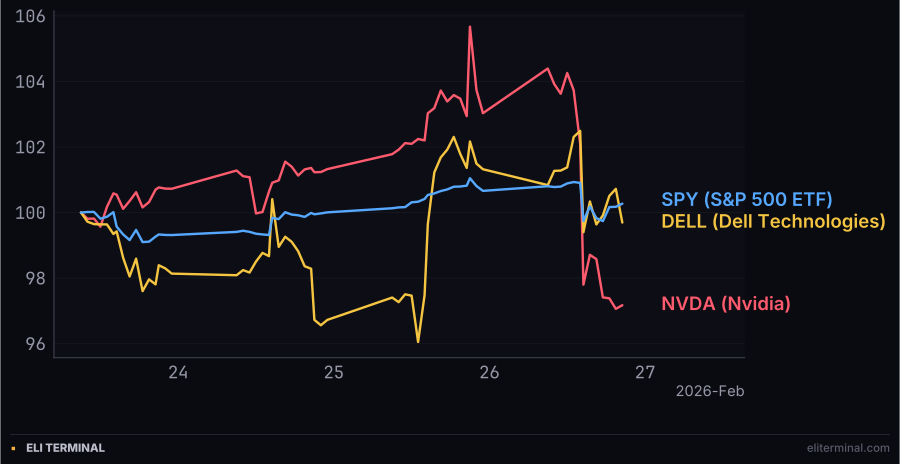
Nvidia's after-hours high came within an hour of its earnings release. The low came at the opening bell the next morning.
Nvidia fell 5.46% to close at 184.89 after an earnings beat that had briefly pushed the stock above 206 in after-hours trading, and Dell slid 1.64% hours before beating its own Q4 estimates after Thursday's bell.
Nvidia's after-hours high came within an hour of its earnings release. The low came at the opening bell the next morning.
Nvidia's fourth-quarter numbers, released after Wednesday's close, beat on every headline line: adjusted earnings per share of 1.62 dollars against a Street estimate of 1.53, revenue of 68.13 billion dollars against 66.21 billion consensus, and a first-quarter revenue outlook near 78 billion dollars versus the roughly 72.60 billion Wall Street had modeled. The stock traded as high as 206.73 in the 22:00 UTC hour Wednesday night, more than 5% above its regular-session close of 195.56.
That level didn't survive the night. By 23:00 UTC Wednesday, Nvidia had already faded to 196.05. Thursday's pre-market carried it down further, to 194.27 by 14:00 UTC, before the stock lost another 8 points in the single half-hour bar spanning the 9:30am ET open, bottoming at an intraday low of 184.32 and closing the regular session at 184.89. The distance from Wednesday night's after-hours peak to Thursday's close ran more than 10%.
Forbes described investors as "left wanting more" even after the beat-and-raise. CEO Jensen Huang told the earnings call that "the demand for tokens in the world has gone completely exponential" and that Nvidia's six-year-old cloud GPUs are "completely consumed," while also addressing the company's reported 30 billion dollar prospective investment in OpenAI. None of it reversed the slide. The specific worry cited across coverage was not the quarter just reported but whether data-center spending among hyperscalers holds at its current pace, a question the numbers themselves couldn't answer.
Broadcom closed down 3.19% to 321.70, Micron fell 3.13% to 415.56, AMD dropped 3.41% to 203.68, and Taiwan Semiconductor's US shares lost 2.82% to 376.81. Every major chip supplier in the AI buildout closed lower on a day with no earnings or guidance news of its own attached to any of them, moving instead on Nvidia's reaction alone.
Microsoft and Meta, the buyers rather than the makers of that hardware, moved the other way: Microsoft closed up 0.28% to 401.72 and Meta gained 0.51% to 657.01. Alphabet fell 1.76%, landing between the two groups. The split ran along a specific line: suppliers of AI compute sold off, and the largest buyers of it did not.
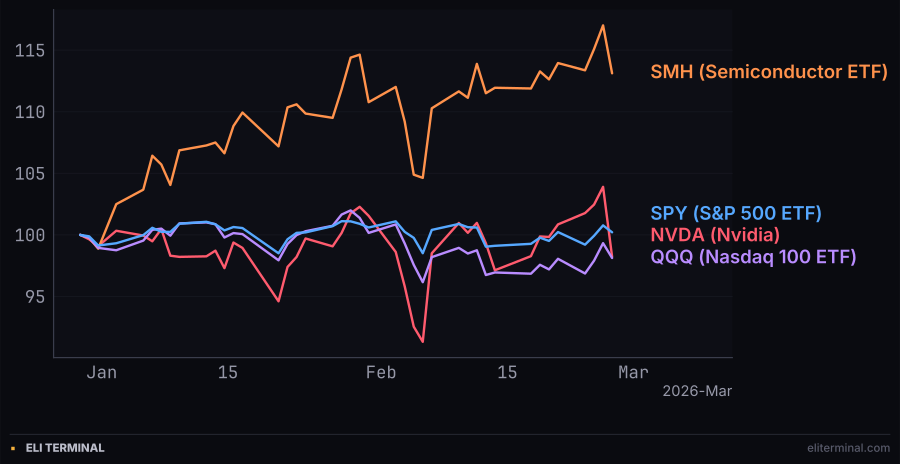
Thursday's drop came out of a two-month run in which the chip sector had outpaced the S&P 500 by more than 10 points.
Zoomed out to two months, Thursday's slide is a dent, not a reversal. The semiconductor ETF SMH still closed the session up more than 13% from its late-December level, having also absorbed and recovered from a sharper one-day drop in early February. Nvidia itself remained roughly flat to slightly negative over the same stretch, the weakest of the group, while the S&P 500 and Nasdaq 100 sit close to unchanged. The two-month picture argues Thursday was Nvidia giving back some of a longer advance the rest of the chip sector still holds.
Dell closed Thursday's regular session at 121.45, down 1.64% from Wednesday's 123.48. The move happened at the same half-hour the market opened: Dell's 14:30 UTC bar opened at 125.10, ran to 126.00, and then fell to a low of 120.31 in the same thirty minutes Nvidia and the S&P 500 both cracked. Nothing about Dell's own business had been disclosed yet.
Dell reported its own fourth-quarter results after Thursday's close: adjusted earnings per share of 3.89 dollars against a 3.52 estimate, revenue of 33.4 billion dollars, up 39% year over year and above the roughly 31.4 billion consensus. AI-optimized server revenue inside its Infrastructure Solutions Group rose 342% to 9.0 billion dollars, and the company disclosed a 43 billion dollar AI server backlog heading into fiscal 2027 alongside guidance for AI server revenue to roughly double next year. That release landed after this session's close and outside this report's window; Thursday's trading in Dell reflects none of it.
West Texas crude fell to a session low of 63.60 by 13:00 UTC Thursday morning, then jumped more than 4% in the following two hours to a high of 66.71 by 16:00 UTC, before easing back to settle near 65.21, down just 0.32% versus Wednesday. The rally's timing lines up with the New York equity open far more precisely than with any single headline out of Geneva that afternoon; no wire carried an exact clock time for Oman's closing statement on the Iran talks, so the two events sit next to each other on the tape without a confirmed join.
The VIX moved on a clearer clock. It sat near 17.5 through the European morning, then jumped from 17.52 to a high of 20.54 between 14:00 and 15:00 UTC, the same hour Nvidia and the S&P 500 both cracked. It closed at 18.63, up 3.90% on the day. Oil spiking alongside a volatility jump inside the same hour, rather than falling as it typically does in an equity selloff, is the day's least explained co-movement.
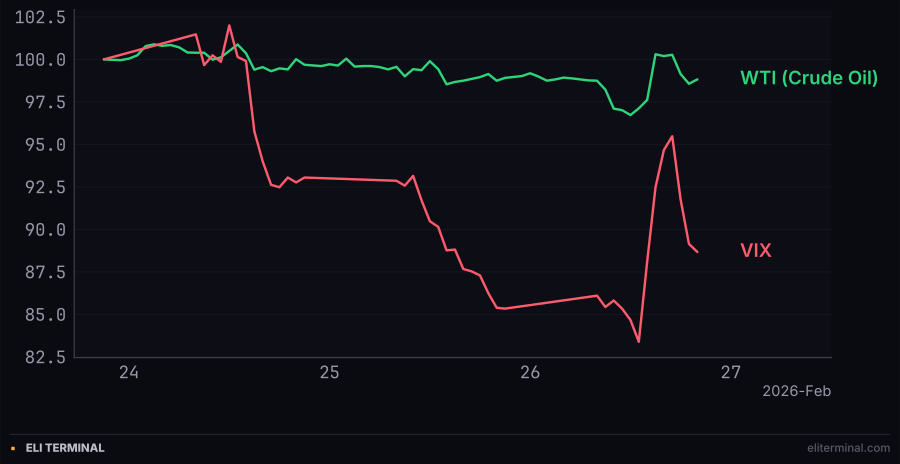
Both lines break higher in the same two-hour window Thursday morning, a pairing that doesn't match the usual pattern.
US and Iranian officials wrapped hours of indirect negotiations in Geneva on Thursday without an agreement. Omani Foreign Minister Badr al-Busaidi, who mediated, said the two sides made "significant progress" and would reconvene at a technical level the following week in Vienna. Iranian state television reported Tehran remained determined to keep enriching uranium and rejected proposals to move its stockpile abroad. The talks' collapse mattered enough that the two countries went to war two days later, but Thursday's tape shows no discrete reaction to the news beyond the oil and volatility moves already tied to the equity open.
The Bureau of Economic Analysis had listed both its fourth-quarter GDP second estimate and its Personal Income and Outlays report for Thursday, but neither actually printed: both had already been pushed back by the fallout from the prior autumn's government shutdown, GDP to March 13 and Personal Income and Outlays to April 9. The one release that did land, weekly jobless claims, rose by 4,000 to 212,000 for the week ended February 21, just above the roughly 215,000-216,000 economists had forecast and still historically low. The 08:30 ET print carries a specific clock time; the S&P 500's 13:00 UTC bar shows a two-point range on the print and no sustained move, a non-reaction to a number that came in close to expectations.