One-day moves, February 25
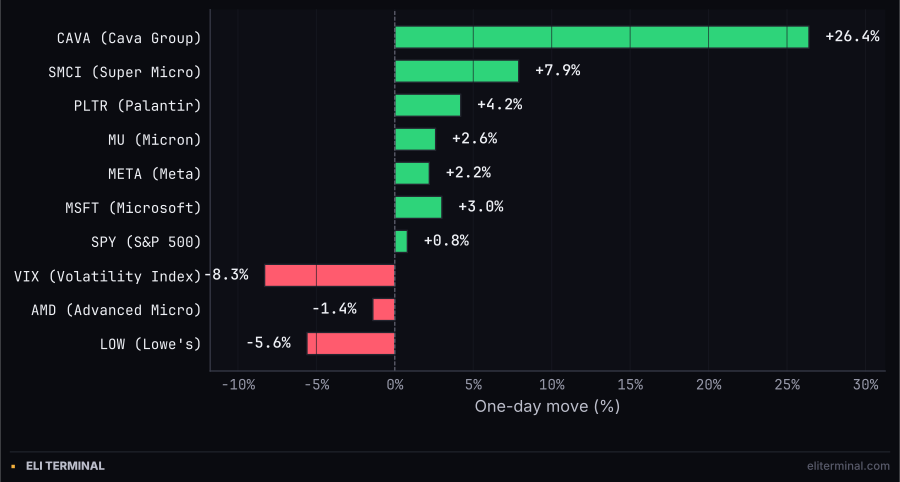
Ten names, ten different mornings. The index barely moved while the pieces underneath it did not agree on a direction.
Cava jumped 26.4% and Lowe's fell 5.6% on the same Wednesday morning, while the S&P 500 closed at a weekly high and the VIX slid to 17.93 hours before Nvidia reported after the bell.
Ten names, ten different mornings. The index barely moved while the pieces underneath it did not agree on a direction.
Lowe's beat fourth-quarter estimates, with sales up more than 10% from a year earlier, and still opened Wednesday down more than 4% before settling at 263.02, off 5.6% on the day. The reason sat in the guidance line: fiscal 2026 adjusted earnings per share of 12.25 to 12.75 dollars, below the Street's 12.94, on a comparable-sales outlook of flat to 2% that read as conservative next to the quarter just reported.
TJX reported the same morning and beat too, adjusted fourth-quarter earnings of 1.43 dollars a share against 1.38 expected, with comparable sales up 5%. Its stock still closed down 1.2% at 155.82. Two retailers beat, one on a soft outlook and one on a clean number, and the market discounted both, just by different amounts.
Cava reported Tuesday evening, after the regular session closed, and the stock was already trading near 76 in Tuesday's after-hours tape, up from a 67.80 close. Fourth-quarter same-restaurant sales rose 0.5% against a Street estimate for a decline, revenue crossed 1 billion dollars for the fiscal year for the first time, and 2026 guidance called for comparable sales growth of 3% to 5%, ahead of the 3.2% analysts had modeled.
The stock kept climbing into Wednesday's open, gapping from Tuesday's 67.80 close past 78 in the first half hour and grinding to 85.67 by the 4pm bell, up 26.4% on the day. Buy orders were still coming in through the early afternoon, with the heaviest single hour of volume, more than 3.8 million shares, arriving between 6:30pm and 7:30pm UTC, four hours after the open.
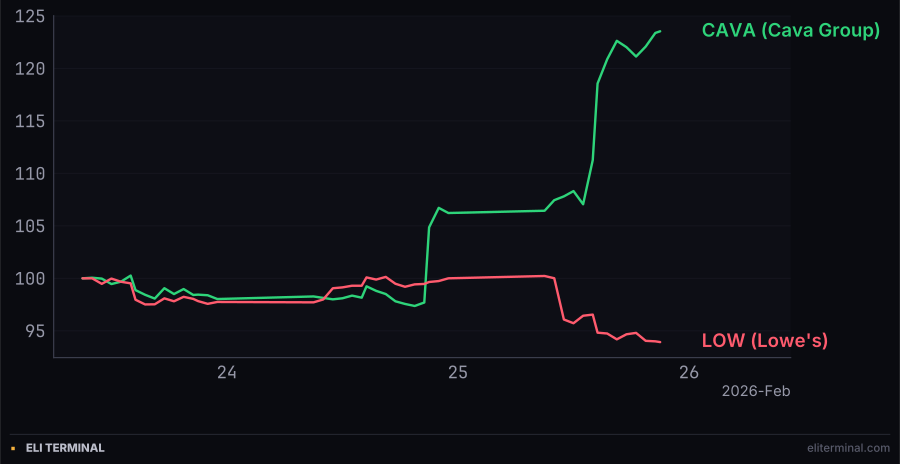
Cava's jump came in two steps: Tuesday evening, then again at Wednesday's bell. Lowe's fell in one.
Super Micro Computer closed at 33.60, up 7.9%, its second single-session gain of 7% or more in eight trading sessions. Wednesday was the Nasdaq's deadline for the company to file its delinquent annual report or face delisting, and Super Micro met it, confirming it was current on its SEC reporting obligations. The stock's gain built through the afternoon, with volume climbing steadily from 2 million shares an hour near midday to more than 3 million by the 8:30pm UTC hour, consistent with the filing news reaching the tape during the session rather than before the open.
Chief executive Charles Liang also set a fiscal 2026 revenue target of 40 billion dollars, well above the roughly 30 billion analysts had been modeling. Between the compliance filing and the revenue target, Wednesday's move has two identifiable catalysts, not zero.
The VIX opened Wednesday at 19.59 and closed at 17.93, falling in every hour of the New York session with no bounce along the way, an eight-day low reached hours before the single biggest earnings report of the year hit the wires. The S&P 500 did the mirror image, climbing from a 690.18 open to a 693.15 close, its highest level of the week.
That combination, a record-adjacent index close and a volatility gauge sliding into a binary event, is what complacency looks like on a chart rather than in a headline. Nvidia's report was due after the bell alongside Salesforce and Snowflake, both of which also climbed into their own prints: Salesforce closed up 3.4% at 191.75 and Snowflake closed up 5.1% at 169.21, neither move explained by anything dated Wednesday.
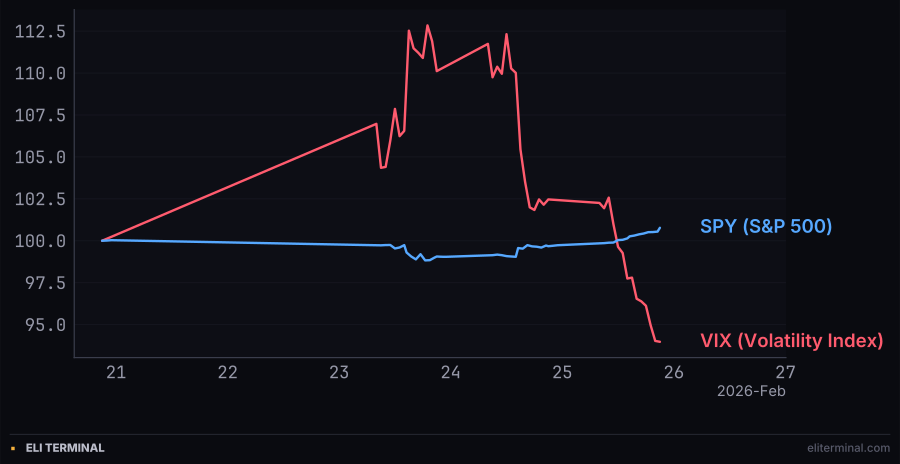
The VIX spent two sessions above its range, then unwound the entire spike in one session, the same session Nvidia was set to report.
Nvidia closed the regular session at 195.56, up 1.4%, and the stock had not had a down day since Monday. Fourth-quarter revenue came in at 68.1 billion dollars, up 73% to 75% from a year earlier, with adjusted earnings of 1.62 dollars a share against a Street estimate near 1.53 to 1.54. Data center revenue reached 62.3 to 62.5 billion dollars, up 75% year over year, and the company guided first-quarter revenue to 78 billion dollars, plus or minus 2%, against a roughly 72.6 billion consensus.
The stock's first move after the release, in the opening minutes of after-hours trading, was higher, adding more than 2% on top of Wednesday's regular-session close. Whether that move holds through Thursday's session is a question this report cannot answer; Wednesday's record is the number itself and how the stock traded into it.
Gold settled at 5,206.40 dollars an ounce, up 0.98% and the highest close of the week, continuing a run that had already carried it above 5,200 twice in the prior five sessions. A market pricing pure risk-on would not usually need gold at a fresh high on the same day the Nasdaq closed at one too. The 10-year Treasury yield closed at 4.048%, up just 1.5 basis points, showing no equivalent flight from duration.
Nothing on the day's schedule explained the gold bid: no CPI, no jobs data, no Fed speech landed Wednesday, and the macro calendar for the day was empty. The move sat alongside the equity rally without an obvious shared cause, adjacency without a join.
Dell reports Thursday, the next major technology print after Nvidia's, alongside Royal Bank of Canada and Toronto-Dominion. Nvidia, Salesforce, and Snowflake all held earnings calls Wednesday evening, and Thursday's regular session is the first chance for any of the three stocks to trade a full day against what they said on those calls.