AMD, TSM and Broadcom against the S&P, one month
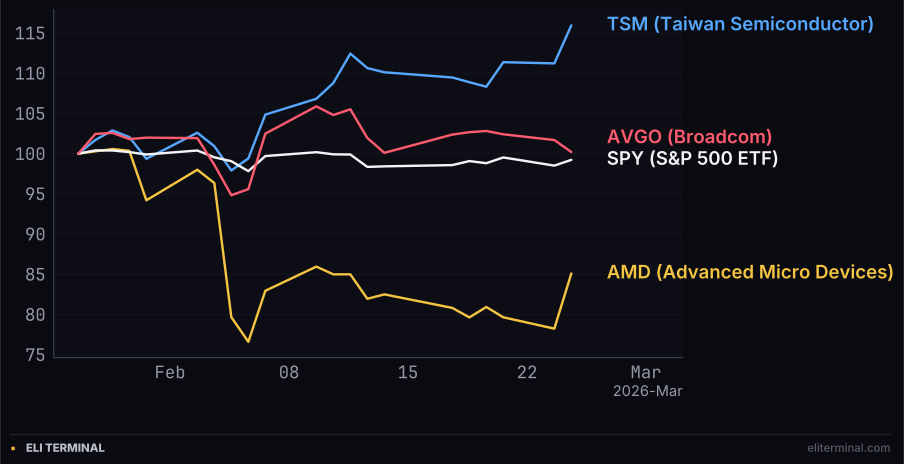
AMD's Tuesday jump claws back only part of a rough three weeks that followed its own February 3 earnings report.
AMD gained 8.8% after a pre-market SEC filing detailed Meta's up to $100 billion GPU commitment, Home Depot rose 2.0% on its first earnings beat in a year, and the S&P 500 closed at 6,890.07, clawing back most of Monday's software-led selloff.
AMD's Tuesday jump claws back only part of a rough three weeks that followed its own February 3 earnings report.
AMD's 8-K landed with the SEC at 12:01:06 UTC Tuesday, disclosing a "definitive multi-year, multi-generation partnership" with Meta Platforms to deploy up to 6 gigawatts of AMD Instinct GPUs, with first shipments of a custom MI450-based chip beginning in the second half of 2026. The filing's hourly candle tells the story on its own: AMD opened that hour at 197.27 and traded as high as 227.03 before the New York cash open even happened, a premarket move of roughly 15% inside sixty minutes.
"We're excited to form a long-term partnership with AMD to deploy efficient inference compute and deliver personal superintelligence," Meta founder and chief executive Mark Zuckerberg said in the companies' joint release. AMD chief executive Lisa Su called it a step toward "placing AMD at the center of the global AI buildout." AMD also issued Meta a performance-based warrant for up to 160 million AMD shares, roughly 10% of the company, vesting only as GPU shipment and stock-price milestones are hit.
AMD's stock never traded above 227 again after that first hour. By the 14:30 UTC cash open it had settled to about 212, and it closed the day at 213.84, up 8.77% versus Monday but nearly 6% below its own premarket high. The pattern held through the afternoon: a run to 216.71 by 17:30 UTC, a pullback to 213.03 by 19:30 UTC, a final push into the 213 to 214 range at the bell.
That is still the largest one-day move on the tape Tuesday and the biggest single-name story of the window. It just isn't the 15% headline the first candle promised. Whoever bought the premarket spike sold some of it back once the cash market opened.
TSM closed at 385.75, up 4.25%, a direct supply-chain read on AMD's news: AMD's Instinct GPUs are fabricated at TSMC. TSM's move started earlier than AMD's did, climbing from 373.75 at the 09:00 UTC Asia session open to 379.58 by noon UTC, before jumping again alongside the AMD filing.
Broadcom was the one megacap chip name that closed red, down 1.47% to 325.49. Broadcom builds Meta's other AI silicon program, the custom MTIA accelerator, and no analyst note or wire story published that day drew a direct line between that business and AMD's new merchant-GPU commitment. It sits as an open contrast: everyone in the AI-chip trade caught a bid off Meta's announcement except the other company already supplying Meta chips.
Home Depot's 8-K was accepted by the SEC at 11:07:18 UTC, well ahead of the New York open. Adjusted fourth-quarter earnings came in at $2.72 a share against $2.54 expected, on revenue of $38.2 billion versus $38.12 billion forecast. Comparable sales rose 0.4%, the chain's first positive quarterly comp after missing three quarters running.
"For the fourth quarter, our results were largely in-line with our expectations, reflecting the lack of storm activity in the third quarter and ongoing consumer uncertainty and pressure in housing," chair and chief executive Ted Decker said in the release. "Adjusting for storms, underlying demand was relatively stable throughout the year." Fiscal 2026 guidance called for sales growth of 2.5% to 4.5% and earnings growth of flat to 4%, hardly aggressive.
The stock's premarket candle ran from 374.89 up to 393.49 in the hour after the filing, a jump of roughly 5%. By the close Home Depot was at 384.48, up 1.99% on the day and more than 2% below that premarket peak. Same mechanism as AMD: a filing-driven premarket spike, a fade once the regular session opened, and a real but smaller gain left standing at 4pm.
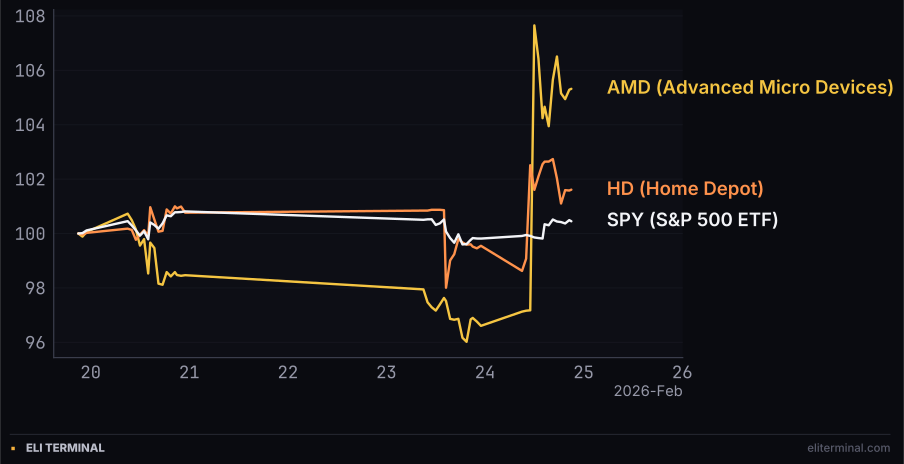
Two unrelated filings, forty minutes apart, produced the same shape: a premarket spike that didn't fully hold.
Anthropic on Friday, February 20, launched Claude Code Security, a tool the company said had already found more than 500 vulnerabilities in production codebases by scanning for them automatically. Cybersecurity stocks fell that Friday and again on Monday, February 23, on fear that AI-native vulnerability scanning threatens the per-seat licensing model the sector is built on. IBM fell 13.15% that Monday, CrowdStrike dropped 9.85%, Cloudflare fell 9.57%, and Okta lost 6.43%, alongside a broader slide in Adobe, Salesforce and ServiceNow that Jefferies analysts had already taken to calling a "SaaSapocalypse."
Tuesday reversed most of it. Salesforce closed up 4.08%, Adobe gained 3.44%, IBM rose 2.67%, Okta added 2.35%, Cloudflare gained 2.26% and ServiceNow rose 1.68%, and the Conference Board's consumer confidence index, released at 15:00 UTC, added to the tone, rising 2.2 points to 91.2.
None of Tuesday's names recovered Monday's full loss, but the direction was unanimous, except for two.
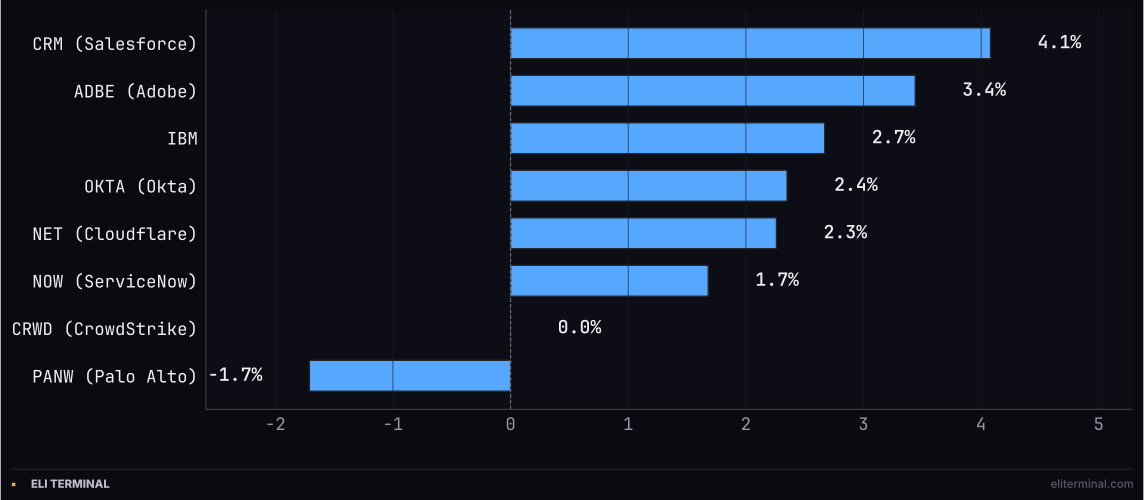
Six of eight names bounced. CrowdStrike sat still and Palo Alto Networks kept falling.
CrowdStrike closed at 87.5625, down two cents from Monday's 87.5825, functionally flat. Palo Alto Networks fell another 1.71% to 141.67, extending Monday's 3.07% decline into a second red session while the rest of the group turned green. Both are named repeatedly in the coverage of Anthropic's tool as the platforms most directly positioned against AI-native code scanning.
Nothing published Tuesday singled out either stock. The tape drew its own distinction: a sector-wide relief rally that stopped at the door of the two companies whose business model sits closest to the thing that scared the market in the first place.
The VIX held near 21 through the European morning, then broke at the 14:00 to 15:00 UTC hour, the same window as the New York cash open, dropping from an intraday high of 22.08 to a low of 19.78 and closing the day at 19.55, down 6.95%. Gold fell from about 5,192 an ounce at 11:00 UTC to a session low of 5,109.50 by 14:00 UTC, the same two-hour stretch that contained both the Home Depot and AMD premarket spikes, before recovering into the close at 5,155.80, down 0.94% on the day. Oil slipped a more modest 1.03% to settle at 65.63.
None of these moves can be pinned to a single headline the way AMD's can. But the timing lines up: a session that started with two bullish filings and a rebound thesis in software ended with the market's two classic fear gauges, volatility and gold, both lower.
All tariffs imposed under the International Emergency Economic Powers Act formally terminated at 05:00 UTC Tuesday, the mechanical result of the Supreme Court's February 20 ruling against that authority. The dollar index closed at 97.88, up just 0.18%, a non-event for a change that had been telegraphed for four days and was already reflected in the currency.
Federal Reserve Governor Lisa Cook gave opening remarks that same day for an "AI and Productivity" panel at the NABE conference in Washington, a sitting Fed governor addressing AI's economic effects on the same Tuesday AMD's AI-infrastructure deal moved the tape. Neither the dollar nor Treasury yields showed any distinguishable reaction to her remarks.
Nvidia reports fiscal fourth-quarter results Wednesday, February 25, the single largest catalyst on the calendar and a direct read on whether Tuesday's AI-infrastructure enthusiasm in AMD extends to the sector's dominant supplier. Salesforce also reports Wednesday, the first hard data point on whether Tuesday's 4.08% software bounce was a genuine repricing of the AI-disruption fear or a one-day relief trade ahead of the print that actually tests it.