One-day moves, February 23
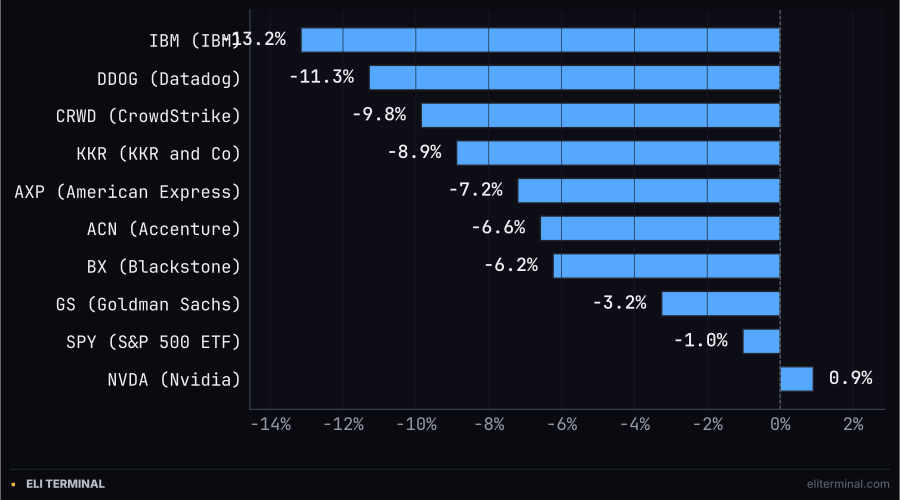
IBM led every name on the tape lower. Nvidia was the only one of the ten that closed green.
IBM fell 13.2% Monday, its worst single day since 2000, while KKR fell 8.9% and American Express fell 7.2% in the same session, on two different clocks.
IBM led every name on the tape lower. Nvidia was the only one of the ten that closed green.
9:30 a.m. Eastern is when Monday's cash session opened, and it is also when American Express, KKR, Blackstone and the Financial Select SPDR fund each posted their sharpest single move of the day. American Express fell from 343.35 to an opening-hour low of 322.40. KKR fell from 99.90 to 94.14 in the same half hour. Both were mostly finished falling by 10:30 a.m.
IBM did not follow that pattern. It opened down only about 3%, a fraction of what hit the financials, then went nearly flat for three hours, trading in a narrow band near 245 to 246 through the entire late morning and into early afternoon.
President Trump posted on Truth Social Monday that any country that tries to "play games" with the Supreme Court's ruling against his tariff authority would face "a much higher Tariff, and worse" than previously agreed, a threat that landed on top of a viral research memo, published Sunday by Citrini Research, framing a hypothetical 2028 recession driven by AI-related white-collar job losses. Both were live in the market before the opening bell.
Financials absorbed the brunt of it. XLF fell 2.6% in the first half hour of trading and closed down 3.35%, its worst day since at least mid-February. Blackstone fell from 119.21 to a session low of 111.04 by mid-morning before a partial recovery to close at 113.71, down 6.23%. Goldman Sachs closed down 3.25%. None of the four had reported anything company-specific that morning.
223.35 is where IBM closed Monday, down 13.15% on the day and its steepest single-session decline since October 2000. The path there was not a straight line from the open. IBM spent 9:30 a.m. to roughly 1:30 p.m. Eastern essentially flat, down about 4% and going nowhere, before a second break began inside the 1:30 p.m. hour that took the stock from 246.29 to an hour-close of 227.67, a slide from roughly 4% down to nearly 12% down in about sixty minutes. The session low printed at 220.72 before a partial bounce into the 223.35 close.
That second leg lines up with Anthropic's release Monday of a Claude Code capability built to automate COBOL analysis and modernization, the legacy programming language that IBM's mainframe consulting franchise is built around, alongside a companion "Code Modernization Playbook." Social commentary on the announcement was already circulating by early afternoon Eastern, in the same window the tape broke. The mechanism was specific enough to name: a task IBM has billed multi-year consulting engagements for, Anthropic just showed could be automated.
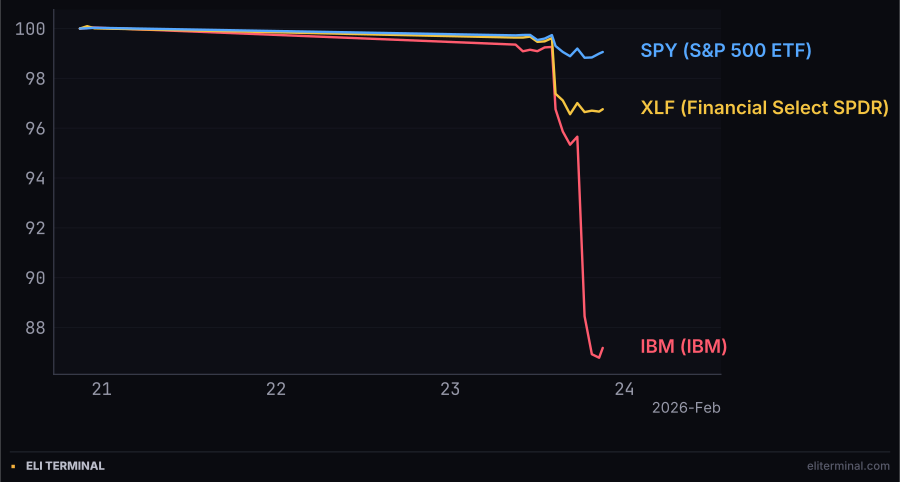
Financials and the index fall together at the open. IBM's real break comes hours later, alone.
The S&P 500's worst print of the day came around 10:30 to 11:00 a.m. Eastern, when SPY touched an intraday low of 680.37. By 1:30 p.m., when IBM began its sharpest leg down, SPY was trading between 681 and 684 and closed the session at 682.87, modestly off its low. The index was done falling for the day well before IBM was.
Accenture closed down 6.58% and Cognizant closed down 6.0%, both companies that, like IBM, sell legacy-system modernization and IT consulting services at scale. Datadog fell 11.28% and CrowdStrike fell 9.85%, continuing a slide that started with Sunday's memo and ran through the entire enterprise-software list. None of the four had earnings or company-specific news scheduled for Monday.
Gold closed at 5,204.70, up 2.87% on the day and its sharpest single-session gain in the past week, while the VIX closed at 21.01, up 10.06%. Both read as a classic flight-to-safety bid on a down day for equities.
The market pricing a US recession in 2026 moved only from 22% to 23% between Sunday night and Monday's close, essentially unchanged despite the equity session. A move large enough to be the sharpest single-stock drawdown in a quarter-century, and a viral memo built around a recession scenario, together bought one point of odds-market movement on the recession question itself.
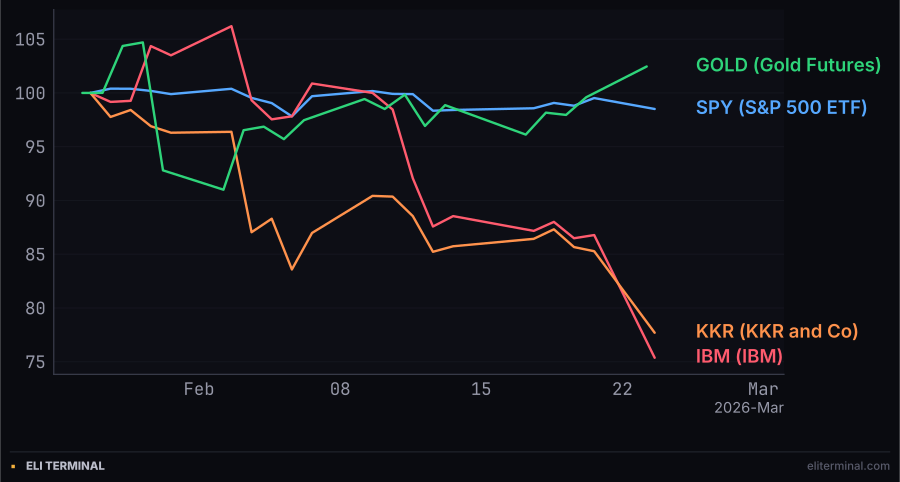
IBM and KKR were already the month's weakest names. Monday didn't start their decline, it steepened it.
Nvidia closed up 0.91% and Apple closed up 0.60%, the only two names on Monday's tape among the day's most-discussed movers to finish in the green. Both sit at the center of the AI buildout that Sunday's memo warned would eventually go bust. Neither is a SaaS company with a subscription base that agentic software could underprice, and neither sells the kind of white-collar consulting labor that Anthropic's tool just showed could be automated. The selling hit the businesses closest to being replaced by AI, not the businesses building it.
The 10-year Treasury yield fell 1.4% to 4.029% Monday, a bond-market bid that reads as flight to safety alongside gold and the VIX, not as a reaction to Federal Reserve commentary on rates. Governor Christopher Waller, speaking at the NABE Economic Policy Conference in Washington, described the Fed's March decision as "close to a coin flip" between holding rates and a 25-basis-point cut, contingent on whether February's jobs data confirms or reverses January's strength. He called January's report "welcome good news" but cautioned that "one month is not a trend."
Nvidia reports earnings Wednesday, the highest-market-cap name on the calendar this week, alongside Salesforce and Snowflake the same day. Nvidia's report tests whether the hyperscaler capex commitments behind Monday's rally in AI-hardware names are intact. Salesforce and Snowflake's reports test the other half of Monday's story directly: whether the enterprise-software growth deceleration that Sunday's memo priced in shows up in the actual guidance, or whether Monday's selling in that group ran ahead of anything the companies themselves have said.