The two weeks into Friday's ruling
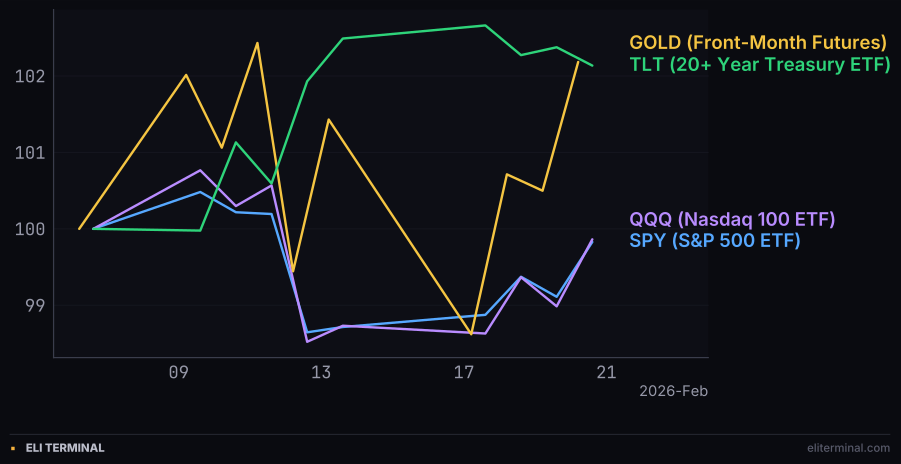
Stocks spent two weeks digging out of a mid-month air pocket. Gold and long bonds never stopped climbing.
A weak GDP print knocked the Dow down roughly 200 points at the open; the Supreme Court's ruling against Trump's tariffs erased it, and the S&P 500 closed +0.72% while Alphabet closed +4.01%, nearly six times the index's gain.
Stocks spent two weeks digging out of a mid-month air pocket. Gold and long bonds never stopped climbing.
Real GDP grew at an annualized 1.4% in the fourth quarter of 2025, the Bureau of Economic Analysis said at 9:30 a.m. Eastern Friday, in an advance estimate that had already been delayed three weeks by the October-November government shutdown. CNBC's own headline called it "badly missing" forecasts. In the same release window, the Commerce Department's Personal Income and Outlays report, also delayed from December, showed core PCE inflation at 3.0% year over year, the fastest pace since February 2025.
Stocks fell on both numbers. The Dow Jones Industrial Average was down roughly 200 points inside the first hour of trading, and the S&P 500 ETF slid to a session low of 681.73 by mid-morning, below Thursday's 684.48 close.
The Court ruled 6-3 in Learning Resources, Inc. v. Trump that Trump's tariffs under the International Emergency Economic Powers Act were unlawful, with Chief Justice Roberts writing for the majority, joined in full by Justices Gorsuch and Barrett and in part by Sotomayor, Kagan, and Jackson. Both the "reciprocal" tariffs and the fentanyl-linked duties on China, Canada, and Mexico fell under the ruling.
The S&P 500 ETF went from its 681.73 low to an intraday high of 689.40 inside the same trading hour the GDP number landed, a swing of more than a full point in percentage terms before the index eased back and spent the rest of the day grinding higher to close at 689.43. The Dow finished up 230.81 points, or 0.47%, at 49,625.97; the Nasdaq Composite added 0.9% to 22,886.07.
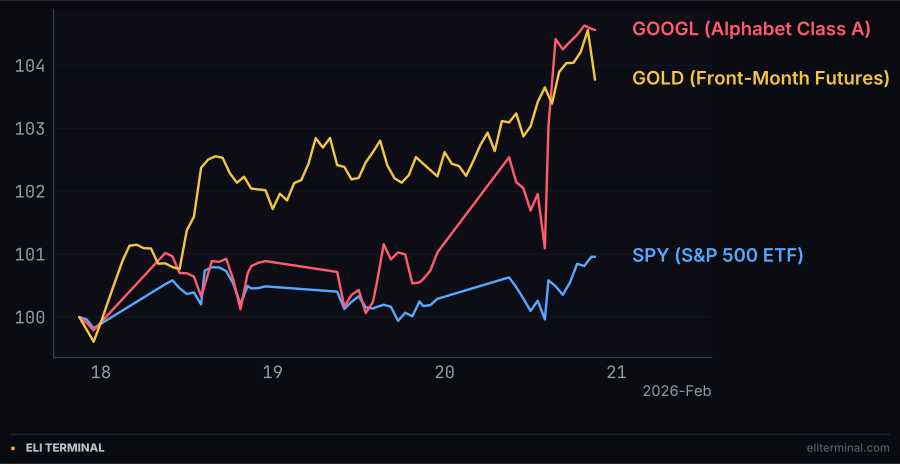
Same trading hour, three very different amplitudes. Alphabet's move dwarfs the index it trades inside.
Trump said Friday he had signed an executive order ending the IEEPA tariffs, effective at midnight Eastern on February 24, and in the same breath announced a new 10% tariff on all countries under Section 122 of the Trade Act of 1974, writing on Truth Social that it was his "Great Honor to have just signed, from the Oval Office, a Global 10% Tariff on all Countries, which will be effective almost immediately." Section 122 tariffs run for a maximum of 150 days without congressional extension.
Friday night, Trump named the two justices he appointed who joined the majority, writing that Neil Gorsuch and Amy Coney Barrett had sided with Chief Justice Roberts, whom he accused of having "led the effort to allow Foreign Countries that have been ripping us off for years to continue to do so." The market had already closed by the time the post went up; Friday's rally stood regardless of what came after the bell.
Alphabet closed at 314.98, up 4.01% from Thursday's 302.85, on more than double the tariff-relief bid that lifted Amazon (up 2.56% to 210.11) and Meta (up 1.69% to 655.66). Where the S&P 500 ETF peaked within the first trading hour and eased back before grinding higher into the close, Alphabet kept climbing straight through midday to an intraday high of 316.50 before settling near 315.
Google chief executive Sundar Pichai was in New Delhi Friday for the India AI Impact Summit, alongside other technology leaders, a scheduling coincidence that a search of Friday's wires did not tie to any specific Alphabet announcement or comment moving the stock. No article published Friday connected Alphabet's size of move to the summit, to the ruling specifically, or to anything else; the size of the move, roughly double the market's own reaction, has no single confirmed cause.
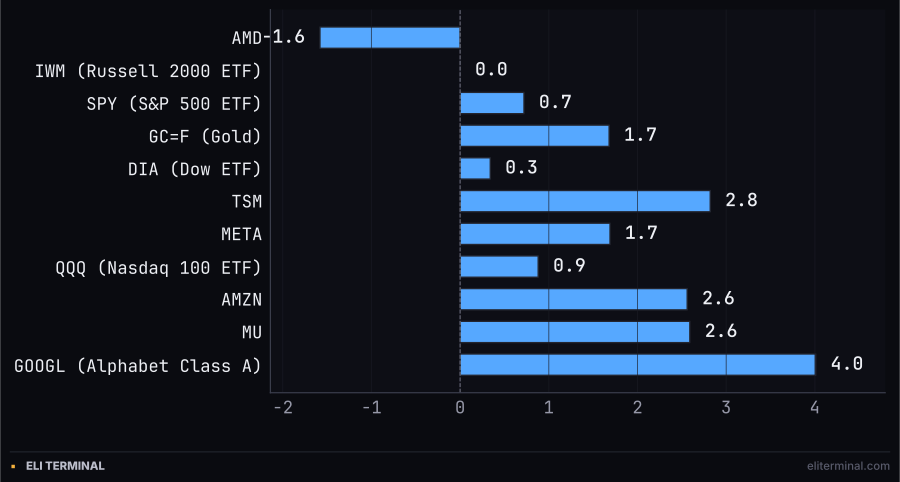
A tariff-relief rally that lifted almost everything still left AMD in the red and Alphabet in a different category entirely.
Gold futures traded near 5,044 as of noon UTC Friday, then jumped to 5,075 by 2 p.m. UTC on the weak GDP and hot PCE data, a straightforward safe-haven bid. The metal then fell as low as 5,005.50 within the hour the Supreme Court ruled, consistent with a risk-on unwind of the morning's hedge. From there it recovered through the New York afternoon, trading above 5,119 by 3 p.m. Eastern before settling at a 5,059.30 close, up 1.68% on the day.
A tariff-relief rally that fully reversed the morning's selloff would ordinarily let a safe-haven asset give back its gains. Gold gave back only part of its intraday spike and still closed higher than every session in the prior two weeks except Wednesday's. The 20-plus-year Treasury ETF told a similar story, essentially flat on the day at 89.41 after four straight sessions holding levels last seen in January.
The Russell 2000 index closed down about 0.05% at 2,663.78, even as the small-cap ETF that tracks it, IWM, closed effectively unchanged at 264.61. AMD fell 1.58% to 200.15 the same day Micron rose 2.59% and Taiwan Semiconductor rose 2.82%, a split inside the same chip trade that a tariff-relief narrative alone does not explain. The VIX fell 5.64% to 19.09, a larger drop in percentage terms than the S&P's own gain, consistent with a market unwinding fear faster than it was pricing in upside.
Trump told reporters at a White House briefing Friday that Iran had "10 to 15 days" to reach a nuclear agreement, adding aboard Air Force One that "bad things" would follow if Tehran refused and that "I would think that would be enough time, 10, 15 days, pretty much maximum." Iranian Foreign Minister Abbas Araghchi, in a same-day interview on Morning Joe, said Iran would have a draft proposal ready within two to three days.
West Texas crude closed at 66.39, down 0.06% on the day, inside the same session that produced a presidential deadline over a live nuclear standoff. Whatever premium the oil market attaches to a war with Iran, Friday's ultimatum did not move it; the reaction, if there is one, has not shown up yet.
The IEEPA tariff termination takes effect at midnight Eastern on February 24, the same day the new Section 122 global tariff was signed to begin running its 150-day clock, and the same week Home Depot and Constellation Energy report earnings. Nvidia, whose roughly 5.3 trillion dollars of market capitalization makes it the largest company reporting that week, is scheduled to report its fiscal fourth quarter on February 25, five trading days after Friday's close, the first mega-cap print to test whether Friday's rally has any durability beyond the ruling that caused it.