Chips split from security software, one month
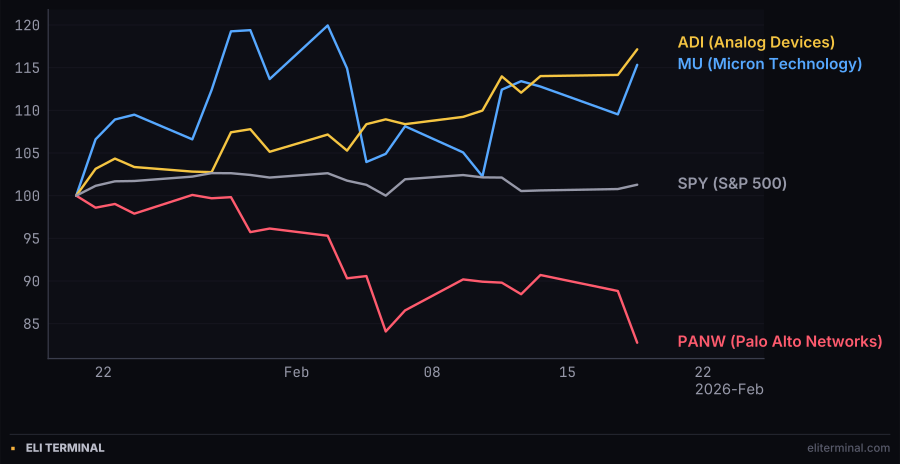
Micron and Analog Devices climbed the same month Palo Alto Networks fell, and Wednesday widened the gap on both sides.
Analog Devices' 7:02 a.m. earnings print sent Micron +5.3% at Wednesday's open, Palo Alto Networks fell 6.8% on its own deal costs, and oil climbed 4.6% through the session with no single headline behind it.
Micron and Analog Devices climbed the same month Palo Alto Networks fell, and Wednesday widened the gap on both sides.
7:02 a.m. Eastern is when Analog Devices' fiscal first-quarter results hit EDGAR Wednesday, and the stock's hourly bar for that window shows why: a jump from a premarket 343 to an intraday high of 374.99 within the same sixty minutes. Revenue came in at $3.16 billion, up 30% year over year, with adjusted earnings per share of $2.46 against a Wall Street estimate near $2.30.
"Bookings growth continued, driven by broad strength in Industrial and record orders for our Data Center segment," chief financial officer Richard Puccio said in the release, adding that the second-quarter revenue outlook of $3.5 billion "reflects a new high watermark for ADI." The board also raised the quarterly dividend 11% to $1.10 a share, the 22nd straight year of increases.
Analog Devices gave back most of that premarket spike by the close, settling at 346.37, up 2.62% for the day rather than the 11% the premarket print implied. Micron, which had no scheduled news of its own Wednesday, opened flat near 400 and then gapped to an intraday high of 423.80 in the first half hour of regular trading, finishing at 420.95, up 5.30%. The two moves shared a morning and a sector; nothing in Wednesday's wires tied them together beyond that.
Palo Alto Networks posted revenue of $2.5 billion Tuesday evening, up 15.7% year over year, and raised its full-year outlook. The stock's after-hours bar still shows a drop from 163.73 to a low of 153 within the same hour the release crossed the wire, on volume the session had not seen all day.
The number that moved it was smaller than the headline: fiscal 2026 adjusted earnings guidance cut to $3.65 to $3.70 a share from a prior $3.80 to $3.90, tied to deal-related costs that more than doubled to $24 million in the quarter as the company digests its roughly $30 billion in recent acquisitions, led by the CyberArk and Chronosphere deals. Palo Alto Networks touched a session high of 155.28 near midday Wednesday before fading back to 152.35 at the close, down 6.82% from Tuesday.
Minutes from the January 27-28 meeting crossed at 2 p.m. Eastern Wednesday, and the S&P 500 fell from 687.84 to 684.21 in the hour that followed before recovering into the close. Governors Christopher Waller and Stephen Miran dissented in favor of a cut; the broader committee argued rate cuts should pause, with "most participants" flagging that progress toward 2% inflation could run slower than expected.
The 10-year yield closed at 4.079%, up roughly 2.7 basis points, and the dollar index added 0.56% to 97.70, both consistent with a hawkish read. Equities, notably, did not agree by the close: the S&P 500 finished at a session high, up 0.56%, the same day its own rate-setting committee argued for less easing ahead.
Constellation Energy reported fourth-quarter adjusted operating earnings of $2.30 a share Tuesday, ahead of the $2.18 analysts had forecast, alongside a completed Calpine acquisition and a Department of Energy loan guarantee to restart the Crane Clean Energy Center. None of that stopped the stock from closing at 294.05 Wednesday, down 2.96% from Tuesday's 303.01.
Constellation is a nuclear-and-power name that trades partly like a long-duration bond: its cash flows are contracted years out, which makes it sensitive to the same afternoon that pushed the 10-year yield higher. A beat-and-fall pattern that showed up in Palo Alto Networks for company-specific reasons showed up in Constellation on the same day rates moved against it.
Gold closed at 4,986.50, up 2.12% from Tuesday, but the daily number hides two separate sessions. The metal rallied through the European morning to an intraday high of 5,031.90 by 11 a.m. Eastern, then gave back roughly 35 dollars into the close as the dollar index climbed from 97.56 to 97.70 in the same afternoon window that carried the Fed minutes. Silver added 5.53% and copper 2.85% on the day, both grinding higher alongside gold's morning leg rather than its afternoon fade.
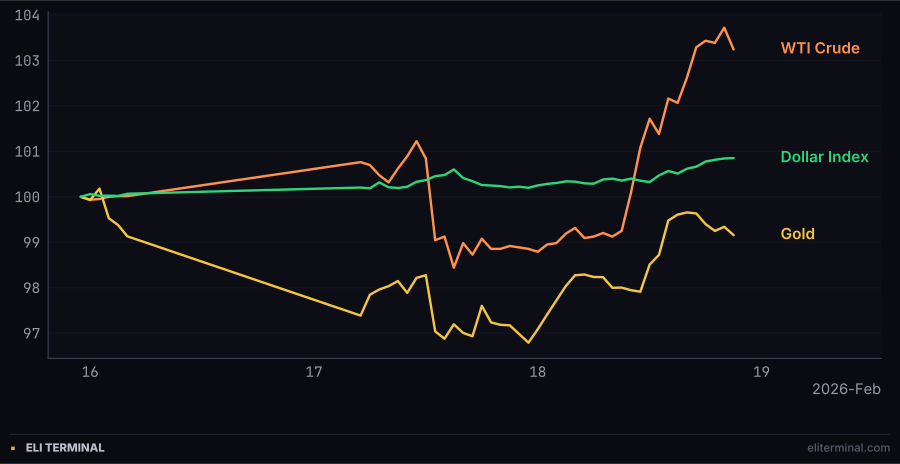
Oil's climb was a steady grind. Gold's was a morning rally that lost half its gain by the close.
West Texas crude opened Wednesday's regular session near 63.80 and closed at 65.19, up 4.59%, without the sharp single-hour break that usually marks a headline-driven move. Brent added 4.35% to 70.35. The grind ran from the New York open through the close, one steady climb rather than a jump.
The nearest news is a day old: Tuesday in Geneva, Omani-mediated talks between U.S. and Iranian negotiators produced what Iran's foreign minister called a "general understanding on a set of guiding principles," a description that reads as de-escalatory, not a supply threat. No deal was announced, and oil rose anyway, on no single dated catalyst a search of Wednesday's wires turned up. Call it what it is: adjacency to a standing risk premium, not a traceable cause.
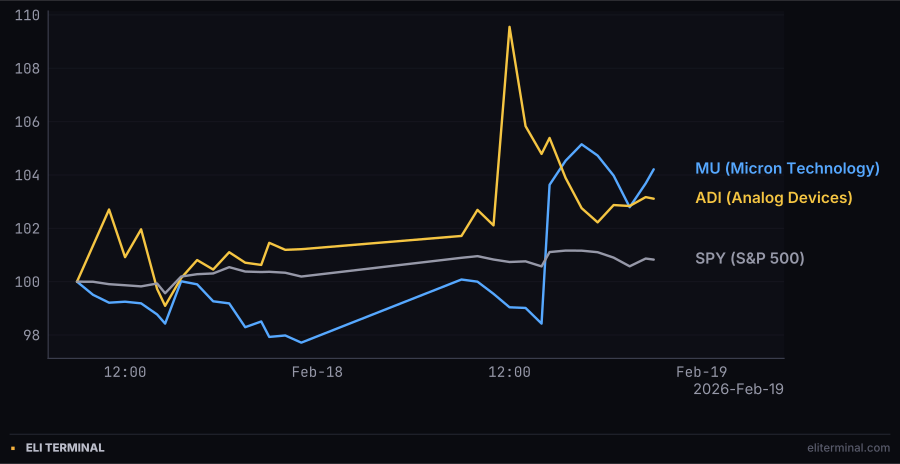
Analog Devices moved first, before the bell. Micron moved second, at it.
Industrial production rose 0.7% in January, the Federal Reserve reported at 9:15 a.m. Eastern, its second straight monthly gain, with capacity utilization up to 76.2%. The S&P 500's hourly bar spanning that release shows a shallow dip from 685.51 to 684.19, smaller than the move the index made in the half hour after the market opened forty-five minutes later. A better-than-expected factory report landed and the tape barely noticed, well before Micron's own gap took over the morning.
Walmart reports fiscal fourth-quarter results before Thursday's open, and Booking Holdings' fourth-quarter release, filed after Wednesday's close, gets its first analyst questions on a call the following morning. Booking closed Wednesday up 3.14% ahead of that report. Nvidia's own fiscal fourth-quarter call is set for February 25, the next scheduled test of whether Wednesday's data-center enthusiasm in Analog Devices and Micron extends to the sector's largest name.