Five days into the earnings gap, and the fade
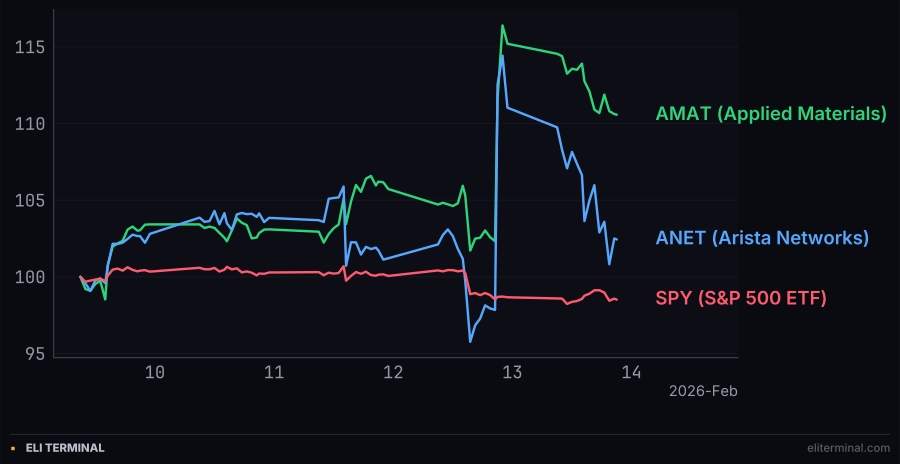
Both lines peak within an hour of Friday's open. Neither holds it.
Applied Materials and Arista Networks both surrendered most of an earnings-day spike by the closing bell, closing up 8.08% and 4.79% instead of the double-digit gains each posted after hours, while the S&P 500 round-tripped a whole rally to close barely changed.
Both lines peak within an hour of Friday's open. Neither holds it.
Applied Materials reported fiscal first-quarter results at roughly 21:00 UTC Thursday, minutes after the closing bell, and the stock jumped from a 328.39 close to an after-hours high of 374.96, a gain of 14.2% within the hour. Arista Networks reported its own fourth-quarter results in the same window and spiked from 135.12 to 163.00 after hours, up 20.6%.
Both prints beat estimates and raised guidance. Neither stock closed anywhere near where it peaked.
By Friday's opening bell at 14:30 UTC, Applied Materials had already given back roughly a third of its overnight gain, trading near 365. It caught one more bid at the open, printing a session high of 376.31, then sold steadily for the rest of the day to close at 354.91, up 8.08% on Thursday but 22.40 points, or 5.9%, below its post-earnings high.
Arista's arc was steeper. The stock traded as high as 152.80 in the pre-open hour, opened at 145.82, and was already down to 141.00 within that first half hour of cash trading. A brief secondary bounce carried it to 148.77 by 16:30 UTC, after which it sold through the rest of the afternoon to a low of 138.00 before a late recovery to close at 141.59, up 4.79% on Thursday but 21.41 points, or 13.1%, off its own after-hours peak.
Applied Materials beat on both lines: earnings per share of 2.38 dollars against a Street estimate of 2.21, and revenue of 7.01 billion dollars against an estimate of 6.88 billion. CEO Gary Dickerson tied the quarter directly to AI infrastructure spending in the earnings release: "Applied Materials delivered strong results in our fiscal first quarter, fueled by the acceleration of industry investments in AI computing," pointing to "high growth rates for leading-edge logic, high-bandwidth memory and advanced packaging." The company guided second-quarter earnings per share to 2.44 to 2.84 dollars and revenue to 7.2 to 8.2 billion dollars, both ranges above what Wall Street had modeled.
Sell-side coverage moved in the opposite direction from the stock on Friday. Citigroup raised its price target to 420 dollars from 400 and kept a buy rating, Royal Bank of Canada set a 430 dollar target, and Barclays raised its target to 450 dollars from 360, all published the same day the stock was falling from its morning high.
A round of price-target increases averaging roughly 20% landed on a session where the shares fell nearly 6% from the open. The disagreement is not between the earnings and the guidance, both of which beat; it is between what the analysts wrote Friday morning and what the order flow did Friday afternoon.
Arista's fourth-quarter revenue reached 2.49 billion dollars, up 28.9% year over year and above a guided range of 2.3 to 2.4 billion. Full-year 2025 revenue came in at 9 billion dollars, up 28.6%.
For 2026, the company raised its outlook to 25% revenue growth, roughly 11.25 billion dollars, and told investors it now expects AI networking revenue to double year over year to 3.25 billion dollars, up from a prior goal of 2.75 billion. Non-GAAP operating margin ran 48.2% for the full year, and quarterly net income topped 1 billion dollars for the first time, at 42% of revenue.
None of that changed between Thursday's after-hours print and Friday's 4pm close. What changed was how much of it the market was willing to pay for in a single session. The stock's slide from 152.80 to 138.00 over the course of Friday, a drop of 9.7% intraday, came with no incremental Arista-specific news found anywhere in Friday's wires.
The Bureau of Labor Statistics released January's consumer price index at 13:30 UTC. Headline CPI rose 0.2% on the month against a forecast of 0.3%, and 2.4% year over year against a forecast of 2.5%, the slowest annual pace since May 2025.
Core CPI ran at 2.5% year over year, the lowest core reading since April 2021. Shelter rose just 0.2% for the month, energy fell 1.5%, and used cars and trucks fell 1.8%, while airline fares jumped 6.5%.
The S&P 500 ETF traded in a tight band around the print itself, then whipsawed at the 14:30 UTC open between a low of 677.52 and a high of 683.37 within the same hour. From there it climbed steadily to a session high of 686.28 by 17:30 UTC, a gain of 1.3% off the day's low.
It then reversed just as steadily, falling to 680.34 by 19:30 UTC and erasing essentially the entire move, before a partial recovery into the close left it at 681.75, up 0.05% on the S&P 500 index for the day. A rally that ran for three hours and covered nearly nine points didn't survive the last two.
The Russell 2000 traded the same shape as the S&P 500 on Friday, bottoming near the CPI release and topping out in the same 17:30 UTC hour, but its round trip was smaller. The Russell 2000 ETF ran from a low of 258.44 to a high of 265.17, a gain of 2.6%, then pulled back to close at 262.96, still up 1.32% on the day and 1% on the underlying index.
Small-cap stocks carry more floating-rate debt and more direct exposure to the path of short-term rates than the mega-cap index, which is the standard reason a cooling inflation print would move the Russell more than the S&P. Friday's session matched that pattern in the rally and only partly matched it in the reversal.
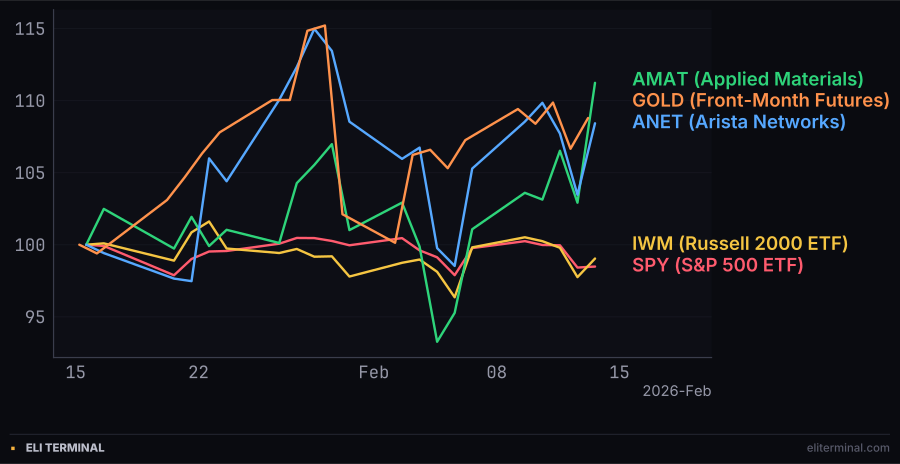
Two single-day earnings spikes dwarf a month of index trading.
Gold had fallen 2.9% Thursday to 4,923.70 an ounce. It was already recovering overnight, trading near 5,000 by 08:00 UTC Friday, then dipped back to 4,988.80 in the hour before the CPI release.
In the hour containing the 13:30 UTC print, gold rose to 5,008.40, its steepest single-hour gain of the morning, and kept climbing through the New York afternoon without giving the move back, closing at 5,022.00, up 2.0% on the day. The 10-year Treasury yield fell to 4.056%, down roughly 4.8 basis points, but that decline extended a slide that had been running for days: the yield closed at 4.698% the previous Friday and had fallen in nearly a straight line since, so Friday's incremental move looks less like a CPI reaction and more like a continuation the print didn't accelerate.
The VIX told a similar non-story with more motion inside it. It opened Friday at 21.48, spiked to 22.40 in the hour after the cash open, fell to 19.18 by early afternoon as the S&P rallied, then popped back to 21.50 as the S&P gave the rally back, before settling at 20.60, down 1.06% on the day. A closing change of about a fifth of a point sat on top of an intraday range of more than three points, the same shape as the S&P's own round trip.
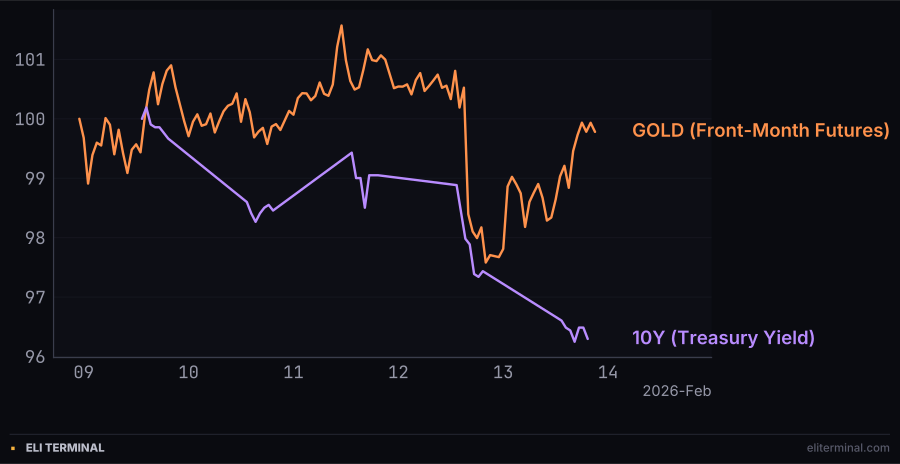
Gold's line bends higher at the print. The yield's line doesn't bend at all.
Nvidia closed at 182.81, down 2.21% on the day, and Broadcom closed at 325.17, down 1.81%. Neither company had scheduled news Friday, and neither found a sympathy bid from the two AI-infrastructure names that beat and raised the night before. Friday's gains belonged specifically to the two stocks that had just reported, not to chip and AI-infrastructure names generally, which is one more way the day's earnings reaction stayed contained rather than spreading.
Funding for the Department of Homeland Security was set to lapse at 05:00 UTC Saturday, the start of a shutdown limited to DHS and its component agencies. Senate Republicans tried to pass a short-term extension Thursday to buy time for negotiations over federal immigration-enforcement conduct; Senate Democrats blocked it. No deal had been reached by Friday's close.
The Federal Reserve's next scheduled decision falls March 18, and Friday's cooler CPI print is the last full inflation read policymakers get before then. A market pricing further softening in prices now has five weeks to find out whether Friday's number was the start of a trend or a single soft month inside a run that includes both.