One-day moves, February 12
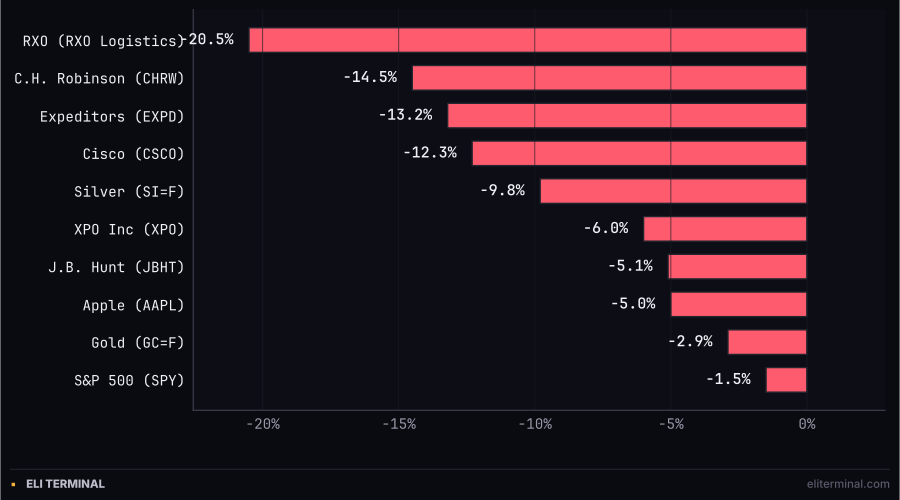
Ten tickers, one theme: something about artificial intelligence attached to every name on this list.
Apple lost 5.0% on a Siri delay and an FTC letter to Tim Cook, Cisco lost 12.3% on memory costs squeezing its own AI buildout, and RXO lost 20.5% after a company most traders had never heard of said its AI could run freight networks with fewer people.
Ten tickers, one theme: something about artificial intelligence attached to every name on this list.
The S&P 500 closed at 681.27, down 1.5%, its third straight losing session. The Nasdaq-100 fell harder, down 2.0% to 600.64, and the VIX jumped 18.0% to 20.82, its sharpest one-day move in over a week.
None of the three biggest single-name stories behind that tape shared a company, a sector, or even a scale. Apple, a nearly three-trillion-dollar phone maker, fell on a delayed software feature. Cisco, a networking hardware company, fell on the rising cost of the memory chips it needs to build AI infrastructure. RXO, a freight broker, fell on a press release from a company with a market capitalization under ten million dollars.
Bloomberg reported Wednesday evening that Apple's AI-upgraded Siri, tested internally for iOS 26.4, was running into snags and would likely slip to May or later rather than shipping within weeks as investors had expected. Thursday morning, FTC Chair Andrew Ferguson sent Tim Cook a letter citing Media Research Center findings that Apple News "systematically promoted" left-leaning outlets while suppressing conservative ones, and asked Apple to "take corrective action swiftly" if true.
Apple traded as low as 273.41 in the pre-market, below Wednesday's 275.50 close, then ticked back to 275.60 right at the 9:30am ET open before breaking hard: the first hour of regular trading alone took the stock from that 275.60 open to a low of 270.06. By the close Apple had fallen to 261.73, down 5.0% on the day and erasing roughly 200 billion dollars of market value in a single session, its worst day since April.
UBS had downgraded the entire U.S. technology sector to Neutral two days earlier, citing hyperscaler capital spending approaching 700 billion dollars a year and what it called lingering "software uncertainty." Thursday gave that call a specific, single-company face.
Cisco reported fiscal second-quarter results Wednesday after the close: revenue of 15.3 billion dollars, up 10% year over year and ahead of the 15.12 billion dollar consensus, with adjusted earnings of 1.04 dollars a share beating a 1.02 dollar estimate. The headline numbers were clean. The guidance was not.
Non-GAAP gross margin came in at 67.5%, down 120 basis points from a year earlier, and Cisco guided third-quarter gross margin to 65.5% to 66.5%, below what analysts had modeled, citing rising memory chip costs tied to the same AI-driven demand crunch that is lifting DRAM and HBM prices industry-wide. The stock fell 6.7% in Wednesday's after-hours session, from 85.48 to 79.73, then kept falling Thursday: another sharp leg down in the first hour after the 9:30am ET open took it from 79.59 to a low of 76.91, and it closed the regular session at 75.00. That full round trip from Wednesday's pre-earnings close of 85.54 works out to a two-session loss of 12.3%.
Algorhythm Holdings, a Fort Lauderdale company with a market capitalization near six million dollars, published a release at 14:21 UTC, nine minutes before Thursday's open, saying its SemiCab platform had let live customers scale freight volumes by 300% to 400% without adding headcount. The claim rested on an internal white paper, not third-party audited data.
Freight and logistics stocks opened little changed at the 14:30 UTC bell, then broke inside that first hour of trading. RXO opened at 16.53, barely above Wednesday's 16.33 close, and fell to an intraday low of 11.18 before closing at 12.99, down 20.5% on the day. C.H. Robinson opened at 196.63 and fell to an intraday low of 149.36, closing at 167.78, down 14.5%. Expeditors International fell 13.2% to 140.56, XPO fell 6.0% to 189.81, and J.B. Hunt fell 5.1% to 218.72.
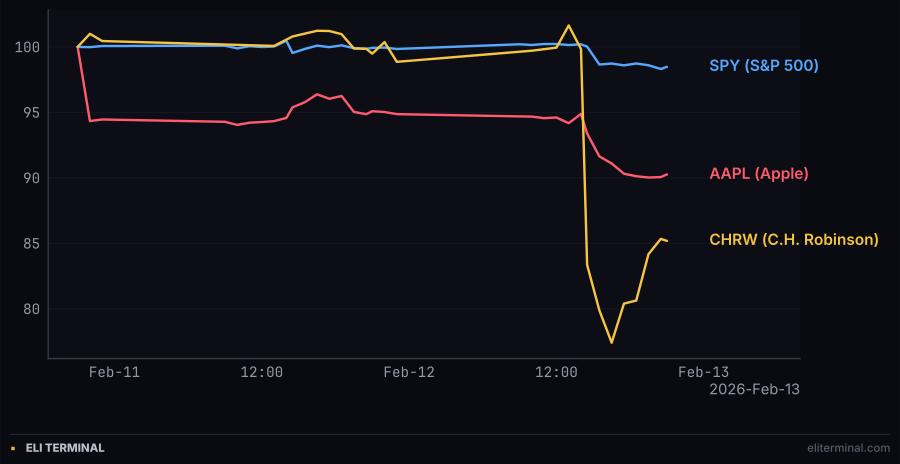
Apple bled slowly from Wednesday's news. C.H. Robinson dropped in one bar, at the open, on Thursday's freight release.
The S&P 500 barely moved at Thursday's open, trading in a tight band around 694 through the first hour even as Apple, Cisco, and the freight names were already down hard. The break came later: between 10:30 and 11:30am ET the index fell from about 693 to 683.6, a move of roughly 1.4% inside a single hour, well after the opening bell had absorbed the morning's individual headlines.
The VIX moved on the same clock. It held near 17 through the morning, then jumped from 17.46 to an intraday high of 20.60 in the 11:00am to noon ET hour, the same window the index cracked. A day that started as three unrelated single-stock and single-sector stories became, by late morning, a broader repricing of how much artificial intelligence is going to cost the companies building it and take from the companies it might replace.
Gold fell from Wednesday's 5,071.60 close to 4,923.70, down 2.9%, and silver fell from 83.75 to 75.55, down 9.8%, both moving lower alongside the equity selloff rather than against it. Precious metals had already crashed once this cycle, on January 30, when silver collapsed from above 121 to near 78 in a single session on news that Kevin Warsh would be nominated as the next Fed chair and a CME margin hike that forced liquidations, a move with its own distinct cause and no comparable equity selloff that day.
Thursday was different in kind: gold and silver moved down in the same session, and largely the same hours, that stocks did. A metal frequently bought as insurance against currency debasement and prized during risk-off stretches instead behaved like just another asset getting sold on a bad day for growth expectations.
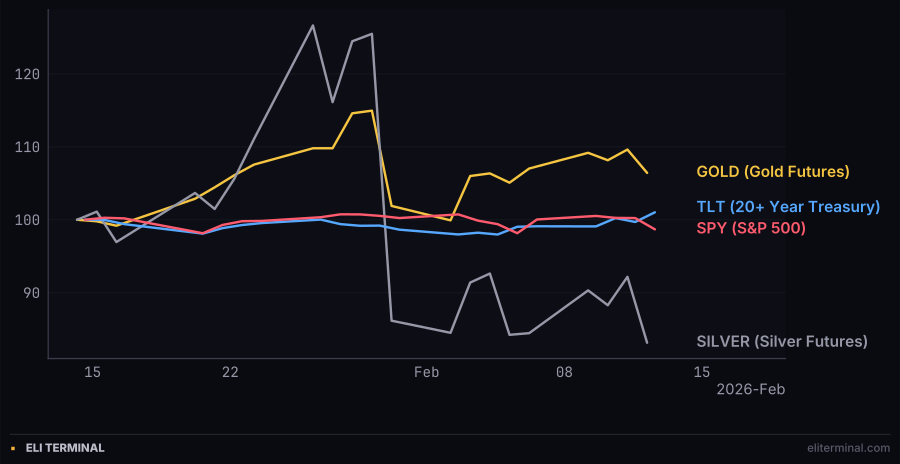
Two precious-metals selloffs in two weeks. Only the second one moved in the same direction as stocks.
The 10-year Treasury yield fell from 4.172% to 4.104%, a drop of roughly 6.8 basis points, while TLT gained 1.3% and IEF gained 0.6%. That is the flight-to-quality trade textbooks describe: falling yields, rising long-duration bond prices, on a day equities sold off hard.
High-yield credit did not participate either way. HYG closed at 80.79, down 0.05% from Wednesday, a rounding error next to the Nasdaq's 2.0% decline. Whatever repriced in equities and precious metals Thursday, the credit market treated as background noise.
The economic calendar listed a Producer Price Index release for Thursday morning, but the actual January PPI data never printed. Shutdown-related backlogs at the Bureau of Labor Statistics pushed it to February 27, more than two weeks out, a fact that did not stop Thursday's session from carrying a real macro data point anyway.
Initial jobless claims for the week ending February 7 came in at 227,000 against a 222,000 forecast, released at 8:30am ET, an hour before the open. Nothing in Thursday's coverage connects that modest miss to the afternoon's selling. The session's drivers were three specific AI-linked stories, not a labor-market surprise.
Applied Materials and Arista Networks both report earnings after Thursday's close, two more AI-capex-linked names landing hours after a session that repriced how the market weighs AI cost against AI benefit. Either result gets read Friday morning against a tape already primed to punish disappointment in that theme.