Two rallies met the same bell. One survived it.
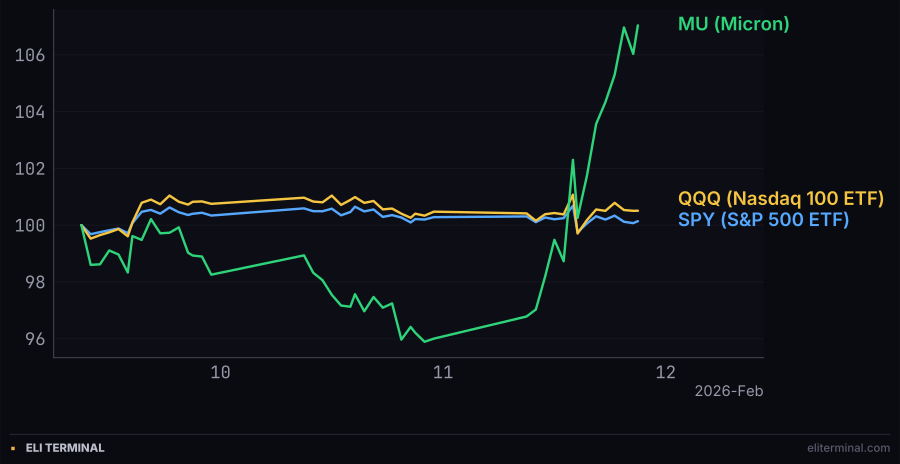
Same opening hour, three tickers. Two of them gave the morning back.
Micron closed at a record 410.34, up 9.9%, on its own conference-stage news, while the S&P 500 gave back an entire jobs-report rally to finish barely below Tuesday's close.
Same opening hour, three tickers. Two of them gave the morning back.
130,000 jobs. That was January's nonfarm payroll gain, more than double the 55,000 economists polled by Dow Jones had penciled in, released at 8:30 a.m. Eastern, 13:30 UTC, after the report itself had been rescheduled twice by a partial government shutdown, first bumped from its original Friday slot to Wednesday. The unemployment rate came in at 4.3%, a tenth below the 4.4% forecast.
The same shutdown had also been due to push out January's consumer price index to this same Wednesday. It did not arrive. The Bureau of Labor Statistics had separately rescheduled the CPI print to Friday, February 13, two days later, a detail that matters because several data calendars still listed a CPI release for February 11 going into the week. Nothing with that name crossed the wires Wednesday.
SPY built its gain steadily between the report and the opening bell: 693.14 by 14:00 UTC, 696.18 by 14:30 UTC premarket, a session high of 697.13 in the minutes after the 9:30 a.m. open. None of it held. By 15:30 UTC, the ETF had fallen to 689.18, a swing of more than a full point in under an hour, and it spent the rest of the day recovering only part of that ground before closing at 691.96, two cents below Tuesday.
QQQ traced the identical shape at a larger scale. The Nasdaq 100 tracker ran from a premarket 616.40 to an opening high of 617.52, then dropped to 607.69, a decline of 1.6%, inside the same hour SPY broke. It closed at 613.11, up 0.27% for the day, meaning the entire opening-hour selloff was clawed back by the close while the S&P's was not. The Dow-tracking DIA fell 0.11%, and the Russell 2000 ETF, IWM, lagged all three at negative 0.45%, its own high of 268.96 falling to a low of 262.10 in the same window.
The move was not built on fear. The VIX closed at 17.65, down 0.79% on a day two major index trackers erased a full rally intraday, the kind of round trip that a volatility-buying market usually marks up, not down. The 10-year yield told a different story again: it closed at 4.172%, up 0.60%, holding nearly all of its post-report gain even as equities gave theirs back, a bond market still pricing a Federal Reserve with less reason to cut soon, a read equities only reached themselves after they had already reversed.
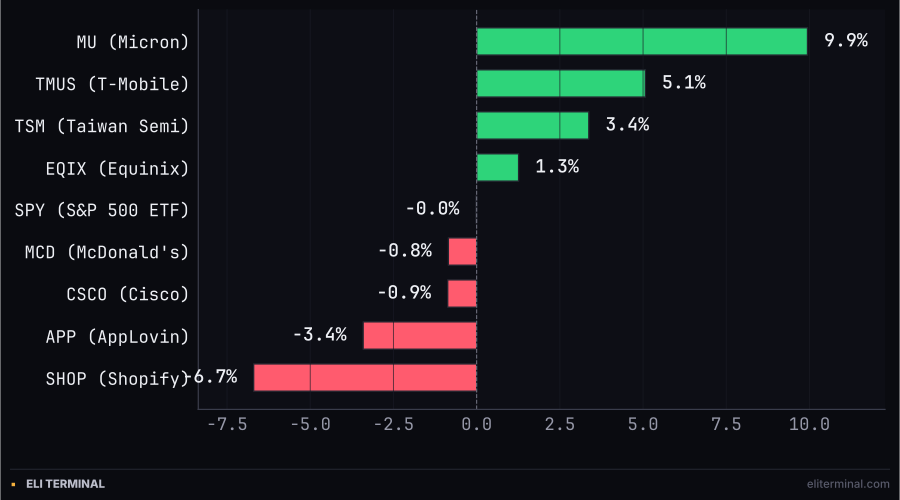
Six of these nine reported earnings the same day. The spread between the best and worst of them ran to 16.6 points.
$2.14 a share against a $2.04 estimate, $24.33 billion of revenue against $24.18 billion expected, 2.4 million postpaid customer additions, and raised multi-year guidance on revenue, margin, and free cash flow. That was T-Mobile's fourth-quarter report. The stock's first reaction was to fall: a premarket low of 186.00 by 14:00 UTC, down 6.7% from Tuesday's 199.43 close, deep in a report that beat on nearly every line investors watch.
The reversal came inside the same opening hour that broke the index trackers. Between 14:30 and 15:30 UTC, T-Mobile ran from 188.15 to 204.99, a climb of nearly 9% in sixty minutes, and kept adding through the session to close at 209.54, up 5.07% and near its 210.48 intraday high. The stock's full range for the day, from its premarket low to its post-open high, spanned just over 12 percentage points, the entire move happening after a beat that the market had first priced as a miss.
Shopify's premarket reaction to its own numbers went the opposite direction from T-Mobile's, and further. Fourth-quarter revenue of $3.672 billion, up 31% year over year, a new $2 billion buyback, and first-quarter revenue guidance in the low-30% range against a 25.1% consensus sent the stock as high as 145.16 premarket by 12:00 UTC, up 14.1% from Tuesday's 127.24 close.
By the opening hour it had gone the other way entirely. Between 14:30 and 16:30 UTC, Shopify fell from 138.90 to an intraday low of 109.60, down 13.9% from Tuesday's close, before recovering into the afternoon to finish at 118.71, down 6.7%. The stock's premarket high to its session low spanned 28 percentage points inside a single trading day built around a revenue beat. Coverage that day pointed to a narrower earnings-per-share miss and first-quarter free-cash-flow margin guidance below last year's as the piece of the report the rally couldn't survive.
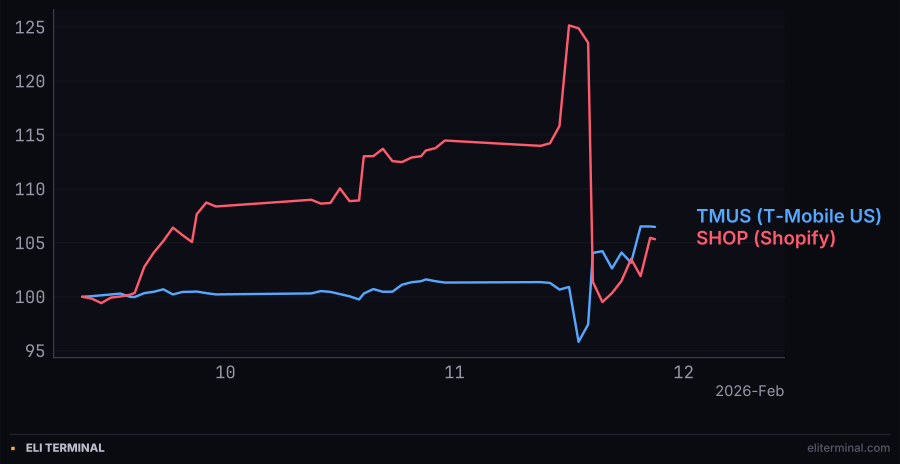
Same earnings morning, same opening hour, opposite starting reactions, similar-shaped reversals.
8:50 a.m. Eastern, 13:50 UTC, roughly twenty minutes after the payrolls number crossed the wires, Micron's chief financial officer Mark Murphy told the Wolfe Research semiconductor conference in New York that high-bandwidth memory shipments under the HBM4 standard had begun in volume, a quarter ahead of the timeline management had given in its December earnings call, and that the company's entire 2026 HBM production capacity was already sold out. No SEC filing carried the news; the conference remarks were the filing.
Micron had already been running before Murphy spoke, up to 385.00 premarket on broader memory-pricing strength, TrendForce having reported DRAM contract prices doubling or more since the fourth quarter on AI-accelerator capacity competing with conventional memory production. It dipped to 372.32 around the jobs-report window, then jumped to 395.90 by 14:00 UTC as the CFO's comments spread. Even Micron was not immune to the opening bell: between 14:30 and 15:30 UTC the stock swung from an intraday high of 410.06 down to 386.57, the same air pocket that hit SPY and QQQ, before climbing through the rest of the session to a record close of 410.34, up 9.94%. Taiwan Semiconductor, a supplier to the same AI-memory buildout, added 3.37% to 374.09.
President Trump and Israeli Prime Minister Benjamin Netanyahu met at the White House Wednesday afternoon for roughly two and a half hours behind closed doors, with no joint statement and no press conference; Trump later posted his own account of the meeting, describing continued negotiation with Iran, on Truth Social. Oil closed at 64.63, up 1.05%, a move in line with several prior sessions and not obviously larger than the days around it.
AppLovin fell 3.41% to 456.81 during Wednesday's regular session. The company's own fourth-quarter results were not due until after the closing bell, alongside a 5 p.m. Eastern earnings call, so whatever moved the stock during the day had nothing to do with numbers nobody outside the company had seen yet.
Three of the day's six scheduled earnings reports produced almost no reaction at all. Cisco closed at 85.54, down 0.87%. McDonald's closed at 323.21, down 0.85%. Equinix closed at 867.52, up 1.26%. Set against Shopify's 28-point range and T-Mobile's 12-point range on the same morning, three of six reports simply did not move their stocks by more than a point in either direction, a split that had nothing to do with the size of the numbers involved and everything to do with which line in each report investors chose to weight.
January's consumer price index, delayed by the same shutdown that pushed the jobs report onto Wednesday's calendar, is now due Friday, February 13, at 8:30 a.m. Eastern, 13:30 UTC. Wednesday's bond market held its yield gain through a session that saw equities erase theirs, a divergence that a hotter or cooler-than-expected inflation print two days later will either extend or unwind.