One-day moves, February 10
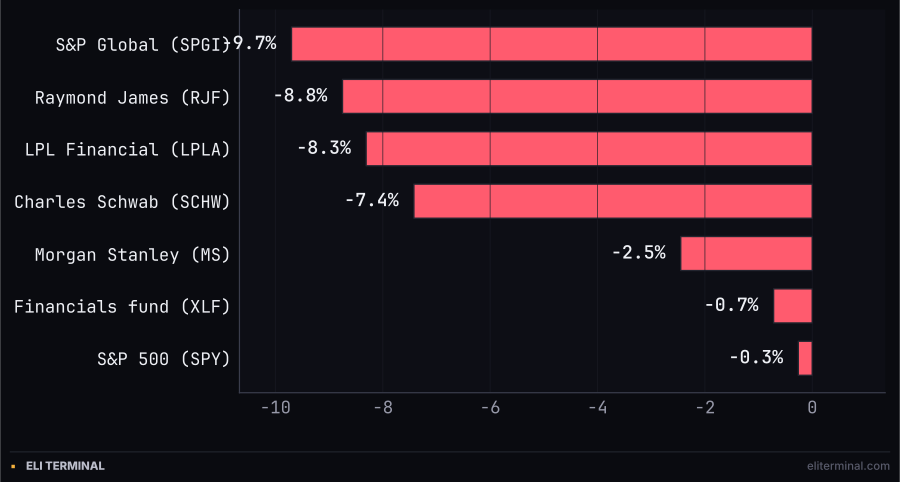
Three wealth managers lost between 7% and 9%. The fund that owns all three barely moved.
LPL Financial fell 8.31% and Charles Schwab fell 7.42% after a rival unveiled an AI tax-planning tool Tuesday, while the Dow closed at a record 50,188.14 and the fund holding both stocks fell just 0.72%.
Three wealth managers lost between 7% and 9%. The fund that owns all three barely moved.
None of LPL Financial, Charles Schwab, or Raymond James Financial reported earnings on Tuesday. All three still posted some of their worst single-day losses in years. LPL Financial closed at 360.58, down 8.31% after touching an intraday low of 348.51. Schwab closed at 99.25, down 7.42%, after falling as low as 97.01 from an opening print of 107.00. Raymond James closed at 158.48, down 8.75%, off an intraday low of 157.19.
The catalyst was a press release. Altruist, a custodian and software platform for independent financial advisors, announced Tuesday that its AI platform Hazel would add tax planning: a feature that reads a client's 1040s, pay stubs, account statements, meeting notes, emails, and custodial records, then produces a personalized tax strategy "within minutes." Raymond James's own equity research desk responded by moving LPL to Market Perform, arguing the stock's roughly 14 times 2026 earnings multiple was already back near its three-year average, a signal the sell side saw the drop as running ahead of any actual earnings threat.
XLF, the financial sector fund that counts Schwab, LPL, and Raymond James among its holdings, closed down just 0.72%. Something else inside that basket, banks and insurers with no exposure to the retail-advisory model, absorbed the difference. The regional bank fund KRE fell 1.06%, in the same neighborhood as XLF and nowhere near the advisors' losses.
Morgan Stanley, which runs its own large wealth-management arm, fell 2.45% to 177.89, a fraction of what LPL, Schwab, and Raymond James lost. Scale and diversification, not the underlying AI question, appear to be what separated Tuesday's biggest losers from everyone else sitting in the same sector fund.
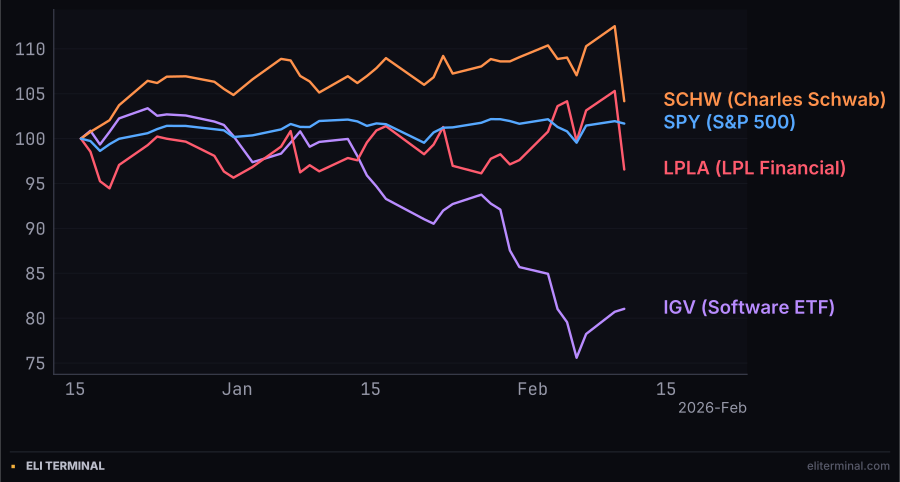
Software absorbed the AI-disruption fear first and had already stopped falling by the time it reached the advisors.
The software sector fund IGV fell from 105.39 in mid-December to a low of 74.40 on February 5, a two-month decline of roughly 25%, as investors priced AI agents from labs including Anthropic and OpenAI into the business models of SaaS companies. Salesforce, ServiceNow, and Adobe were all down between 24% and 30% over the same stretch; Palantir was down close to 24%. By February 9, IGV had climbed back to 85.06, three sessions of recovery off the low.
LPL Financial and Schwab did not participate in that decline. Both traded in a narrow band through January and the first week of February while software fell apart around them. The AI-disruption trade found a fresh target in wealth management only after its first target had already stopped falling, not while software was still in free fall.
The Commerce Department's advance retail sales report, released at 8:30 a.m. Eastern, showed January sales fell 0.2% against a consensus call for a flat reading, the softest print since a similar miss in December. The 10-year Treasury yield fell to 4.147%, down 1.21% on the day, as traders leaned further into a case for the Federal Reserve to resume cutting. A Polymarket contract on at least one Fed rate cut in 2026 priced at 17.5% Tuesday, up from 10% a month earlier, having ticked higher on both February 9 and February 10.
The S&P 500 fell only 0.33% to 6,941.81 and the Dow closed at a record 50,188.14, up 0.14%. A soft consumer print sitting alongside a record Dow close is not the shape of a broad growth scare; the retail sales miss shows up in rates and in Fed pricing, not in blue-chip equities.
Guidance, not the quarter, sank S&P Global. The ratings and data company closed at 379.45, down 9.70% and its worst single day in years, after fourth-quarter adjusted earnings of 4.30 dollars a share missed by two cents and 2026 guidance of 19.40 to 19.65 dollars came in below the Street's 19.96 estimate. Coca-Cola fell a comparatively mild 1.49% to 76.81 after comparable earnings per share of 0.58 dollars beat estimates but revenue of 11.8 billion dollars missed for the first time in five years, with 2026 guidance calling for 7% to 8% comparable earnings growth.
Spotify went the other way entirely, gaining 14.75% to close at 476.02 after touching an intraday high of 495.94. The streamer added 38 million net monthly active users in the quarter, reaching 751 million, six million above its own guidance, while revenue of 4.83 billion dollars and adjusted earnings of 4.73 dollars a share both cleared Wall Street's estimates by a wide margin. Guidance, not the headline beat or miss, decided the size of Tuesday's reaction across all three names.
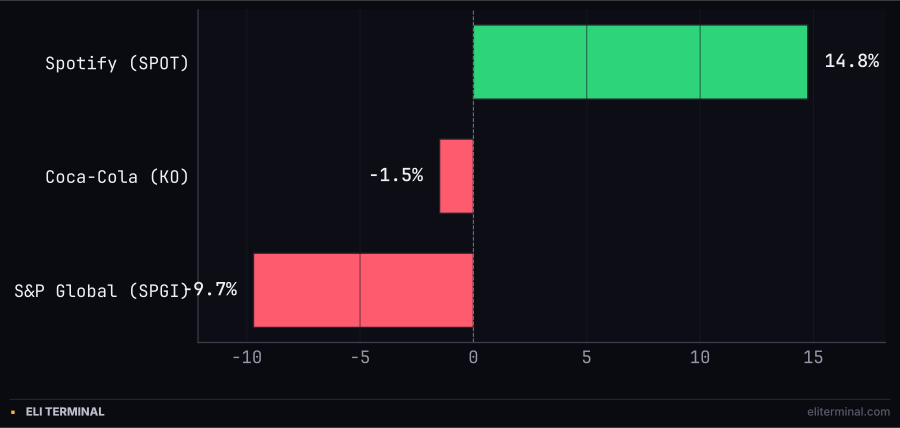
Three names reported the same morning. The stock move tracked the outlook, not the quarter that just closed.
President Trump told Fox Business's Larry Kudlow on Tuesday that Iran wants a nuclear deal and would be "very foolish" not to reach one. Oil and gold both closed lower on the day: West Texas crude fell 0.62% to 63.96 and gold fell 0.93% to 5,003.80. A comment read by some as de-escalatory coincided with softer, not firmer, prices in the two assets that usually move first on Iran headlines, consistent with a market that had already discounted the remark or wasn't trading on it at all.
Gilead Sciences and Welltower both report after Tuesday's close, giving the market a same-week reference point for whether earnings reactions keep tracking guidance over headline beats. LPL Financial, Schwab, and Raymond James face no scheduled news before their own next earnings dates, so any further move from here has to explain itself the way Tuesday's initial drop, sourced entirely to a competitor's product launch, already did.