The month the bounce sits inside
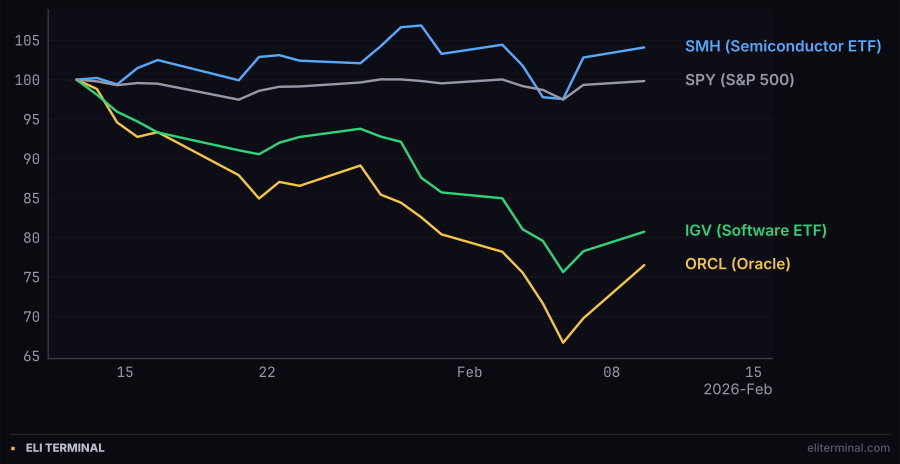
Oracle and software fell hardest into February 5 and have recovered the least. Chips barely dipped and are the only group up on the month.
Oracle gained 9.6% on a broker note about OpenAI's balance sheet, the VIX collapsed 14.8% to 17.36, and Oracle is still down roughly a quarter from its mid-January level even after Monday's move.
Oracle and software fell hardest into February 5 and have recovered the least. Chips barely dipped and are the only group up on the month.
Oracle closed Monday at 156.59, up 9.6% from Friday and up 9.4% from the intraday low it touched on February 5. That close still sits 23.5% below the 204.68 Oracle posted on January 12, four weeks earlier. Monday was the single best day of Oracle's rebound, and Oracle is still down almost a quarter for the month.
The same shape shows up across the group that led the early-February selloff. The software ETF IGV closed Monday at 85.06, up 3.2% on the day, and is still down roughly 19% from its mid-January level.
The chip ETF SMH, by contrast, only dipped to a February 5 low of about 2% under its January 12 mark and closed Monday up about 4% for the same four weeks. Chips got hit less and are the only piece of the AI trade actually ahead for the month.
D.A. Davidson analyst Gil Luria upgraded Oracle to Buy from Neutral premarket Monday, keeping a 180 price target that implied roughly 26% upside from Friday's close. The note's argument was narrow: a stabilized OpenAI, reportedly backed by up to 140 billion dollars in capital and expected to raise another 100 billion by quarter's end, should be able to keep paying Oracle for the data center capacity Oracle is building for it.
Oracle's own tape confirms the note landed before the open. The stock was already trading near 149 by 14:00 UTC, an hour ahead of the New York bell, up from Friday's 142.82 close. At the 14:30 UTC open it gapped straight to a session high of 159.75, then gave back almost 2 points into the close.
Nvidia, Broadcom, and AMD all show the identical fingerprint: flat or drifting through the premarket hours, then a step higher in the exact half hour Oracle's note hit the tape. Nvidia opened its 14:30 UTC bar at 184.10 and touched 193.66 within that same bar before settling near 190 into the close. Broadcom's 14:30 UTC bar ran from 330.77 to a high of 343.50, on its way to an intraday peak of 352.34 an hour later.
Both stocks gave back a piece of that spike by the close. Nvidia finished at 190.04, about 1.9% under its intraday high, and Broadcom finished at 343.94, about 2.4% under its 352.34 peak.
The move was real and it was Oracle's, and the other AI-infrastructure names got carried by it rather than generating their own reason to run.
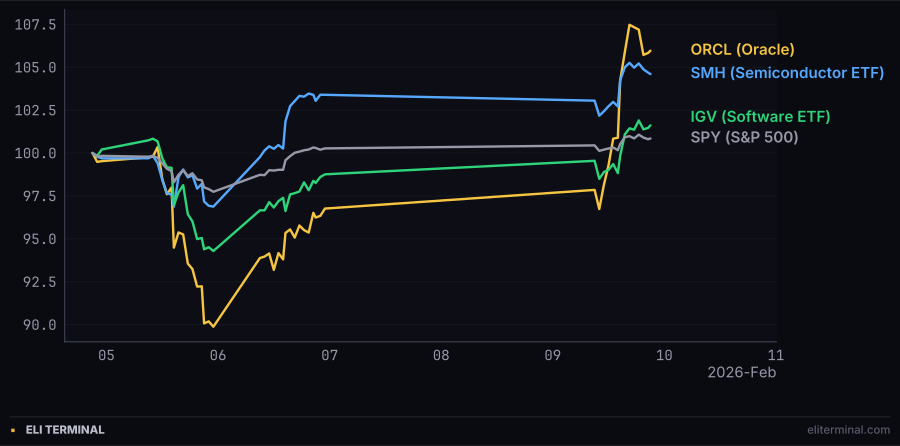
Oracle's Monday spike faded into the close. The software line did not.
3.2% is what the software ETF IGV gained on Monday, more than the 1.25% the chip ETF SMH gained and more than the 1.57% the broader tech fund XLK gained. IGV also closed within a few cents of its intraday high of 85.44, with no afternoon fade at all, while SMH gave back roughly 0.8% from its own peak.
Software was the epicenter of the late-January and early-February selloff, sold on fears that AI coding and agent tools would eat the software industry's own customers rather than help them. That same group turned in the steadiest gain of Monday's session, holding its advance through the close while the chip names that grabbed the bigger headlines gave part of theirs back.
The VIX closed Monday at 17.36, down 14.8% on the day and back near the 15 to 17 range it occupied before the selloff began in earnest around January 30. The index spiked to 21.77 at Thursday's close, its high for the episode, and has now retraced almost the entire move in three trading sessions.
Options pricing and the underlying stocks are telling different stories. The VIX says the market no longer expects violent moves in either direction, while Oracle, IGV, and the broader software group say the selling from ten days ago has not actually been unwound, only stopped.
Both can be true at once: the crash is over, and the prices it produced are still on the board.
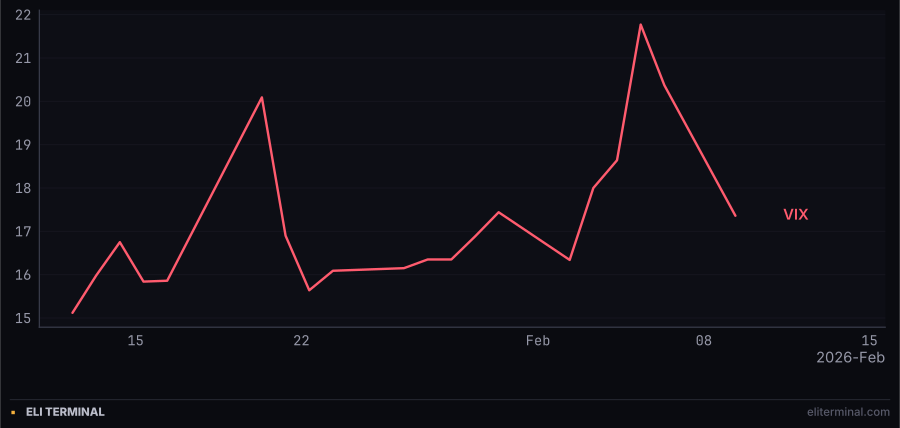
Three sessions erased almost the entire spike.
Sanae Takaichi's Liberal Democratic Party won a two-thirds supermajority in Japan's lower house election held over the weekend, its largest victory since World War Two. The Nikkei 225 jumped past 57,000 intraday before closing 3.9% higher at 56,363.94, a record, while the broader Topix also closed at a record.
The result crossed the wires and was fully reflected in Tokyo's close hours before New York opened, so Monday's American session carried no fresh reaction to it beyond the general tailwind of one more major index printing an all-time high on the same calendar day. The two stories, Oracle's OpenAI-driven gap and Takaichi's election win, developed on separate continents and separate clocks and simply landed on the same date.
Gold closed at 5,050.90 an ounce, up 2.0% and back above the round number it had dipped under on February 6. The dollar index fell 0.8% to 96.82, and the 10-year Treasury yield eased less than a basis point to 4.198%. None of the three moved sharply enough on Monday alone to be the day's story, but all three have leaned the same direction, weaker dollar, firmer gold, lower long-end yields, since the late-January selloff began, consistent with a market still pricing a Federal Reserve that cuts rather than holds.
Oil was the exception, climbing 1.3% to 64.36 a barrel, its highest close since before the selloff started. West Texas crude has now risen for four straight sessions without a headline attached to any single day of the move, which is itself worth noting: a steady climb in a widely watched barrel that no wire service tied to a specific catalyst.
A four-day partial government shutdown that ran from January 31 through February 3 pushed the Labor Department's January jobs report back to Wednesday, February 11, and the January Consumer Price Index back to Friday, February 13. The Homeland Security Department is funded only on a stopgap through February 13 as well, a second lapse deadline sitting on the same date as the inflation print.
Both delayed reports will land within the same 48-hour window, and both were pushed off the calendar by the same funding fight rather than by any economic surprise. Whatever the January data shows, the market will be reading two months of information compressed into two release days, with Oracle's rally and the VIX's collapse as the backdrop it reads them against.