A month of divergence, into February 5
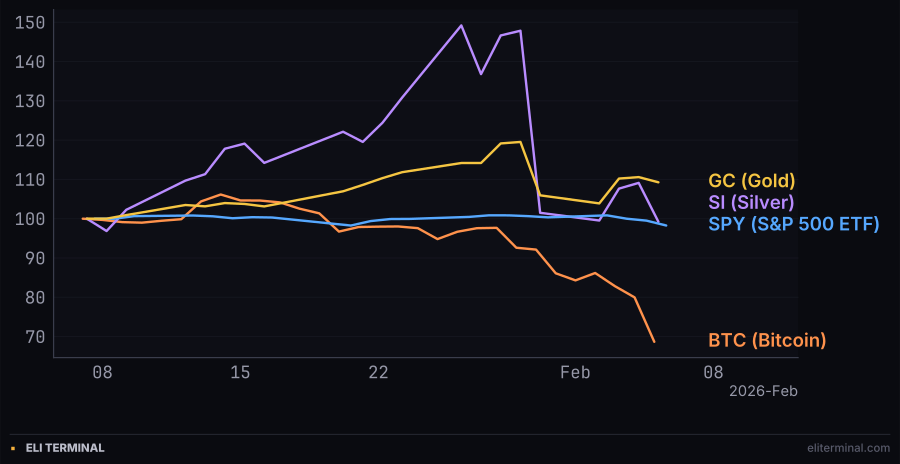
Same month, same risk-off label, four completely different magnitudes.
Amazon's $200 billion capex guidance crossed the wire right at the closing bell, Bitcoin fell 14% to its worst level since October, and the VIX posted its sharpest jump of the window at +16.8%.
Same month, same risk-off label, four completely different magnitudes.
222.69 is where Amazon closed Thursday, down 4.42% in a regular session that sold off steadily from the opening bell and never recovered. The company's own fourth-quarter results did not cross the wire until roughly 4pm Eastern, the same minute that session ended.
Revenue came in at $213.4 billion, up 14% year-over-year and above the $211.33 billion analysts had modeled, and AWS revenue climbed 24% to $35.6 billion, its fastest growth in 13 quarters. Diluted earnings landed at $1.95 a share, narrowly under the $1.98 forecast built into the day's estimates, even as net income rose to $21.2 billion.
"With such strong demand for our existing offerings and seminal opportunities like AI, chips, robotics, and low earth orbit satellites, we expect to invest about $200 billion in capital expenditures across Amazon in 2026, and anticipate strong long-term return on invested capital," CEO Andy Jassy said in the release itself. That figure runs more than $50 billion above the $146.6 billion Wall Street had modeled and roughly 50% above the $131.8 billion Amazon spent in 2025.
What that guidance does to the stock plays out after this session closes. Thursday's tape shows a session that had already priced in trouble before the number existed, not a reaction to it.
Bitcoin held near 73,000 into Wednesday's New York close, then broke down in two separate legs Thursday. The first ran from about 69,350 to 67,300 between 14:00 and 15:00 UTC, roughly the New York cash open. The second and steeper leg ran from 68,120 at 16:00 UTC down to 63,140 by 21:00 UTC, a slide that continued through the entire U.S. afternoon and bottomed intraday at 62,354, about 51% below its October high above 126,000.
No single dated headline explains a move of that size. Bloomberg and crypto desks pointed to forced deleveraging inside crypto derivatives markets, with $2 billion to $2.5 billion of Bitcoin futures liquidated over the surrounding days. What the tape adds is timing: Bitcoin's steepest hours, 16:00 to 21:00 UTC, ran alongside the S&P's own fade into the close, both markets bleeding hardest in the same afternoon window despite trading on entirely different clocks.
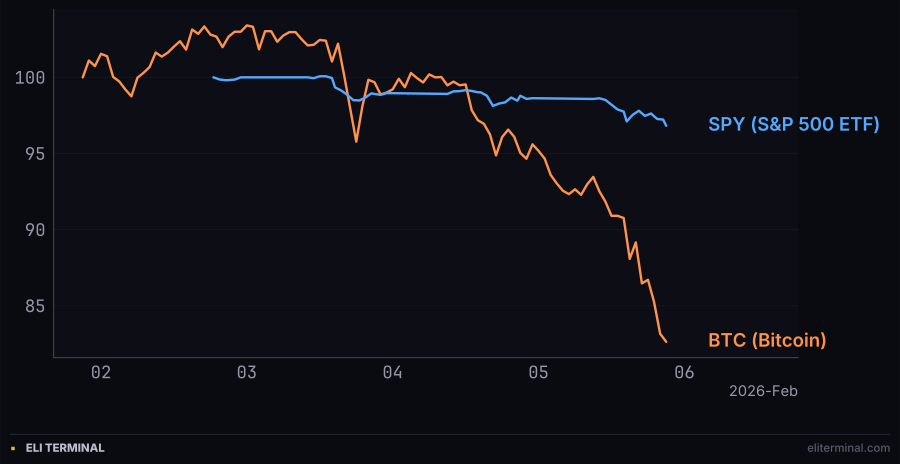
Different scale, same afternoon: both lines turn down hardest after the New York open.
Silver futures settled Thursday at 76.53, down 9.07% from Wednesday's 84.17 close. That is a fraction of the move the metal posted five sessions earlier, when CME Group's shift to percentage-based margin requirements helped drive silver from about 122 to under 79 over January 30 and 31. Thursday's decline was its own event: the contract fell from about 86 to 74 in a single hour around 9pm Wednesday evening, then spent the rest of the session grinding lower before settling.
Gold closed at 4,861.40, down just 1.2% on the day. Both metals sit under the same margin regime and the same week of deleveraging headlines; only one of them moved like it.
21.77 is where the VIX closed Thursday, up 16.79% and its sharpest one-day percentage gain of the window this report covers, touching an intraday high of 23.1 around 10am Eastern. A market pricing broad macro fear would typically drag other fear gauges with it.
Instead, the Polymarket contract on a U.S. recession by the end of 2026 fell to 23% Thursday from 27.5% just two sessions earlier, a five-point drop on the same afternoon equities posted their worst close in weeks. The separate market on an AI bubble bursting sometime in 2026 barely moved at all, ticking to 18.35% from 18.65% the day before, a non-reaction on a day when Amazon's spending plans, Bitcoin's plunge, and a fresh leg down in mega-cap technology names all pointed at exactly the kind of stress that contract exists to price.
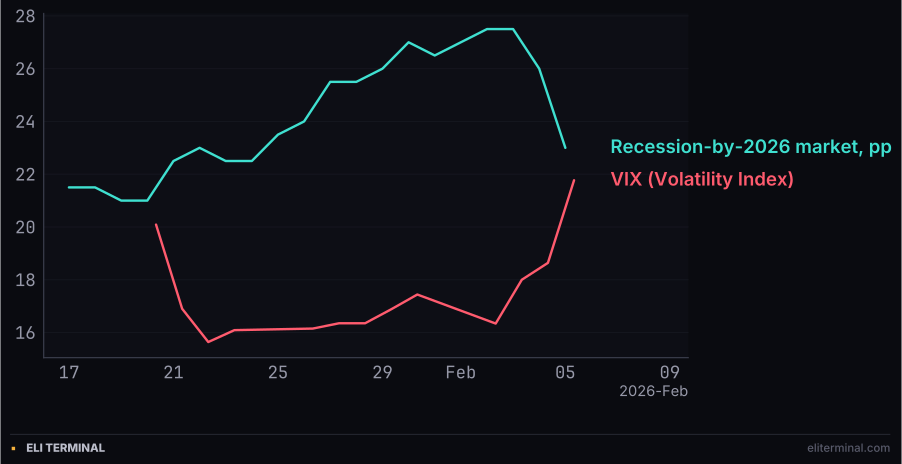
The lines converge instead of moving together: equity fear up, recession pricing down, on the same afternoon.
Before Amazon or Bitcoin dominated the tape, two numbers had already landed. Initial jobless claims for the week ending January 31 came in at 227,000 against a 222,000 forecast at 8:30am Eastern, and the December jobs-openings survey, released at 10am Eastern, showed openings falling to 6.542 million, the third straight monthly decline and the lowest reading since September 2020.
The 10-year Treasury yield fell to 4.21%, down about 6.5 basis points on the day, and long bonds gained: TLT closed up 1.09%. With claims, JOLTS, Amazon's pre-print slide and Bitcoin's own leg all landing inside the same nine-hour window, isolating what the labor data alone did to stocks is not honest. The S&P's steepest single bar of the day came at the 9:30am Eastern open, the same half hour Amazon, the broader technology complex, and Bitcoin's U.S.-session leg all turned over together.
At the National Prayer Breakfast at the Capitol, in remarks running from 9:57 to 10:16am Eastern, Trump said Iran is negotiating with the United States because "they don't want us to hit them," and added, "we have a big fleet going over to Iran."
If that language were going to put a fear premium into crude, Thursday's tape didn't show it. WTI settled at 63.29, down 2.84% on the day, its worst single-session percentage move of the two weeks captured here, sliding through the same afternoon hours those remarks aired that morning. Oil's decline traces more cleanly to the day's broader deleveraging in Bitcoin, silver and equities than to anything said in Washington.
Meta closed at 670.21, up 0.18%, the only one of Thursday's largest technology names to finish green. Microsoft fell 4.95% on its own capex and AI-spending questions echoing Amazon's, AMD dropped 3.84%, Nvidia fell 1.33%, and Alphabet's Class A shares slipped 0.63%.
Meta had already reported its own quarter the week before this window and carried neither of Thursday's two live catalysts, Amazon's guidance or Bitcoin's collapse, on its own balance sheet. Whatever pushed the rest of the group lower on the same afternoon did not touch it.
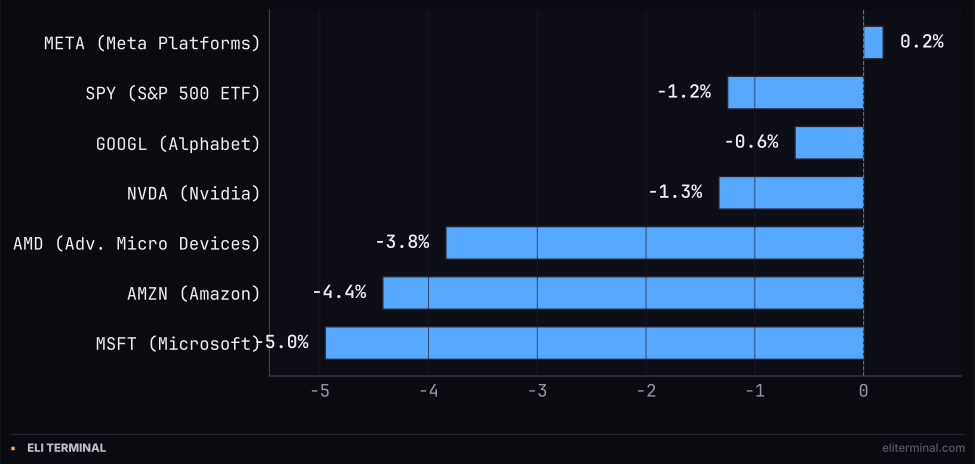
Six names down, one up, and the one that's up didn't have a Thursday catalyst attached to it.
The next scheduled catalyst is the January employment report, due 8:30am Eastern Friday, arriving in the same week claims and JOLTS both ran soft. Amazon's stock, separately, still has to trade on Thursday's after-the-bell numbers in a session this report's window doesn't reach. The 4.42% decline recorded here came before that print, not after it.