One-day moves, February 4
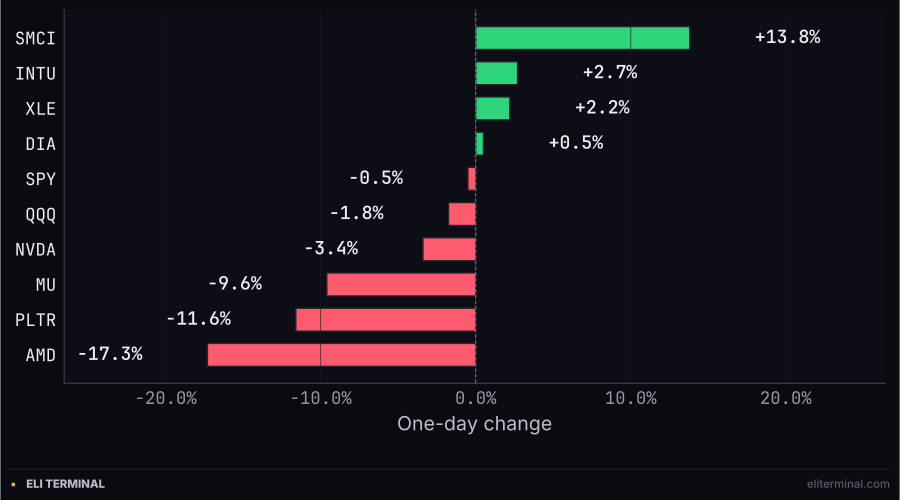
Three AI-hardware earnings reactions, three different directions, inside one broadly red tape.
AMD fell 17.3% on a Q1 guide the market judged too cautious for the AI buildout, Palantir erased its earnings pop by dropping 11.6%, and Supermicro rose 13.8% the other way on its own beat.
Three AI-hardware earnings reactions, three different directions, inside one broadly red tape.
Fourth-quarter revenue hit a record $10.27 billion Tuesday, ahead of the roughly $9.67 billion analysts had modeled, with data center revenue up 39% year over year to $5.4 billion. Non-GAAP earnings per share came in at $1.53 against a $1.32 estimate. None of it held the stock up a day later.
AMD's own press release put the fault line in the outlook section: first-quarter revenue guided to approximately $9.8 billion, plus or minus $300 million, a number that beat the Street's roughly $9.38 billion estimate but represents a sequential decline of about 5% from the December quarter, with non-GAAP gross margin easing to about 55% from 57%. "We are entering 2026 with strong momentum," CEO Lisa Su said in the release, but a sequential revenue decline in the middle of what every hyperscaler calls an accelerating AI buildout is what traders chose to price. AMD opened already down near 220 in the premarket, well below Tuesday's 242.11 close, then kept sliding through the session to a low of 199.15 before closing at 200.19.
Palantir closed at 157.88 on Tuesday, up 6.9% on the session after Monday's fourth-quarter report showed 70% year-over-year revenue growth and adjusted earnings of 25 cents against a 23-cent estimate. By Wednesday's close it was back to 139.54, down 11.6% on the day and below where it started the week. Nearly the entire round trip happened in the session's first two hours: Palantir opened at 155.85, gapped through the 14:30 UTC bell, and was trading near 141 within 30 minutes and near 137 by 16:30 UTC.
Palantir shares had not rallied into a quarterly report for the first time in two years, and going in the stock still carried a multiple near 142 times expected earnings, the third-highest in the S&P 500. Strong numbers arrived Monday into a market already unwilling to pay more for them, and two sessions later the move gave that reluctance a number.
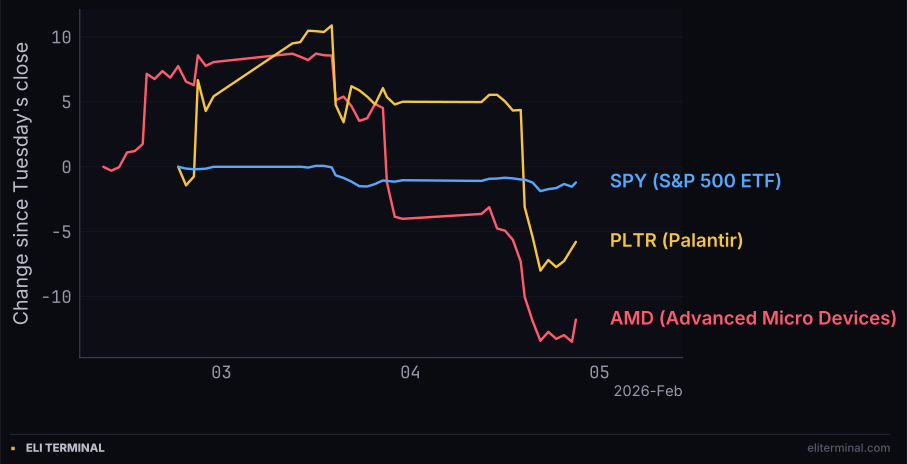
Palantir's giveback front-loaded into the first two hours. AMD never had a pop to give back; it opened lower and kept going.
Supermicro closed Wednesday at 33.76, up 13.8% from Tuesday's 29.67, after reporting fiscal second-quarter revenue of roughly $12.7 billion Tuesday, more than double the year-ago quarter and above analyst estimates near $10.4 billion. The company raised its full-year revenue outlook to about $40 billion from a prior $36 billion and guided next quarter's revenue to at least $12.3 billion, both above where the Street sat before the print.
Supermicro's own session was not a straight line. Shares gapped up at Wednesday's open, gave back roughly a third of the move by midday, and rallied back into the close. The stock finished at its second-highest level of the day, a beat-and-raise the market kept buying even as it sold AMD's guide from the same AI-hardware complex in the same 24 hours.
Salesforce closed down 6.8% and ServiceNow down 7.0% on Tuesday; both were roughly flat to higher on Wednesday, with Salesforce closing at 199.44, up 1.6%, and ServiceNow at 111.07, up 1.2%. Intuit fell 10.9% Tuesday and rose 2.7% Wednesday. Coverage published Wednesday describing a fresh software-stock plunge amid fears that AI tools would displace per-seat subscription software was, in the tape's own numbers, recapping a move that had already priced a day earlier.
The Nasdaq 100 fell 1.75% Wednesday and the technology sector ETF XLK fell 2.8%, both driven overwhelmingly by AMD, Micron, and Nvidia rather than by the software names the AI-disruption narrative names most often. Micron closed at 379.40, down 9.6%, and Nvidia at 174.19, down 3.4%, both without earnings of their own that day, caught in the same-week AI-hardware repricing AMD's guide triggered.
ADP's January employment report crossed at 8:15am ET (13:15 UTC), showing private payrolls up just 22,000, the softest reading in months and well below the pace employers had been running. The 10-year yield sat at 4.268% in the hour before the release and 4.284% in the hour after, a move of roughly one and a half basis points. It closed the day at 4.275%, essentially unchanged from Tuesday's 4.274%.
A labor print that weak, on a day the Nasdaq fell 1.75% and the VIX rose to 18.64, would ordinarily be read as reinforcing a case for earlier Fed cuts. Treasuries did not reprice it that way. The session's stress stayed inside single stocks and never reached the rate market.
WTI crude traded near 63.5 through the European morning, then jumped from 63.53 to a high of 65.53 inside the 17:00-18:00 UTC hour, closing that hour at 65.13 before settling the day at 65.14, up 3.07%. The move followed a stretch of escalating rhetoric from President Trump toward Iran and a currency crisis inside Iran that had put protesters in the streets of multiple cities, a combination traders have been treating as a threat to OPEC's fourth-largest producer rather than as noise.
Gold moved the opposite direction in the same hours. Futures opened the day near 5,038, climbed toward 5,113 in the London morning, then fell steadily from 14:00 UTC through 17:00 UTC to an intraday low of 4,867.70, a drop of roughly 4.8% peak to trough, before recovering into the close at 4,920.40, up just 0.34% on the day. That flat close sits on top of a much larger unwind: gold has been sliding since Friday, January 30, when President Trump's nomination of Kevin Warsh, seen as a hawkish pick, to lead the Federal Reserve triggered the steepest gold selloff in more than a decade and forced CME Group to raise COMEX gold margins to 8% from 6%. Wednesday was the fourth trading day of that unwind, not a new story, and the geopolitical bid that lifted oil never showed up in the metal traders usually treat as the same trade.
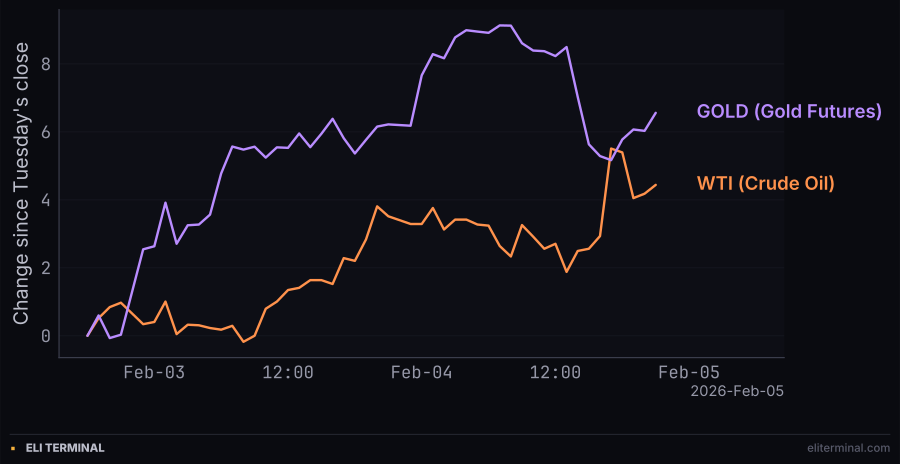
Gold's Wednesday round trip dwarfs its 0.34% close-to-close change. Oil's climb was steadier and held.
Alphabet's fourth-quarter results were due after this session's close, with the Street modeling revenue near $111.4 billion, up about 15% year over year, and earnings per share near $2.57 across sixteen analyst estimates, according to the day's schedule of confirmed reporters. Alphabet has beaten on both lines in each of the past nine quarters, and its shares fell 1.96% Wednesday to 333.04 heading into the print, a smaller move than AMD's or Palantir's but a decline nonetheless on a day when the market had already shown it would punish an AI-capex name for a guide that merely met rather than exceeded expectations.
Whatever Alphabet reports, Wednesday's session set the bar it will be read against: beat-and-raise bought Supermicro a 13.8% day, and beat-and-meet cost AMD 17.3% of its value in the same 24 hours.